
Introduction: Understanding ETP in Baddi
Industrial wastewater management is an important consideration for manufacturing facilities across different sectors. Industrial processes can generate wastewater containing suspended solids, oils, organic matter, dissolved chemicals, colour, and other contaminants. The characteristics of this wastewater depend on the raw materials, production methods, cleaning operations, and chemicals used within a facility.
For industries searching for ETP in Baddi, understanding the different types of effluent treatment plants and their treatment approaches is an essential first step. An Effluent Treatment Plant (ETP) is designed to treat industrial wastewater through a combination of physical, chemical, and biological processes, depending on the wastewater characteristics and the intended treatment outcome.
The right treatment system is not necessarily the most complex or expensive one. It is the system designed around the actual wastewater composition, flow rate, available space, operational requirements, and applicable discharge or reuse criteria. Businesses planning an effluent treatment plant should therefore evaluate their treatment requirements before selecting specific technologies.
In this guide, we explain the major types of ETP plants, the technologies commonly used in industrial wastewater treatment, and the factors industries should consider when selecting a suitable solution in Baddi, Himachal Pradesh, and other industrial locations across India.
What Is an Effluent Treatment Plant?
An Effluent Treatment Plant is a wastewater treatment system that removes or reduces contaminants from industrial effluent before the treated water is discharged, reused, or transferred to an additional treatment stage. Its configuration depends on the nature and concentration of pollutants present in the wastewater.
For example, wastewater containing large suspended particles may require screening and settling, while wastewater containing dissolved chemicals may require chemical treatment. Effluent containing biodegradable organic matter may need biological treatment, provided the wastewater conditions are suitable for the selected biological process.
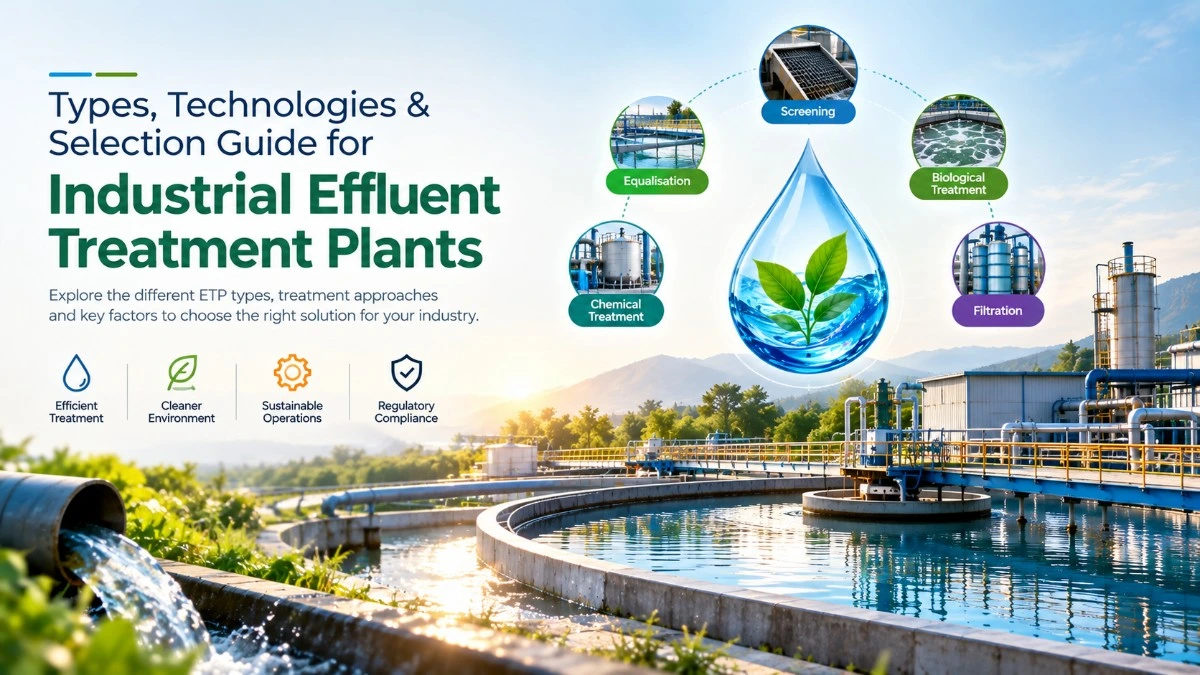
In many industrial applications, several treatment stages operate together rather than relying on a single technology. A complete system may include preliminary treatment, equalisation, chemical treatment, biological treatment, clarification, filtration, and additional polishing processes where required.
Industries can explore the available water and wastewater treatment solutions to understand how different treatment stages can be combined according to a project's requirements.
Why Do Industries in Baddi Need to Understand Different ETP Types?
Baddi is an important industrial location in Himachal Pradesh, with manufacturing businesses operating across different sectors. However, wastewater characteristics are not identical across industries, even when facilities are located in the same industrial area.
The wastewater generated by one manufacturing process may contain biodegradable organic matter, while another process may produce effluent with high dissolved solids, variable pH, oils, or chemicals that require specialised treatment. Consequently, an ETP designed for one facility may not be suitable for another without proper assessment.
Understanding the different types of ETP plants helps industries make more informed decisions about:
- Wastewater characteristics: Identifying the contaminants that need to be treated.
- Treatment requirements: Determining which physical, chemical, biological, or advanced processes may be necessary.
- System capacity: Estimating the wastewater flow and variations in daily production.
- Water reuse: Evaluating whether additional treatment may be needed for a particular reuse application.
- Operation and maintenance: Understanding equipment requirements, sludge handling, monitoring, and routine operational activities.
- Compliance requirements: Establishing the applicable treatment and discharge criteria for the specific facility.
Businesses evaluating an ETP and STP technology solution should assess these factors before finalising a treatment configuration.
Different Types of ETP Plants and Treatment Approaches
ETP plants can be classified according to the treatment processes they use. Common approaches include physical treatment, chemical treatment, biological treatment, combined treatment systems, and advanced treatment technologies. Many industrial installations combine several of these approaches to achieve the required treatment outcome.
1. Physical Treatment-Based ETP
Physical treatment removes contaminants through mechanical separation, screening, settling, flotation, or filtration. These processes are commonly used during the preliminary and primary stages of an effluent treatment plant.
Physical treatment may be appropriate for wastewater containing suspended solids, floating materials, or separable oil and grease. However, physical separation alone generally cannot remove every dissolved contaminant, so additional treatment may be necessary.
Common physical treatment units include:
- Screening: Removes larger floating and suspended objects that could interfere with downstream equipment.
- Grit removal: Separates heavier inorganic particles where these are present and relevant to the process.
- Oil and grease separation: Helps separate free oil or floating grease when the wastewater characteristics permit physical separation.
- Equalisation tanks: Collect wastewater and help balance variations in flow and pollutant concentration.
- Primary settling tanks: Allow settleable solids to separate from wastewater under suitable conditions.
- Filtration: Removes particles from water as part of the treatment or polishing process.
The exact arrangement depends on the wastewater characteristics and the requirements of subsequent treatment stages. For facilities planning an ETP plant installation, selecting appropriate preliminary treatment equipment helps protect downstream processes and supports stable operation.
2. Chemical Treatment-Based ETP
Chemical treatment uses selected chemicals to change the properties of contaminants so that they can be removed more effectively. It is frequently used when wastewater contains suspended particles that are difficult to settle, certain dissolved substances, or contaminants that require chemical adjustment before further treatment.
Depending on the wastewater analysis, chemical treatment may involve pH correction, coagulation, flocculation, chemical precipitation, or other specific reactions.
Coagulation and flocculation: Coagulation helps destabilise fine suspended particles, while flocculation encourages smaller particles to combine into larger aggregates. These aggregates may then be removed through settling or flotation, depending on the system design.
pH adjustment: Acidic or alkaline wastewater may require pH correction to create suitable conditions for subsequent treatment. The chemicals and dosage must be selected according to measured wastewater characteristics and process requirements.
Chemical precipitation: Certain dissolved constituents can be converted into less-soluble forms through appropriate chemical reactions. The resulting solids must then be separated and managed properly.
Chemical treatment can be an important part of industrial wastewater treatment, but it is not a universal solution for every pollutant. Chemical selection, dosing, reaction conditions, and sludge production must be evaluated during system design.
For facilities with more complex treatment requirements, a combined industrial water and wastewater treatment system may integrate chemical treatment with physical separation and other downstream processes.
3. Biological Treatment-Based ETP
Biological treatment uses microorganisms to break down biodegradable organic matter present in wastewater. These microorganisms require suitable environmental conditions, including appropriate pH, temperature, nutrients, and oxygen availability where an aerobic process is used.
Biological treatment is commonly considered when the wastewater contains biodegradable organic pollutants. Its suitability depends on factors such as the organic load, toxicity, salinity, nutrient balance, and the presence of substances that may inhibit microbial activity.
Biological treatment systems may include suspended-growth or attached-growth processes. The correct arrangement depends on the wastewater characteristics, required treatment performance, available space, and operational capacity.
Some common biological treatment approaches are explained below.
4. Activated Sludge Process (ASP)
The Activated Sludge Process is a biological treatment method in which microorganisms are maintained in suspension within an aeration tank. Air or oxygen is supplied to support biological activity, allowing microorganisms to consume biodegradable organic matter under suitable operating conditions.
After biological treatment, the mixed liquor generally flows to a secondary clarifier. The clarifier separates biological solids from the treated water. Part of the settled sludge may be returned to the aeration tank to maintain the required biomass concentration, while excess sludge is removed for appropriate management.
The performance of an activated sludge system depends on several operating parameters, including aeration, sludge concentration, hydraulic retention time, solids retention time, loading conditions, and wastewater composition.
ASP can be considered for suitable industrial wastewater, but it requires consistent monitoring and operational control. Wastewater containing toxic compounds, sudden changes in loading, or other inhibitory substances may require pretreatment or a different biological configuration.
5. Moving Bed Biofilm Reactor (MBBR)
A Moving Bed Biofilm Reactor uses specially designed plastic carriers within a treatment tank. Microorganisms grow as a biofilm on the surfaces of these carriers, where they participate in the biological treatment of wastewater.
In an aerobic MBBR system, aeration helps provide oxygen and keeps the carriers moving. A downstream separation stage is generally needed to remove suspended solids from the treated water. Screening arrangements are also important to retain the carriers within the reactor.
MBBR technology can offer flexibility in reactor design because treatment biomass grows on carrier surfaces. However, the appropriate carrier quantity, tank configuration, aeration arrangement, loading conditions, and downstream solids separation must be established through engineering design.
Industries comparing different ETP treatment technologies should assess whether an MBBR configuration matches their wastewater characteristics and operational requirements rather than selecting it solely because it is a modern technology.
6. Sequencing Batch Reactor (SBR)
A Sequencing Batch Reactor treats wastewater in a tank through a series of controlled operating stages. Depending on the process design, these stages can include filling, reaction, settling, decanting, and idle periods.
During the reaction stage, biological treatment takes place under the specified operating conditions. The settling stage allows biological solids to separate from the treated water, after which the clarified water is withdrawn according to the system's operating sequence.
SBR systems can combine biological reaction and settling within the same tank, potentially reducing the need for separate tanks for these functions. However, the overall arrangement may still require equalisation, pretreatment, sludge handling, or additional polishing depending on the application.
Since SBR operation is based on scheduled cycles, wastewater flow patterns, storage requirements, automation, and operational supervision are important considerations during planning.
7. Membrane Bioreactor (MBR)
A Membrane Bioreactor combines biological wastewater treatment with membrane-based solids separation. The biological process treats biodegradable contaminants, while membranes act as a physical barrier for suspended solids and microorganisms under the specified operating conditions.
MBR systems can produce a treated-water stream with low suspended solids when properly designed and operated. Their suitability depends on the intended reuse or discharge requirements, membrane configuration, wastewater composition, and overall treatment objectives.
Important considerations include membrane fouling, cleaning requirements, aeration demand, energy consumption, replacement costs, and the need for suitable pretreatment. These factors influence both the initial design and ongoing operating costs.
Where treated water is intended for further purification, an MBR may form one stage of a larger treatment arrangement. The need for additional processes such as reverse osmosis treatment must be determined from the required water quality and the characteristics of the treated effluent.
8. Combined Physical, Chemical, and Biological ETP Systems
Many industrial wastewater treatment plants use a combination of physical, chemical, and biological processes. This approach is often necessary because industrial wastewater can contain several different types of contaminants that cannot be adequately treated by one process alone.
A treatment arrangement may begin with screening and equalisation, followed by chemical treatment where required. Biological treatment may then reduce biodegradable organic matter, followed by clarification and filtration or other polishing stages.
A simplified treatment sequence could include:
- Collection and screening of incoming industrial wastewater.
- Equalisation to manage variations in flow and wastewater characteristics.
- pH adjustment or chemical treatment where required.
- Primary solids separation, where appropriate.
- Biological treatment when biodegradable organic matter needs to be reduced.
- Secondary clarification or another suitable solids separation stage.
- Filtration or additional treatment to meet the specified outlet quality.
- Sludge collection, treatment, and appropriate handling.
This sequence is illustrative rather than a fixed design. Some wastewater streams need fewer stages, while others require specialised pretreatment or advanced processes. The correct sequence must be determined from wastewater analysis, treatability studies where necessary, and the applicable treatment objectives.
For industries seeking an integrated solution, Shreya Environmental provides information about its turnkey project execution services, which can be considered when planning a treatment project from system design through implementation.
Advanced Treatment Technologies Used in ETP Plants
Some industrial wastewater streams require additional treatment beyond conventional physical, chemical, and biological processes. Advanced treatment technologies are selected according to the contaminants that remain after the main treatment stages and the intended use or discharge of the treated water.
9. Activated Carbon Filtration
Activated carbon filtration uses a porous carbon material to adsorb certain dissolved organic compounds and other substances that have an affinity for the carbon surface. It may be used to address particular colour, odour, or organic contaminant concerns, depending on the wastewater composition and carbon characteristics.
Activated carbon is not equally effective for every dissolved pollutant. Its performance depends on the contaminant, competing substances, contact conditions, and the condition of the filter media. Spent carbon must be replaced or regenerated according to the selected system and applicable handling requirements.
10. Membrane Filtration and Reverse Osmosis
Membrane filtration uses membranes to separate substances from water according to the membrane type and operating conditions. Different membrane processes provide different separation characteristics, so they should not be treated as interchangeable technologies.
Reverse osmosis uses pressure to separate water from many dissolved salts and other constituents through a semipermeable membrane. It may be considered when a project requires additional dissolved-solids reduction or a particular treated-water quality.
RO systems also generate a concentrated reject stream that requires appropriate management. Pretreatment, scaling potential, fouling risk, recovery targets, operating pressure, and concentrate disposal or further treatment must all be assessed during planning.
Industries evaluating this option can learn more about reverse osmosis systems and how membrane treatment may fit into a wider wastewater management strategy.
11. Zero Liquid Discharge (ZLD) Systems
Zero Liquid Discharge is an approach intended to minimise or eliminate liquid wastewater discharge from a facility through treatment, water recovery, and management of the remaining concentrated residues. Depending on the wastewater characteristics and project objectives, a ZLD system may combine conventional treatment, membrane processes, evaporation, crystallisation, or other concentration and solids-handling technologies.
Not every ETP requires a ZLD system. The decision depends on applicable requirements, water recovery objectives, wastewater composition, the feasibility of managing concentrated streams, energy use, capital investment, and operating costs.
Where a project requires assessment of high-recovery or no-liquid-discharge options, industries can explore Shreya Environmental's Zero Liquid Discharge solutions. It is also useful to understand what Zero Liquid Discharge means before deciding whether this approach is appropriate.
For a more detailed explanation, read the guide to the Zero Liquid Discharge process and the overview of ZLD plant technologies, including RO, MEE, MVR, ATFD, and crystallisation.
How to Choose the Right ETP Plant for an Industry in Baddi
Selecting the right ETP requires more than comparing equipment types or nominal treatment capacities. The treatment system must be designed around the wastewater actually generated by the facility and the quality requirements that the treated water must meet.
1. Analyse the Wastewater Characteristics
The first step is to understand the wastewater through appropriate sampling and laboratory analysis. Depending on the industry, relevant parameters may include pH, total suspended solids, chemical oxygen demand, biochemical oxygen demand, oil and grease, total dissolved solids, specific chemicals, and other industry-relevant pollutants.
Not every parameter is relevant to every facility. The testing programme should be based on the production process, expected contaminants, regulatory requirements, and the intended treatment outcome. Wastewater analysis helps identify which treatment processes may be necessary and whether specialised pretreatment is required.
2. Estimate Flow Rate and Variations
ETP capacity should be established using realistic wastewater generation data, including daily flow, peak flow, operating hours, production schedules, and variations between production batches. A facility with intermittent wastewater generation may need a different equalisation arrangement from a facility producing a relatively continuous flow.
Future production changes should also be considered where reliable information is available. Capacity planning should avoid relying solely on a rough estimate of water consumption without accounting for the amount and nature of wastewater actually generated.
3. Consider the Industrial Process
Different industries generate different wastewater streams. Manufacturing processes, equipment cleaning, raw material handling, and chemical use can all influence wastewater composition. Even facilities within the same sector may require different treatment arrangements.
Where multiple wastewater streams are generated, it may be useful to evaluate whether they can be combined or whether certain streams require separate collection and pretreatment. Mixing incompatible streams without assessment can create additional treatment difficulties.
4. Define the Required Treated-Water Quality
The treatment target should be established before finalising the process design. Requirements can differ depending on whether the treated effluent is intended for discharge under applicable permissions, further treatment, or reuse in a specific industrial application.
Water intended for reuse may need additional treatment depending on the application. For example, water suitable for one utility purpose may not be suitable for a process requiring lower dissolved solids or stricter water quality.
Where water reuse is a project objective, evaluate the complete water and wastewater treatment arrangement rather than considering the ETP in isolation.
5. Evaluate Space and Site Conditions
Available land, tank placement, access for maintenance, electrical infrastructure, pipe routing, sludge storage, and the location of existing utilities can influence the layout of an ETP plant. These practical considerations should be reviewed during engineering and site planning.
Some treatment technologies may offer a more compact arrangement under particular conditions, while others may require additional tanks, equipment, or supporting facilities. The appropriate layout depends on the selected process and site-specific requirements.
6. Plan for Operation and Maintenance
An ETP needs routine operation and monitoring after commissioning. Depending on the technology, this may include checking pumps and blowers, monitoring pH and other process parameters, maintaining chemical dosing equipment, managing sludge, cleaning filters or membranes, and maintaining operating records.
Biological systems may need monitoring of aeration, biomass conditions, and loading changes. Membrane systems may require additional attention to fouling and cleaning. Chemical treatment systems require appropriate chemical handling and dosage control.
Industries should consider maintenance responsibilities, operator training, spare parts, energy consumption, and sludge management when comparing alternatives. Shreya Environmental's operation and maintenance services provide a relevant starting point for understanding ongoing support requirements.
7. Check Applicable Environmental Requirements
The required treatment performance depends on the facility's industry, location, consent conditions, discharge route, and other applicable environmental requirements. Industries should identify the standards and conditions relevant to their specific operation rather than assuming that one treatment specification applies to every facility.
Appropriate sampling, monitoring, documentation, and maintenance help businesses assess whether their treatment systems are operating as intended. Environmental consultancy may also be useful when identifying applicable requirements and planning wastewater management activities.
Businesses can explore environmental consultancy services when they need support understanding environmental requirements associated with their industrial operations.
Common Mistakes to Avoid When Selecting an ETP
Choosing an effluent treatment plant without a clear understanding of wastewater characteristics can lead to operational problems, unnecessary expenses, or unsuitable treatment performance. Industries can reduce these risks by addressing common planning mistakes early.
- Selecting a system based only on capacity: Flow rate matters, but pollutant concentration and wastewater composition are equally important.
- Assuming every industry needs the same process: Treatment requirements differ according to the manufacturing process and contaminants present.
- Ignoring wastewater fluctuations: Variations in flow, pH, or pollutant loading can affect downstream treatment.
- Overlooking sludge management: Chemical and biological treatment can generate sludge that requires suitable handling and disposal.
- Ignoring the final treatment target: A system should be designed around the required outlet quality and intended water use.
- Underestimating operating costs: Energy, chemicals, labour, maintenance, and residual management contribute to lifecycle costs.
- Adding advanced treatment without evaluating the need: RO or ZLD may be suitable for some projects, but not every facility requires these technologies.
- Neglecting routine monitoring: Equipment installation alone does not guarantee consistent treatment performance.
Careful planning and a technically appropriate design can help industries choose an ETP arrangement that matches their actual operational requirements. A detailed evaluation of the available ETP treatment technologies is a useful part of this process.
ETP in Baddi: Planning an Industrial Wastewater Treatment Project
Industries searching for an ETP plant in Baddi should begin by documenting their wastewater generation points, production processes, existing treatment facilities, and intended discharge or reuse arrangements. This information helps establish the scope of the project and identifies the technical questions that need to be resolved.
A practical assessment may include reviewing available wastewater analysis, estimating average and peak flows, identifying existing tanks and equipment, checking site constraints, and determining the applicable treatment requirements. Where wastewater composition is variable or difficult to treat, additional sampling or treatability testing may be appropriate before selecting a final process.
For an existing facility, the assessment may also examine whether the current plant has inadequate capacity, operational difficulties, ageing equipment, or a treatment process that no longer matches the production profile. In such cases, the appropriate response may involve operational improvements, equipment upgrades, process modification, or a more extensive redesign.
Businesses planning a new project can also consider how their ETP will integrate with other water management systems. Depending on the facility's requirements, this may include a separate water treatment plant, an STP for domestic sewage, an effluent treatment arrangement for a shared treatment facility, or additional wastewater recovery processes.
It is important to distinguish industrial effluent from domestic sewage. Although ETP and STP systems may share certain treatment principles, the wastewater characteristics and treatment requirements can be different. The correct system should be selected according to the source and composition of the wastewater.
For a broader overview of the subject, read our complete guide to ETP plants in Baddi and learn more about what an ETP plant is and why it is important for industries.
How Shreya Environmental Can Help with ETP Projects
Shreya Environmental Consultancy Services supports industrial water and wastewater management projects through solutions covering effluent treatment, sewage treatment, water treatment, reverse osmosis, Zero Liquid Discharge, environmental consultancy, turnkey project execution, and operation and maintenance.
For businesses evaluating ETP in Baddi, Himachal Pradesh, the first step is to understand the wastewater stream and define the required treatment outcome. A suitable treatment approach can then be assessed according to the facility's process, wastewater flow, pollutant characteristics, site conditions, and applicable requirements.
Depending on the project scope, industries may explore Shreya Environmental's effluent treatment plant solutions, review the available ETP and STP technologies, or discuss an integrated turnkey project execution approach. Facilities requiring ongoing operational support can also review the company's operation and maintenance services.
Where additional water recovery or advanced treatment is required, options such as reverse osmosis and Zero Liquid Discharge can be evaluated based on the project's technical and operational requirements.
Although Baddi is an important industrial focus area, treatment requirements are determined by the facility and its wastewater rather than location alone. Shreya Environmental's solutions can also be explored by industries in other locations across India, subject to project scope and service requirements.
To discuss an industrial wastewater treatment requirement, visit the environmental consultancy page or contact Shreya Environmental through its official website.
Frequently Asked Questions About ETP in Baddi
1. What is an ETP plant?
An Effluent Treatment Plant treats industrial wastewater to reduce contaminants before discharge, reuse, or further treatment. Its design depends on wastewater composition, flow rate, and the required treated-water quality.
2. What are the main types of ETP plants?
Common treatment approaches include physical treatment, chemical treatment, biological treatment, and combined systems. Technologies such as activated sludge, MBBR, SBR, MBR, membrane filtration, and RO may be used where appropriate to the wastewater characteristics and treatment objectives.
3. Which ETP technology is suitable for an industry in Baddi?
The appropriate technology depends on the type of wastewater generated, its pollutant concentration, flow variations, available space, and applicable discharge or reuse requirements. Wastewater analysis and engineering assessment help identify a suitable treatment arrangement.
4. What is the difference between physical, chemical, and biological treatment?
Physical treatment separates contaminants through processes such as screening, settling, and filtration. Chemical treatment uses chemical reactions to adjust wastewater properties or help remove contaminants. Biological treatment uses microorganisms to reduce biodegradable organic matter under suitable conditions. Many ETP plants combine these approaches.
5. Is biological treatment necessary in every ETP?
No. Biological treatment is useful when the wastewater contains biodegradable organic matter that can be treated under suitable conditions. Some wastewater streams may require mainly physical and chemical processes, while others need specialised treatment. The process should be selected based on wastewater analysis.
6. Can an ETP plant help industries reuse treated wastewater?
Yes, treated wastewater may be suitable for certain reuse applications if it meets the relevant water quality requirements. Additional treatment, such as filtration or reverse osmosis, may be necessary depending on the intended use and the characteristics of the treated effluent.
7. What is the difference between an ETP and an STP?
An ETP is primarily designed to treat industrial effluent, while an STP treats domestic sewage from sources such as toilets, washrooms, and domestic facilities. Their treatment processes may overlap, but the systems must be designed for the specific wastewater characteristics.
8. Does every ETP plant require RO or ZLD?
No. Reverse osmosis and Zero Liquid Discharge are additional treatment or recovery options used when justified by water quality objectives, recovery requirements, applicable conditions, or project-specific needs. They are not automatically necessary for every industrial wastewater treatment plant.
9. What information is needed before planning an ETP plant?
Useful information includes the industrial process, wastewater generation rate, available laboratory analysis, variations in flow and composition, required treated-water quality, site conditions, and applicable environmental requirements. This information supports the selection and sizing of suitable treatment processes.
10. Does Shreya Environmental provide solutions beyond Baddi?
Shreya Environmental's service range covers industrial water and wastewater treatment solutions, including ETP, STP, RO, ZLD, environmental consultancy, turnkey project execution, and operation and maintenance. Industries outside Baddi can also enquire about their requirements and confirm the suitability of the available services for their project location.
Conclusion
Selecting the right ETP involves understanding wastewater characteristics, identifying the required treatment outcome, and choosing processes that can address the contaminants present in the effluent. Physical, chemical, and biological treatment each serve different purposes, while advanced technologies such as membrane filtration, reverse osmosis, and Zero Liquid Discharge may be considered when additional treatment or water recovery is required.
For businesses exploring ETP in Baddi, a well-planned approach should consider not only the installation but also process compatibility, sludge management, operational requirements, maintenance, and applicable environmental conditions. A treatment system designed around the actual wastewater stream is a more appropriate starting point than selecting a technology based on general assumptions.
Shreya Environmental Consultancy Services can be explored for industrial wastewater treatment, water management, environmental consultancy, turnkey project execution, and operation and maintenance requirements. Visit the ETP solutions page to learn more about effluent treatment options, or explore the broader water and wastewater solutions available for industrial applications.