
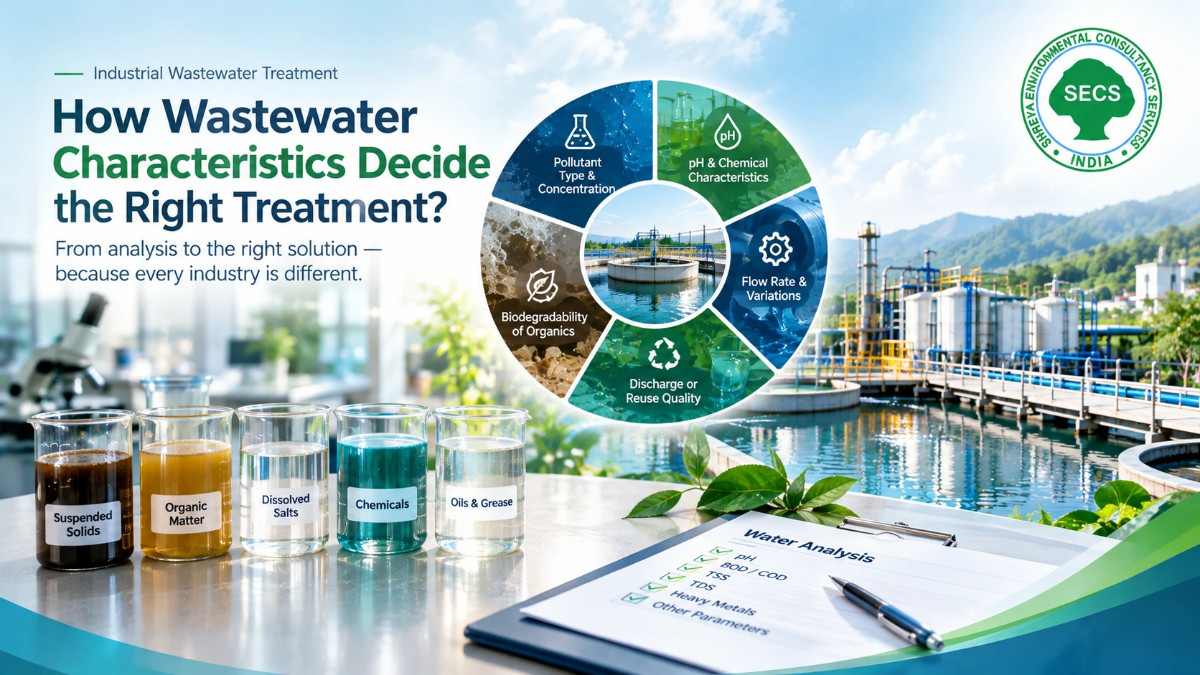
Industrial wastewater treatment is not simply a matter of passing effluent through a standard set of tanks. Different manufacturing processes produce wastewater with different pollutant concentrations, chemical properties and treatment requirements. A process that works well for one wastewater stream may be unsuitable for another, even when both facilities generate similar volumes of effluent.
For industries exploring ETP in Baddi, understanding how wastewater characteristics influence treatment selection is an important part of planning an effective system. The right approach begins with identifying the pollutants present, determining the required treated-water quality and selecting processes that can address those specific conditions.
This guide explains how industrial effluent is assessed, how treatment methods are matched to different contaminants, why wastewater testing matters and how industries can evaluate whether their treatment process is achieving its intended results.
Why Industrial Wastewater Cannot Be Treated the Same Way Every Time
Industrial wastewater varies according to the raw materials used, manufacturing operations, cleaning procedures, production schedules and water consumption. A facility may generate wastewater containing mainly suspended solids, while another may produce effluent with high organic loading, dissolved salts, oils or chemicals that interfere with conventional treatment.
Even within one factory, wastewater composition can change between production batches or cleaning cycles. A concentrated wastewater stream generated during equipment washing, for example, may have very different characteristics from the routine wastewater collected throughout a shift.
These differences influence the treatment sequence, equipment requirements, chemical dosing and operating conditions. They also determine whether biological treatment is suitable or whether additional pretreatment is needed.
For a broader introduction to plant planning and industrial wastewater management, refer to our complete guide to ETP plants in Baddi. This article takes the discussion further by focusing on the technical reasoning behind treatment decisions.
What Determines the Treatment Required for Industrial Effluent?
Before selecting treatment equipment, an industry needs to understand both the wastewater entering the system and the quality required at the outlet. Several factors influence the process design.
1. Type and Concentration of Pollutants
The first consideration is the nature of the contaminants. Suspended particles behave differently from dissolved substances, while biodegradable organic matter requires a different treatment approach from certain persistent or toxic chemicals.
Pollutant concentration also matters. A process that can handle a relatively low contaminant load may require additional stages or different operating conditions when the incoming wastewater becomes more concentrated. Treatment selection should therefore be based on representative wastewater analysis rather than assumptions about the industry alone.
2. Biodegradability of Organic Matter
Biochemical oxygen demand (BOD) and chemical oxygen demand (COD) are commonly used to understand aspects of organic pollution. However, COD alone does not establish whether wastewater can be treated effectively through a biological process.
Some organic compounds are readily biodegradable, while others may degrade slowly or interfere with microorganisms. Comparing relevant test results, investigating the nature of the effluent and conducting treatability studies where necessary can help determine whether biological treatment is appropriate.
3. pH, Salinity and Chemical Characteristics
Highly acidic or alkaline wastewater may require pH adjustment before subsequent treatment. Dissolved salts can remain in the water even after suspended solids and biodegradable organic matter have been reduced.
Salinity, temperature and certain chemical constituents may also affect biological activity, chemical reactions or membrane performance. The design should account for these factors when selecting treatment stages and determining the operating conditions of each unit.
4. Wastewater Flow and Production Variations
Flow rate is not the only consideration when estimating treatment requirements. The timing of wastewater generation and variations in pollutant concentration can affect the load reaching individual treatment units.
Equalisation may help manage these fluctuations by balancing flow and wastewater characteristics before further treatment. Where production creates occasional concentrated or potentially incompatible streams, segregation and controlled introduction may be more appropriate than sending everything directly into a common collection tank.
5. Intended Discharge or Reuse Quality
The required outlet quality determines how far the wastewater must be treated. The objective may be to meet applicable discharge conditions or to produce water suitable for a defined industrial reuse application.
These targets are not necessarily identical. Water that is suitable for one application may require additional treatment before it can be used in a process with stricter requirements for dissolved salts, hardness, suspended solids or other parameters.
Matching Wastewater Contaminants to Suitable Treatment Processes
Effective industrial effluent treatment involves matching each major pollutant group to an appropriate removal or reduction mechanism. A treatment train may combine several processes because no single unit is designed to remove every possible contaminant.
Suspended Solids and Larger Particles
Screening can remove larger debris before it reaches pumps and downstream equipment. Depending on particle size and settling behaviour, further separation may involve settling tanks, clarifiers or suitable filtration systems.
Where particles are very fine or remain dispersed in the water, chemical coagulation and flocculation may help form larger aggregates that can be separated more effectively. The choice depends on the wastewater properties and the performance required from the separation stage.
Fine Particles, Certain Colour and Chemically Treatable Pollutants
Chemical treatment may be useful when wastewater contains fine suspended matter or certain contaminants that respond to specific chemical reactions. Coagulation and flocculation can improve the separation of suitable particles, while other treatment chemicals may be selected for particular wastewater characteristics.
Chemical selection should not be based on guesswork. Laboratory evaluation and jar testing, where appropriate, can help compare chemicals, assess dosage requirements and observe how the wastewater responds under controlled conditions.
These tests are useful because excessive chemical dosing may increase operating costs and sludge generation, while inadequate dosing may lead to poor separation. Actual performance must be verified against the treatment objective.
Biodegradable Organic Matter
Where the wastewater contains suitable biodegradable organic matter, biological treatment can form an important part of the process. Microorganisms transform biodegradable pollutants under controlled conditions, reducing the organic load in the treated water.
Biological treatment requires appropriate operating conditions. Factors such as pH, temperature, nutrient availability, organic loading and the presence of inhibitory substances can influence performance. Pretreatment may be needed where the incoming effluent contains compounds that are unsuitable for direct biological treatment.
For more information about the available process configurations, see our page on ETP and STP treatment technologies. The appropriate technology depends on the actual wastewater and project requirements, not simply on the name of the process.
Dissolved Salts and Other Constituents Requiring Additional Treatment
Conventional screening, clarification and biological treatment do not necessarily remove dissolved salts effectively. Where salinity or other dissolved constituents must be reduced, additional treatment may be required.
Reverse osmosis is one possible option for suitable applications. It uses a membrane to separate water from many dissolved substances, but its performance depends on feedwater characteristics, pretreatment, membrane selection, operating conditions and recovery targets. The resulting concentrated stream must also be managed appropriately.
Industries considering this type of treatment can explore reverse osmosis systems for further information. RO should be selected only after confirming that it addresses the specific water-quality objective.
Specific or Difficult-to-Treat Contaminants
Some industrial wastewater streams contain substances that require specialised treatment or additional pretreatment. Certain metals, persistent organic compounds, solvents or inhibitory chemicals may not be adequately addressed by a conventional treatment sequence alone.
The appropriate response depends on identifying the substances involved, their concentrations and the relevant treatment requirements. Targeted chemical treatment, specialised separation processes or other technologies may be considered after a technical assessment. No single advanced process should be assumed suitable for every difficult wastewater stream.
How Individual Treatment Stages Work Together
The performance of an ETP depends not only on choosing suitable treatment processes but also on arranging them in a sequence that supports the overall objective. Each stage should prepare the wastewater for the next one while helping protect downstream equipment and biological processes where applicable.
Pretreatment Protects Downstream Processes
Screening, segregation, equalisation and pH adjustment may help reduce operational problems before the wastewater reaches more sensitive treatment stages. For example, removing large debris protects pumps, while controlling extreme pH can help create conditions suitable for subsequent treatment.
Chemical Treatment Can Support Separation
Where the wastewater contains particles that do not settle readily, chemical treatment may improve their separation. The resulting flocs must then be removed through a suitable clarification or separation process. Adding chemicals without providing an effective method of separating the resulting solids will not achieve the intended outcome.
Biological Treatment Requires Suitable Incoming Conditions
Where biological treatment is used, the incoming wastewater must be compatible with the microorganisms and the selected process. Sudden changes in loading, extreme pH or inhibitory substances can affect performance. Pretreatment and equalisation may help manage these risks when incorporated into the design.
Polishing Addresses Remaining Water-Quality Requirements
After the principal treatment stages, filtration, disinfection or other polishing processes may be required. The choice depends on the contaminants that remain and the quality needed for discharge or reuse.
This is why the treatment sequence should be developed as an integrated process rather than a collection of unrelated equipment. Each unit needs a defined purpose, appropriate operating conditions and a measurable contribution to the final treatment objective.
Why Wastewater Testing Matters Before Selecting an ETP Process
Wastewater testing provides the information needed to make treatment decisions based on evidence. Without suitable analysis, a design may overlook important contaminants, underestimate variations in pollutant loading or select processes that cannot achieve the required outlet quality.
A wastewater assessment may include the following activities, depending on the industrial application:
- Identify wastewater sources: Map the production, washing, cleaning and other operations that contribute to the effluent.
- Measure flow: Determine average and peak flow rates and identify important variations during production.
- Collect representative samples: Use suitable sampling methods that reflect normal operations and relevant production variations.
- Analyse relevant parameters: Assess pH, TSS, BOD, COD, dissolved solids, oil and grease or other industry-specific parameters as appropriate.
- Evaluate treatment suitability: Use treatability testing or jar testing where necessary to investigate possible treatment options.
- Define performance targets: Establish the required treated-water quality based on applicable discharge conditions or the intended reuse application.
Testing should be interpreted in the context of the manufacturing process and the conditions under which samples were collected. A single sample may not represent wastewater that varies significantly between production batches.
Industries that need help evaluating their environmental requirements can learn more about environmental consultancy services. A properly defined assessment helps establish the basis for process selection and subsequent performance evaluation.
Why a Treatment Process That Works for One Industry May Fail in Another
Using a treatment design without confirming its suitability for the incoming wastewater can lead to unstable performance, higher operating costs or failure to meet the intended treatment target.
One possible problem is the presence of inhibitory substances that affect biological treatment. Another is a sudden increase in pollutant concentration that exceeds the conditions for which the process was designed. Poorly controlled pH, unsuitable chemical dosing or ineffective solids separation can also affect treatment results.
Changes in production materials or cleaning practices may alter the wastewater characteristics even when the plant itself has not changed. Regular review of process data and wastewater quality can help identify these changes before they become persistent operational problems.
When a treatment system underperforms, the appropriate response is to investigate the cause rather than automatically add another treatment unit. The assessment should consider incoming wastewater, operating conditions, equipment performance, sludge behaviour and the actual quality of the treated water.
How to Evaluate Whether an Effluent Treatment Process Is Working
A treatment process should be evaluated against defined performance objectives. Equipment running normally does not, by itself, demonstrate that the required water quality is being achieved.
Comparing representative inlet and outlet samples can help show how relevant pollutant concentrations change through treatment. For example, BOD and COD results may provide information about organic-load reduction, while TSS measurements can help assess solids separation. Other parameters should be monitored where they are relevant to the discharge or reuse requirements.
Results should be interpreted alongside operating records, flow variations and the conditions under which samples were taken. A change in wastewater production or composition may explain a decline in performance even if the treatment equipment has not developed a mechanical fault.
Where results indicate a problem, the investigation should identify which treatment stage is responsible and what corrective action is appropriate. Routine monitoring, maintenance and documented operating procedures help maintain a clearer picture of plant performance over time.
When Does Industrial Effluent Need Additional Treatment?
Additional treatment may be necessary when the main treatment process does not achieve the required water quality or when the intended reuse application imposes stricter requirements. The need should be established by comparing actual treated-water results with the relevant targets.
For example, a conventional treatment process may reduce organic pollution and suspended solids while leaving dissolved salts at levels unsuitable for a particular reuse application. A suitable membrane process or other specialised treatment may then be evaluated, with attention to pretreatment and the management of concentrated residual streams.
Where a project aims to minimise or eliminate routine liquid effluent discharge, a more extensive recovery arrangement may also be considered. Explore zero liquid discharge (ZLD) solutions and our guide to the ZLD process for a closer look at these approaches.
Additional treatment is not automatically necessary for every ETP. Its suitability depends on the pollutant profile, applicable requirements, recovery objectives, operating costs and the management of treatment residuals.
Planning Industrial Effluent Treatment in Baddi, Himachal Pradesh
For an industrial unit evaluating ETP in Baddi, the most useful starting point is a clear understanding of its wastewater generation and treatment objectives. The system should be selected around the actual effluent profile rather than a generic plant configuration.
Before finalising a treatment arrangement, industries should identify their wastewater sources, establish representative flow and quality data, determine the applicable discharge or reuse requirements and assess the processes needed to achieve those targets.
It is also important to consider how the plant will operate after installation. Chemical consumption, energy use, sludge management, monitoring, equipment maintenance and the availability of trained operating personnel can all influence long-term performance.
Shreya Environmental Consultancy Services provides effluent treatment plant solutions for industries assessing wastewater treatment requirements. Businesses can explore the available services and discuss their project needs with the team to determine what technical evaluation may be appropriate.
For facilities that generate both industrial effluent and domestic sewage, the treatment requirements should be assessed separately according to the characteristics of each wastewater stream. Learn more about sewage treatment plant solutions where domestic wastewater management is also relevant.
Where ongoing support is required, the scope of operation and maintenance services can also be considered as part of the overall wastewater management plan.
Conclusion: Select the Treatment Process Based on the Wastewater
Effective industrial effluent treatment begins with understanding the wastewater rather than choosing equipment first. Pollutant characteristics, concentration, biodegradability, flow variations and final water-quality requirements all influence which treatment stages are suitable.
Testing and treatability evaluation can help identify the appropriate processes, while careful sequencing allows individual treatment units to work together towards a defined objective. Performance monitoring then helps verify whether the system is achieving the intended results and highlights where further investigation may be needed.
For industries looking for ETP in Baddi, a wastewater-specific approach provides a stronger foundation for practical treatment planning. Contact Shreya Environmental Consultancy Services to discuss your wastewater characteristics, intended treatment outcomes and potential ETP requirements.
Frequently Asked Questions About Industrial Effluent Treatment
1. Why do different industrial wastewater streams require different treatment processes?
Different wastewater streams contain different pollutants and concentrations, and these substances respond differently to treatment. The suitable process depends on factors such as biodegradability, pH, suspended solids, dissolved constituents, potential toxicity and the required treated-water quality.
2. How do engineers decide whether industrial wastewater needs chemical or biological treatment?
Engineers assess the wastewater composition, pollutant characteristics and treatment objectives. Chemical treatment may help remove certain suspended or chemically treatable contaminants, while biological treatment is appropriate for suitable biodegradable pollutants under controlled conditions. Some wastewater streams require a combination of both.
3. Can wastewater with high COD always be treated using biological treatment?
No. A high COD result indicates a substantial chemical oxygen demand, but it does not establish how readily the pollutants can be biodegraded. Wastewater may contain slowly biodegradable or inhibitory compounds, so additional analysis and treatability testing may be needed before selecting a biological process.
4. Why is wastewater analysis important before selecting an ETP process?
Wastewater analysis helps identify the pollutants present, their concentrations and the treatment targets that must be achieved. It supports process selection, chemical evaluation, capacity planning and the identification of any pretreatment or advanced treatment requirements.
5. What happens if industrial wastewater contains substances that inhibit biological treatment?
Inhibitory substances can reduce microbial activity and affect biological treatment performance. The wastewater should be investigated to identify the cause, and options such as source segregation, suitable pretreatment or changes to the treatment approach may be evaluated based on the findings.
6. Why might treated industrial wastewater require additional filtration or RO?
Conventional treatment may reduce suspended solids and organic pollutants without removing all dissolved constituents. Additional filtration or reverse osmosis may be considered when the remaining water-quality parameters do not meet the requirements of the intended discharge or reuse application.
7. How can an industry check whether its effluent treatment process is achieving the required results?
Industries can compare representative inlet and outlet sample results, monitor relevant water-quality parameters and review operating records. Performance should be assessed against the applicable discharge conditions or the quality requirements of the intended reuse application.
8. What information should an industry provide when planning ETP in Baddi?
Useful information includes the wastewater sources, production processes, average and peak flow rates, available laboratory analysis, production variations and intended discharge or reuse objectives. This information helps establish the basis for evaluating a suitable treatment arrangement.