What Is the Zero Liquid Discharge (ZLD) Process?
The zero liquid discharge (ZLD) process is an advanced industrial wastewater treatment approach designed to recover usable water from wastewater while minimizing or eliminating liquid discharge from the treatment system. Instead of sending treated wastewater to an external discharge point, a ZLD system progressively treats, concentrates and processes the wastewater so that water can be recovered for reuse and the remaining dissolved solids can be converted into a manageable solid residue.
The ZLD plant working principle generally combines several treatment technologies rather than relying on one individual process. Depending on the wastewater characteristics, a typical system may include pre-treatment, membrane treatment such as reverse osmosis (RO), evaporation, crystallization and solid handling.
For industries operating in water-intensive manufacturing environments, understanding the ZLD process is important because wastewater composition, dissolved solids, recovery requirements and disposal limitations all influence the final treatment configuration. ZLD in Baddi is particularly relevant to industries that need reliable wastewater management and higher levels of water recovery.
Why Is ZLD Used for Industrial Wastewater Treatment?
Industrial wastewater can contain dissolved salts, suspended solids, organic matter, chemicals and other contaminants that make direct reuse or discharge difficult. Conventional treatment may remove many pollutants, but the resulting treated water or concentrated reject can still require further management.
A ZLD system addresses this challenge by taking the treatment process further. Water is recovered from wastewater streams, while the remaining concentrated reject is further processed through thermal or crystallization stages.
Common objectives of a ZLD system include:
- Maximizing recovery and reuse of treated water
- Reducing or eliminating liquid wastewater discharge
- Managing high-TDS and concentrated wastewater streams
- Reducing dependence on freshwater sources
- Recovering water from RO reject and other concentrated streams
- Converting concentrated dissolved solids into a manageable solid form
The exact treatment sequence depends on the industry, wastewater characteristics, required water quality and recovery target.
How Does a ZLD Plant Work?
The ZLD plant working principle can be understood as a series of treatment and concentration stages. Wastewater is first conditioned and treated to remove contaminants that could interfere with downstream equipment. Membrane systems may then recover a significant portion of the water, while the remaining concentrated stream is sent to evaporation and crystallization stages.
A simplified ZLD process can be represented as:
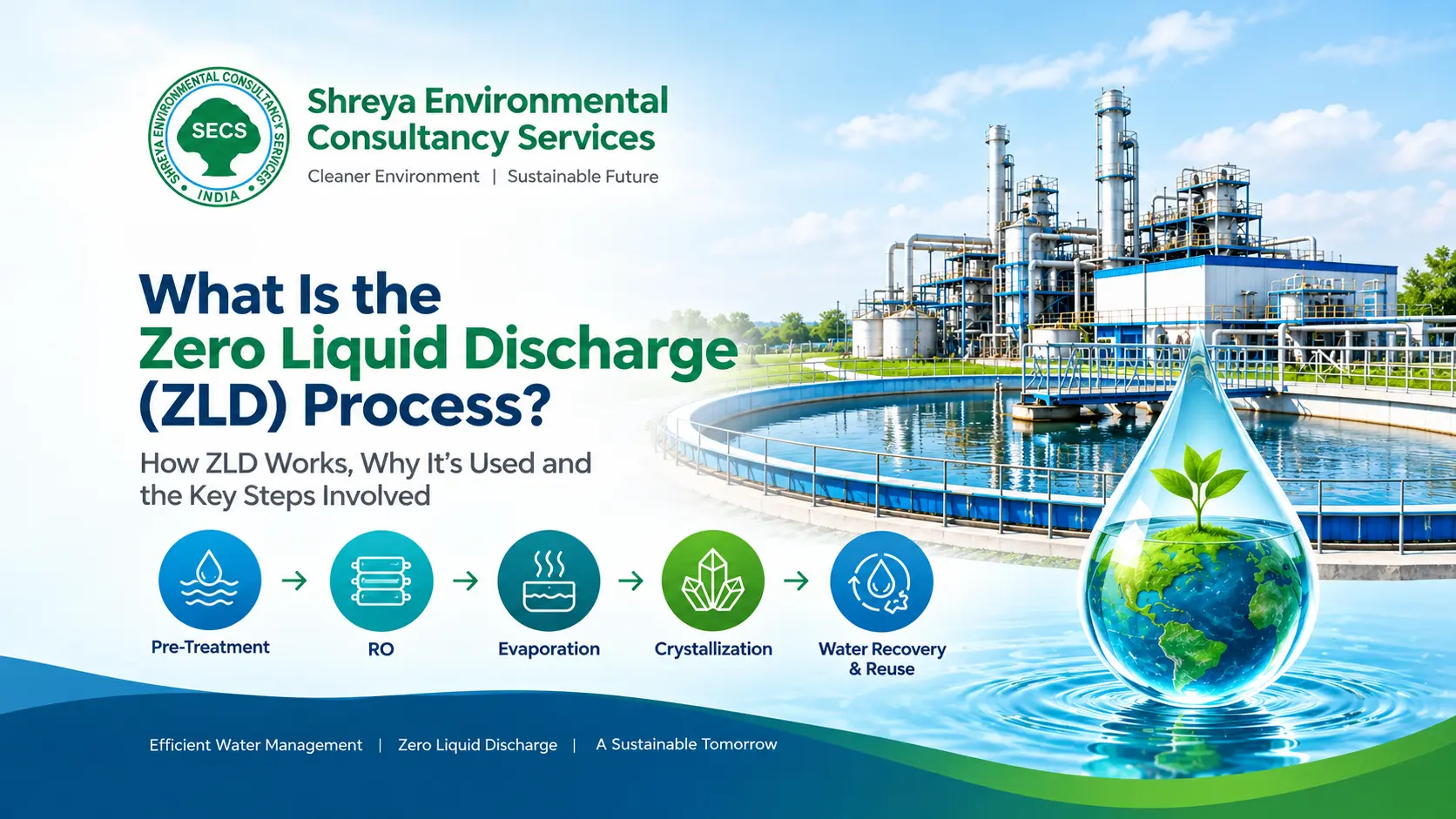
Industrial Wastewater ? Pre-Treatment ? RO ? RO Reject ? Evaporation ? Concentration ? Crystallization/Solid Separation ? Water Recovery and Reuse
Not every ZLD plant uses exactly the same configuration. Some systems use multiple-effect evaporators (MEE), mechanical vapor recompression (MVR), forced circulation evaporation, falling film evaporation, atmospheric or vacuum evaporation, agitated thin film drying (ATFD), crystallizers or combinations of these technologies.
Step 1: Wastewater Collection and Characterization
The first stage of a ZLD project is understanding the wastewater that needs to be treated. Industrial wastewater can vary significantly depending on the manufacturing process and raw materials used.
Important wastewater parameters may include pH, TDS, conductivity, COD, BOD, suspended solids, hardness, silica, chlorides, sulphates, oils, heavy metals and other industry-specific contaminants.
Proper wastewater characterization helps determine the appropriate treatment sequence and prevents unsuitable process selection. Laboratory analysis, treatability studies and pilot testing may also be considered for complex wastewater streams.
Step 2: Pre-Treatment
Pre-treatment is an important part of the zero liquid discharge process because it prepares the wastewater for downstream membrane and thermal treatment.
Depending on wastewater quality, pre-treatment can include processes such as screening, equalization, pH correction, coagulation and flocculation, clarification, filtration, activated carbon treatment or other specialized processes.
The objective is to reduce suspended solids, fouling-causing substances and other contaminants that could affect the performance of downstream equipment.
For industries that require a dedicated effluent treatment plant, the pre-treatment stage can be integrated with the overall wastewater treatment configuration before the concentrated streams are sent to ZLD treatment.
Step 3: Reverse Osmosis and Water Recovery
After suitable pre-treatment, the wastewater may be passed through a reverse osmosis (RO) system. RO uses a semi-permeable membrane to separate water from many dissolved contaminants under pressure.
The RO system generally produces two streams:
- Permeate: The recovered water that can be reused depending on its quality and the industrial application.
- Reject: The concentrated stream containing a higher proportion of dissolved salts and other contaminants.
RO can provide significant water recovery, but it cannot continue concentrating wastewater indefinitely because increasing dissolved solids can affect osmotic pressure, scaling and membrane performance. This is where the downstream stages of a ZLD treatment process become important.
For more information about membrane-based treatment, industries can also explore the reverse osmosis treatment solution.
Step 4: Handling the RO Reject
The RO reject is one of the most important streams in a ZLD system. It contains concentrated dissolved salts and other contaminants that need further treatment.
Instead of discharging this concentrated stream as liquid wastewater, the ZLD system sends it to additional concentration and separation stages.
The treatment method selected for RO reject depends on factors such as TDS, flow rate, scaling potential, chemical composition, required recovery and the characteristics of the final solid residue.
Step 5: Evaporation and Further Concentration
Thermal evaporation is a major stage in many ZLD plants. The objective is to remove water from the concentrated wastewater through evaporation, producing a condensate stream and a much more concentrated residual stream.
Depending on the project, different evaporator configurations may be considered. These can include:
- Multiple Effect Evaporator (MEE)
- Mechanical Vapor Recompression (MVR)
- Forced Circulation Evaporator
- Falling Film Evaporator
- Other specialized evaporation systems
The choice of evaporator depends on wastewater chemistry, flow rate, energy requirements, scaling characteristics and the required final recovery.
The evaporated water is condensed and may be routed back for appropriate reuse or polishing, while the remaining stream becomes increasingly concentrated.
Step 6: Concentrate Treatment and Crystallization
As evaporation continues, dissolved salts and other non-volatile components become increasingly concentrated. Eventually, the remaining stream may require crystallization or drying to separate the dissolved solids from the remaining moisture.
A ZLD crystallizer can be used in suitable applications to promote the formation and separation of solid crystals from the concentrated stream.
Depending on the process design, an ATFD or another suitable drying technology may also be used to further reduce moisture and produce a solid residue.
This stage is important because the fundamental objective of ZLD is not simply to concentrate wastewater but to minimize or eliminate the final liquid discharge.
Step 7: Water Recovery and Reuse
Water recovered during membrane treatment and evaporation can potentially be reused within the industrial facility after achieving the required quality.
Possible reuse applications can include cooling systems, process water, washing operations, utility applications or other suitable industrial uses, depending on water quality requirements.
Water reuse can reduce the facility's dependence on fresh water and improve overall water management. However, the final reuse application should always be determined according to the quality of recovered water and the specific requirements of the industrial process.
Step 8: Solid Residue Management
The final stage of the ZLD process involves handling the concentrated salts and solid residue produced by the treatment system.
The physical and chemical characteristics of the solids depend heavily on the original wastewater composition. Depending on the application, the recovered solids may require collection, dewatering, storage, transportation or disposal in accordance with applicable requirements.
Therefore, solid management should be considered during the initial design of the ZLD plant rather than treated as a separate issue after installation.
ZLD Process Flow in Simple Terms
The complete process can be summarized in the following sequence:
- Wastewater collection: Industrial wastewater is collected and characterized.
- Pre-treatment: Suspended solids and other problematic contaminants are reduced.
- RO treatment: A portion of the water is recovered through reverse osmosis.
- RO reject concentration: The concentrated reject is sent for further treatment.
- Evaporation: Thermal systems remove additional water from the concentrated stream.
- Condensate recovery: Evaporated water is condensed and may be reused after suitable treatment.
- Crystallization or drying: Remaining dissolved solids are converted into a solid residue.
- Water reuse: Recovered water is returned to suitable industrial applications.
What Technologies Are Used in a ZLD Plant?
A ZLD system is usually an integrated treatment plant rather than a single piece of equipment. The technologies selected depend on the wastewater characteristics and the required treatment objectives.
| Technology | Typical Role in ZLD |
|---|---|
| Pre-treatment | Removes suspended solids and contaminants that can affect downstream treatment |
| Reverse Osmosis | Recovers water and concentrates dissolved contaminants |
| MEE | Evaporates water from concentrated wastewater |
| MVR | Uses vapor recompression to improve evaporation efficiency in suitable applications |
| ATFD | Further concentrates and dries suitable high-TDS streams |
| Crystallizer | Facilitates separation of dissolved salts as solid crystals |
What Factors Affect ZLD Plant Design?
There is no single ZLD configuration suitable for every industry. The final design should be developed according to the wastewater characteristics and operational requirements of the facility.
Important design considerations include:
- Wastewater flow rate
- TDS and conductivity
- COD and organic load
- Hardness and scaling potential
- Silica and other dissolved constituents
- Wastewater temperature
- Required water recovery
- Energy availability and operating cost
- Final water quality requirements
- Characteristics and quantity of solid residue
- Available plant space
- Existing ETP and RO infrastructure
For this reason, a detailed wastewater assessment is an important step before selecting a complete zero liquid discharge plant.
ZLD in Baddi for Industrial Wastewater Management
ZLD in Baddi can be relevant for industrial facilities that need advanced wastewater management, particularly where water reuse, high-TDS reject treatment or reduction of liquid discharge is an important operational objective.
Baddi and the surrounding industrial areas include manufacturing facilities with different wastewater characteristics and treatment requirements. Consequently, ZLD solutions should be designed around the specific industrial process rather than using a standard configuration for every facility.
Shreya Environmental Consultancy Services provides water and wastewater treatment solutions that can be evaluated according to the wastewater characteristics, treatment objectives and operational requirements of an industrial facility.
Industries looking for integrated treatment can also explore our Zero Liquid Discharge plant solutions and water and wastewater treatment solutions.
Benefits of a Properly Designed ZLD System
A properly designed ZLD system can provide several operational and environmental benefits when the technology is matched correctly with the wastewater characteristics.
- Higher recovery and reuse of treated water
- Reduction of liquid wastewater discharge
- Better management of high-TDS wastewater and RO reject
- Reduced dependence on freshwater for suitable applications
- Integration with existing ETP and RO systems
- Improved control of concentrated wastewater streams
- Potential recovery of salts or other solids depending on wastewater composition
However, ZLD systems can involve significant capital, energy and maintenance requirements. Proper process selection, equipment sizing and wastewater characterization are therefore essential for reliable operation.
ZLD Process vs Conventional Wastewater Treatment
Conventional wastewater treatment and ZLD treatment can serve different objectives. An ETP may primarily focus on treating wastewater to meet a specified discharge or reuse quality, whereas a ZLD system is designed to take concentrated wastewater further by recovering additional water and managing the remaining dissolved solids.
In many industrial applications, ZLD is therefore integrated with conventional treatment rather than completely replacing it.
For industries requiring conventional effluent treatment before advanced wastewater management, Shreya Environmental Consultancy Services also provides ETP and STP technology solutions.
Frequently Asked Questions About the ZLD Process
What is the ZLD process?
The ZLD process is an industrial wastewater treatment approach that aims to recover usable water while minimizing or eliminating liquid discharge. It commonly combines pre-treatment, RO, evaporation and crystallization or drying technologies.
How does a ZLD plant work?
A ZLD plant typically treats industrial wastewater through several stages. After pre-treatment, RO may recover part of the water while concentrating the reject. The concentrated stream can then undergo evaporation and further solid separation so that additional water is recovered and the remaining solids are managed as a solid residue.
What is the role of RO in a ZLD plant?
Reverse osmosis helps recover water from suitable wastewater streams while concentrating dissolved salts and other contaminants into the RO reject. The reject can then be treated through downstream ZLD processes.
What is MEE in the ZLD process?
MEE, or Multiple Effect Evaporator, is a thermal evaporation system that removes water from concentrated wastewater. It can be used to further concentrate streams that cannot be economically treated through membrane processes alone.
What happens to the final ZLD residue?
The final residue generally consists of concentrated salts and other solids originating from the wastewater. Its handling, storage, disposal or potential recovery depends on its composition and the applicable requirements.
Can ZLD water be reused?
Recovered water from a ZLD system can potentially be reused in industrial applications after achieving the required water quality. The appropriate reuse application depends on the quality of the recovered water and the facility's process requirements.
Is every industrial wastewater suitable for the same ZLD configuration?
No. ZLD plant design depends on wastewater flow, TDS, COD, hardness, scaling potential, chemical composition, required recovery, energy availability and other site-specific factors. A suitable treatment configuration should therefore be developed after evaluating the wastewater characteristics.
Conclusion
The zero liquid discharge process is a multi-stage approach to industrial wastewater management that combines water recovery with concentration and solid handling. From pre-treatment and RO to evaporation, crystallization and final residue management, each stage plays a specific role in reducing liquid discharge and maximizing water recovery.
Understanding the ZLD plant working principle is important when evaluating a wastewater treatment project because the correct combination of technologies depends on the wastewater composition, recovery target and operating conditions.
For industries evaluating ZLD in Baddi, a site-specific assessment of wastewater characteristics and treatment requirements can help determine the appropriate ZLD configuration. Shreya Environmental Consultancy Services provides industrial water and wastewater treatment solutions based on the specific requirements of each project.