
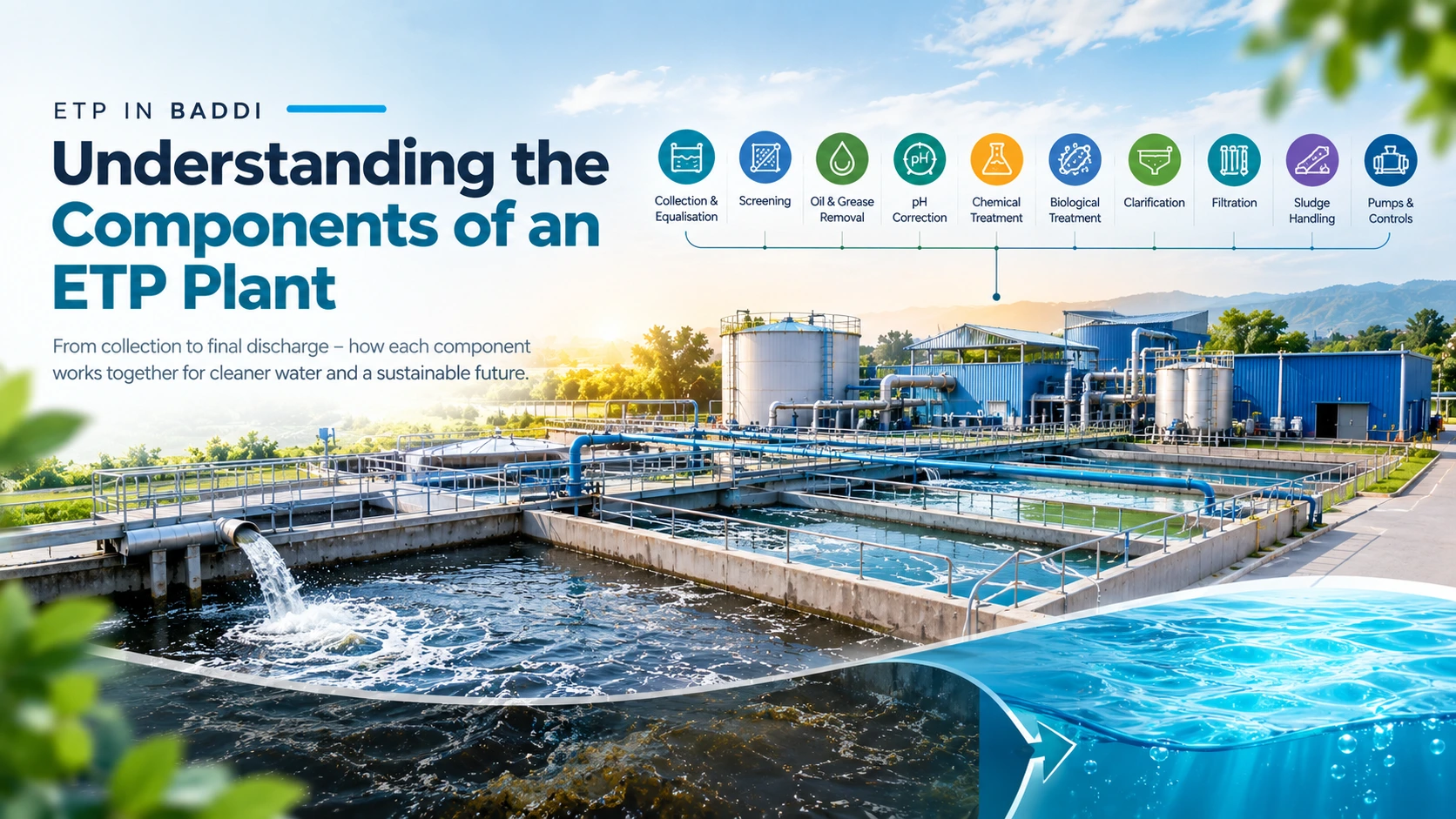
ETP in Baddi: Understanding the Components of an ETP Plant
An ETP in Baddi is not a single treatment machine. It is a connected system of tanks, treatment units, pumps, pipelines, dosing equipment, separation equipment and controls, with each component performing a specific role in the treatment of industrial effluent. The arrangement and selection of these components depend on the wastewater characteristics, flow, treatment objectives and applicable discharge or reuse requirements.
Understanding the individual components is important when evaluating an ETP plant in Baddi because the performance of the overall system depends on how these units work together. A properly selected collection system, for example, supports stable downstream treatment, while suitable clarification and filtration equipment helps separate solids before the treated stream moves to further treatment stages.
There is no single component layout that is suitable for every industry. Pharmaceutical, textile, food-processing, chemical, engineering and other industrial facilities can generate wastewater with very different characteristics. For this reason, an Effluent Treatment Plant needs to be considered as a complete treatment train rather than as a collection of standard equipment.
What Are the Main Components of an ETP Plant?
The main components of an ETP are generally arranged according to the sequence in which wastewater needs to be treated. Depending on the application, an industrial ETP may include preliminary screening, collection and equalisation, oil and grease separation, pH correction, chemical treatment, biological treatment, clarification, filtration, sludge handling and additional polishing or recovery systems.
Some plants may use only selected treatment stages, while others require several processes in combination. The objective is to provide each downstream unit with wastewater conditions that are suitable for the next stage of treatment.
Typical ETP Components
- Collection and equalisation tanks: receive wastewater and help manage variations in flow and pollutant concentration.
- Screening systems: remove larger floating and suspended materials before they enter pumps and treatment units.
- Oil and grease removal units: separate free oil, grease and similar floating substances where present.
- Neutralisation systems: adjust wastewater pH when chemical correction is required.
- Coagulation and flocculation units: assist in aggregating fine suspended or colloidal matter for subsequent separation.
- Clarifiers: provide settling and separation of suspended solids from the liquid stream.
- Biological treatment units: use controlled biological processes where biodegradable organic matter needs to be treated.
- Filters: remove remaining suspended particles and provide additional polishing where required.
- Sludge handling equipment: collects, concentrates and dewaters sludge generated during treatment.
- Pumps, valves, pipelines and controls: move wastewater between stages and regulate plant operation.
The exact configuration should be determined from wastewater analysis, process requirements and the intended quality of treated water. Technologies such as ETP and STP technologies can therefore involve different combinations of treatment units rather than one fixed design.
Collection Tank and Equalisation Tank
The collection stage is where wastewater generated by different industrial activities is brought into the treatment system. Depending on the plant layout, wastewater streams may first pass through collection arrangements before reaching an equalisation tank. This stage provides the connection between the factory's wastewater generation points and the main treatment process.
An equalisation tank in an ETP is particularly important where wastewater flow or composition changes during the day. Industrial processes may not produce the same quantity or strength of effluent continuously. Equalisation provides a controlled holding volume so that downstream treatment units receive a more consistent feed.
What Does an Equalisation Tank Do?
- Receives incoming wastewater before subsequent treatment stages.
- Helps balance variations in wastewater flow.
- Reduces sudden changes in pollutant concentration reaching downstream units.
- Provides a controlled feed to chemical or biological treatment processes.
- Can support mixing or agitation to reduce settling and maintain a reasonably uniform wastewater condition.
The tank design depends on factors such as wastewater flow, operating pattern, required retention time, wastewater characteristics and the treatment process that follows. Mixing arrangements may be required where solids could settle or where maintaining a more uniform wastewater composition is important.
Equalisation should not be confused with complete treatment. Its main purpose is to provide hydraulic and process stability before the wastewater moves through the subsequent treatment stages. A well-considered equalisation stage can therefore influence how consistently later components operate.
Screening System and Bar Screens
Screening is normally one of the first physical separation steps in an industrial wastewater treatment system. Its purpose is to intercept larger solids and floating materials before they reach pumps, valves, tanks and other treatment equipment.
A bar screen in an ETP consists of bars or openings designed to retain material above a selected size while allowing wastewater to pass through. The spacing and configuration depend on the type and quantity of solids expected in the incoming wastewater.
Why Screening Is Important
Large solids can create operational problems if they enter downstream equipment. They may obstruct pumps, interfere with valves, occupy useful tank volume or complicate later sludge-handling processes. Removing these materials at the beginning therefore provides a basic level of protection for the rest of the plant.
Screening can be manual or mechanically operated depending on the size and operating requirements of the installation. The collected screenings also need appropriate handling and disposal in accordance with the site's operating and waste-management practices.
Screening does not replace the later treatment stages. It is a preliminary physical separation step designed mainly to protect equipment and prepare the wastewater for subsequent processes.
Oil and Grease Removal Unit
Some industrial effluents contain free oil, grease or other floating substances. Where these contaminants are significant, an oil and grease removal unit can be incorporated into the treatment train before processes that may be affected by excessive floating material.
The basic principle is physical separation. Because free oil and grease can behave differently from the water phase, suitable separation arrangements allow floating material to accumulate and be removed from the wastewater. The design may vary depending on the type of oil or grease, wastewater flow, concentration and whether the contaminants are present as free, dispersed or emulsified material.
Why Oil and Grease Removal Matters
Excessive oil and grease can interfere with downstream treatment. In particular, uncontrolled oily material may affect chemical treatment, clarification, biological processes or filtration depending on its characteristics and concentration.
For this reason, the oil and grease removal stage should be selected according to the actual wastewater rather than assuming that the same separator arrangement will work for every industrial application. Where emulsified or chemically stabilised oils are present, additional treatment may be necessary because simple gravity separation may not be sufficient.
The separated oil and grease also form a waste stream that requires appropriate collection and handling. Its management should be considered as part of the overall ETP design rather than treated as an afterthought.
Neutralisation Tank and Chemical Dosing System
Industrial wastewater can have a pH that is too acidic or too alkaline for the treatment processes that follow. A neutralisation tank in an ETP provides a controlled environment in which chemicals can be added to adjust pH towards the range required by the subsequent treatment stage.
The neutralisation system generally includes a tank, mixing arrangement, chemical storage and dosing equipment, together with suitable measurement and control provisions. The exact chemicals used depend on the wastewater characteristics and the required treatment conditions.
How Chemical Dosing Works
Chemical dosing is not simply the addition of a fixed quantity of chemical. The required dose can vary with wastewater flow, pH, pollutant concentration and process conditions. A properly designed system therefore considers both the dosing equipment and the method used to monitor the treatment condition.
Depending on the plant configuration, pH sensors or other instrumentation can provide information for operator control or automated dosing. Adequate mixing is also important so that the added chemical can react throughout the wastewater rather than remaining concentrated in one part of the tank.
Neutralisation may be required before chemical precipitation, biological treatment or other downstream processes. The required operating range should therefore be established from the treatment process and wastewater characteristics rather than applying one universal pH value to every ETP.
Coagulation and Flocculation Units
Coagulation and flocculation are commonly used when wastewater contains fine suspended particles, colloidal matter or other contaminants that are difficult to remove through simple settling. These processes help transform smaller particles into larger aggregates that can subsequently be separated through clarification or another suitable solid-liquid separation process.
Coagulation
During coagulation, a suitable chemical coagulant is added to destabilise particles that remain dispersed in the wastewater. Rapid and effective mixing helps distribute the chemical throughout the wastewater and promotes the required chemical interaction.
The choice and dose of coagulant depend on the wastewater. Factors such as pH, suspended solids, colloidal content and other chemical characteristics can influence the effectiveness of the process. Jar testing or other process evaluation methods may be used during treatment development to determine suitable operating conditions.
Flocculation
Flocculation generally follows coagulation. The wastewater is mixed more gently to encourage destabilised particles to come together and form larger flocs that are easier to separate.
The objective is not simply to produce larger particles but to create flocs with characteristics suitable for the separation equipment that follows. Mixing intensity, retention time, chemical conditions and wastewater characteristics can all influence floc formation.
After coagulation and flocculation, the wastewater commonly proceeds to a clarification or other separation stage. This illustrates why ETP components cannot be selected independently: the performance of one unit affects the operating conditions required by the next.
In the next part, we will move into the core separation and treatment equipment, including primary and secondary clarifiers, aeration tanks, biological treatment systems, filtration units, RO, sludge dewatering equipment, pumps and instrumentation.
Clarifier in an ETP: Primary and Secondary Clarifiers
A clarifier in an ETP is a solid-liquid separation unit designed to allow suspended particles or biological solids to settle from wastewater. Clarification is important because treatment processes can generate solids that need to be separated from the liquid before the wastewater moves to the next stage.
Depending on the treatment configuration, an ETP may include a primary clarifier, a secondary clarifier, or another suitable clarification arrangement. The terminology describes the position and purpose of the clarifier within the treatment sequence rather than indicating that every ETP must contain both types.
Primary Clarifier in an ETP
A primary clarifier is generally positioned after preliminary or chemical treatment where the process is intended to separate settleable solids, chemically formed flocs or other suspended material before further treatment.
As wastewater enters the clarifier, the flow conditions are controlled to allow heavier solids to settle towards the bottom. Floating material may be collected separately, while the clarified liquid moves towards the next treatment stage.
Where coagulation and flocculation are used upstream, the clarifier can also provide the separation stage for the larger flocs created by those processes. The design therefore needs to match the characteristics of the solids being generated.
Secondary Clarifier in an ETP
A secondary clarifier is commonly associated with biological treatment. Its purpose is to separate biological solids from the treated liquid after the wastewater has passed through an aeration or other biological process.
The settled biological solids may be returned to the biological treatment process where the system requires sludge recirculation, while excess sludge can be directed towards sludge handling. The clarified liquid continues to the next treatment or polishing stage.
Clarifier performance depends on more than tank size. Hydraulic loading, solids characteristics, settling behaviour, inlet and outlet arrangements, sludge withdrawal and operating conditions all influence separation. This is why clarification should be considered as part of the complete ETP process rather than as an isolated tank.
Aeration Tank and Biological Treatment Equipment
An ETP aeration tank is used in treatment systems where biological processes are required to reduce biodegradable organic matter or other pollutants that can be addressed through biological activity. The tank provides a controlled environment in which microorganisms interact with the wastewater under suitable operating conditions.
One important component of an aeration system is the equipment used to transfer oxygen into the wastewater. Depending on the process design, this may involve blowers, air distribution pipelines, diffusers or other aeration arrangements.
Role of Aeration Equipment
- Supplies air or oxygen to support the biological treatment process where required.
- Maintains mixing within the biological treatment zone in systems where aeration also contributes to circulation.
- Helps maintain process conditions suitable for the microorganisms involved.
- Supports the treatment of biodegradable pollutants under the designed operating conditions.
The aeration requirement depends on wastewater characteristics and the biological process selected. Excessive or insufficient aeration can both affect plant operation, so the system should be designed and operated according to the actual process requirements.
Biological treatment also requires attention to factors such as organic loading, dissolved oxygen, solids concentration, nutrient availability where relevant, temperature and pH. These parameters can influence biological activity and therefore need to be considered when designing and operating an industrial ETP.
Secondary Treatment and Biological Solids Separation
Secondary treatment generally refers to treatment stages designed to further reduce biodegradable organic matter and other pollutants after preliminary or primary treatment. In an industrial ETP, the exact biological process depends heavily on the wastewater characteristics and the treatment objectives.
Where an aerobic biological process is used, wastewater enters the biological treatment zone under controlled conditions. Microorganisms utilise suitable biodegradable substances as part of their metabolic activity, producing biological solids that subsequently need to be separated from the treated water.
Why Biological Solids Separation Is Necessary
The biological process does not end when microorganisms have interacted with the wastewater. The resulting biomass needs to be separated from the liquid so that the treated water can continue through the treatment train.
This is commonly achieved through a secondary clarifier or another appropriate solid-liquid separation process. A portion of settled biological solids may be returned to maintain the required biomass concentration, while excess sludge is removed for further handling.
This connection between the aeration tank, biological solids and secondary clarifier demonstrates the importance of designing treatment units as an integrated system. Changes in one component can influence loading, solids concentration and operating conditions elsewhere in the biological treatment process.
Not every industrial wastewater requires the same biological configuration. Some effluents may contain substances that are poorly suited to biological treatment, while others may require significant chemical or physical treatment before biological processing. Process selection should therefore follow wastewater characterisation rather than a standard equipment list.
Filters Used in an ETP Plant
Filtration is commonly used as a polishing or solids-removal stage after clarification and other treatment processes. An ETP filtration system can help remove remaining suspended particles and improve the quality of the treated stream before discharge, reuse or further treatment.
The type of filter selected depends on the particles that need to be removed and the quality required at the outlet. Common filtration arrangements in industrial wastewater treatment include pressure-based media filters, activated carbon filters and other specialised filtration systems.
Pressure Sand Filter in an ETP
A pressure sand filter uses a granular filter media bed to retain suspended particles as wastewater passes through it. It is commonly used where reduction of residual suspended matter is required after earlier treatment and clarification.
The filter gradually accumulates retained solids and therefore requires periodic backwashing or another suitable cleaning procedure. The frequency depends on the wastewater quality, loading and filter operating conditions.
Activated Carbon Filter in an ETP
An activated carbon filter may be incorporated where additional removal of certain dissolved organic substances, colour, odour or other contaminants is required and the wastewater characteristics are suitable for carbon treatment.
Activated carbon does not provide a universal solution for every dissolved contaminant. Its effectiveness depends on the nature of the substances present, contact conditions, carbon characteristics and other process factors. Media replacement or regeneration also needs to be considered as part of operation and maintenance.
Why Filtration Comes After Earlier Treatment
Filtration is often more effective when excessive solids have already been removed upstream. Sending a heavily loaded wastewater stream directly to a fine filtration stage can increase pressure drop, shorten filter cycles and increase maintenance requirements.
For this reason, filters should be viewed as part of a treatment sequence. Screening, clarification, chemical treatment and biological processes may each reduce a particular portion of the contaminant load before the water reaches the filtration stage.
Advanced Treatment Units: Where RO Fits Into an ETP
Reverse Osmosis (RO) is a membrane-based treatment process that may be added to an ETP when the required treated-water quality cannot be achieved through conventional treatment alone or when a suitable water-recovery objective requires membrane treatment.
RO works differently from tanks, clarifiers and conventional media filters. It uses pressure to drive water through a semi-permeable membrane while retaining a significant portion of dissolved substances. This creates a treated permeate stream and a concentrated reject stream that both need to be considered in the overall system design.
RO is therefore not automatically required in every ETP. Its inclusion depends on factors such as the quality of the treated water required, dissolved solids, reuse objectives, upstream treatment performance and the management of the resulting reject stream.
Where membrane treatment is appropriate, adequate pretreatment is particularly important. Suspended solids, scaling potential, fouling substances and other feed-water characteristics need to be controlled to support reliable membrane operation.
Where water recovery requirements are more stringent, RO may form part of a larger recovery strategy involving additional treatment. For industrial facilities considering Reverse Osmosis systems, the membrane stage should therefore be evaluated together with the upstream ETP and downstream concentrate-management requirements.
Sludge Collection and Dewatering Equipment
ETP treatment does not only produce treated water. Several treatment processes can generate sludge, including suspended solids removed during clarification, chemically precipitated solids and excess biological biomass. Sludge management is therefore an essential part of an industrial wastewater treatment system.
Sludge collected from clarifiers is generally directed towards a sludge-handling stage. Depending on the plant configuration and sludge characteristics, this may involve thickening, holding, conditioning and mechanical dewatering.
Sludge Dewatering
The purpose of dewatering is to reduce the water content of sludge so that the resulting material is easier to handle, transport and manage. Different equipment can be selected according to sludge characteristics, required capacity, operating conditions and site requirements.
Common dewatering approaches can include filter presses, centrifuges, screw presses or other suitable systems. The appropriate choice depends on the characteristics of the sludge rather than simply the wastewater flow rate.
Chemical conditioning may also be used before mechanical dewatering to improve separation of water from solids. The conditioning requirement depends on the type of sludge and the selected dewatering equipment.
Sludge generated by an ETP should be managed in accordance with applicable waste-management requirements and the site's approved handling and disposal arrangements. It should not be treated as an incidental by-product of the plant.
Pumps, Pipelines, Valves and Chemical Dosing Systems
Tanks and treatment units cannot function as an integrated ETP without a suitable hydraulic and chemical-transfer system. Pumps, pipelines and valves move wastewater, sludge, chemicals and treated water between the different stages of the plant.
Pumps
Different pumps may be required for raw effluent transfer, treated-water movement, sludge transfer, chemical dosing and other duties. Pump selection depends on parameters such as flow rate, head, fluid characteristics, solids content and the operating conditions of the particular service.
Pipelines and Valves
Pipelines provide the physical connection between treatment units, while valves allow operators or control systems to isolate equipment, regulate flow and direct streams where required. Material selection is also important because industrial wastewater and treatment chemicals can create different corrosion or compatibility considerations.
Chemical Dosing Equipment
Chemical dosing systems generally include chemical storage, dosing pumps, associated pipelines and injection arrangements. Depending on the process, chemicals may be used for pH adjustment, coagulation, flocculation, conditioning or other treatment requirements.
A reliable dosing system needs to account for the chemical being handled, required dosing range, storage arrangements, safety provisions and process-control requirements. The dosing system should be sized around the actual treatment process rather than treated as a separate accessory.
Instrumentation, Sensors and Control Systems
Modern ETP plants may use instrumentation to monitor treatment conditions and support consistent operation. Sensors and control equipment provide information about process parameters so that operators can understand how the treatment system is performing and make appropriate adjustments.
Depending on the plant design, instrumentation may monitor parameters such as pH, flow, dissolved oxygen, pressure, level, conductivity or other process-specific measurements. Not every parameter is required in every ETP; the instrumentation package should correspond to the treatment process and operational needs.
Why Instrumentation Matters
For example, pH measurement can support neutralisation and chemical dosing, while dissolved oxygen measurement can assist in managing an aerobic biological process. Flow measurement can help operators understand hydraulic loading, and tank-level instruments can support pump and process control.
Control systems can range from manual operation to more automated arrangements using control panels, programmable logic controllers and associated monitoring equipment. The appropriate level of automation depends on plant size, process complexity, operating requirements and the level of process control needed.
Instrumentation does not replace proper treatment design or operator attention. Sensors require suitable installation, calibration, cleaning and maintenance if their readings are to remain useful for process control.
These components together form the operating backbone of an ETP: treatment tanks perform the process work, separation units remove solids, filters polish the water, sludge systems handle the generated solids, and pumps, valves and instrumentation keep the entire treatment sequence connected and controllable.
How ETP Components Work Together
The individual components of an ETP are most effective when they are designed as a connected treatment sequence. Wastewater normally moves through several stages, with each unit addressing a particular characteristic of the effluent or preparing the stream for the next treatment process.
A typical sequence may begin with screening and collection, followed by equalisation, oil and grease separation where required, pH correction, coagulation and flocculation, clarification, biological treatment, secondary clarification and filtration. Additional treatment such as Reverse Osmosis systems may be included when the required treated-water quality or reuse objective calls for membrane treatment.
Example of an ETP Treatment Sequence
- Industrial wastewater is collected and transferred into the treatment system.
- Screening removes larger solids and floating material.
- Equalisation helps manage variations in flow and wastewater characteristics.
- Oil and grease separation is provided where relevant to the wastewater.
- Neutralisation adjusts pH when required by the treatment process.
- Coagulation and flocculation promote the formation of separable particles or flocs.
- Primary clarification separates settled solids from the liquid stream.
- Biological treatment is used where biodegradable pollutants require biological removal.
- Secondary clarification separates biological solids from the treated liquid.
- Filtration provides additional suspended-solids removal or polishing.
- Further treatment, such as RO, may be introduced when required for reuse or specific water-quality objectives.
- Sludge generated throughout the process is collected and sent for appropriate handling and dewatering.
This sequence is only an example. An actual ETP plant in Baddi may have a different configuration depending on the industrial process, wastewater analysis, treatment targets, available space and other project requirements.
The important point is that an ETP should not be evaluated by counting how many tanks or machines it contains. The suitability of the plant depends on whether each component performs the required function and whether the components are properly integrated.
How ETP Components Vary by Industry
Different industries generate different types of wastewater, so the components required in an ETP can vary considerably. The wastewater may differ in pH, suspended solids, organic matter, oils, dissolved substances, colour, salts and other characteristics depending on the manufacturing process and chemicals used.
For example, an industrial facility with significant suspended solids may require effective screening, chemical treatment and clarification, while a wastewater stream with a substantial biodegradable organic load may require a biological treatment stage. Where dissolved solids or specific reuse requirements become important, additional membrane or advanced treatment may need to be considered.
Pharmaceutical and Chemical Industries
Pharmaceutical and chemical manufacturing can produce wastewater with variable chemical characteristics depending on the processes, raw materials and cleaning operations involved. Treatment may therefore require a combination of equalisation, pH control, chemical treatment, biological treatment or other processes based on wastewater analysis.
Food and Beverage Industries
Food-processing wastewater can contain biodegradable organic matter, suspended solids, fats and oils. Depending on the process, screening, equalisation, oil and grease removal, biological treatment and clarification can form important parts of the treatment train.
Textile and Similar Processing Industries
Textile-related wastewater can contain colour, suspended solids, chemicals and variable organic loads. Chemical treatment, clarification, biological treatment, filtration or additional processes may be considered depending on the actual wastewater and required outlet quality.
Engineering and Manufacturing Facilities
Engineering and manufacturing facilities can generate wastewater containing suspended solids, oils, metals or other process-specific contaminants. The appropriate treatment configuration depends on the individual manufacturing processes and the characteristics of the generated effluent.
These examples demonstrate why an industrial ETP plant should be based on the wastewater rather than on the industry name alone. Two facilities operating in the same broad sector can still require different treatment configurations.
Choosing the Right Components for an ETP Plant in Baddi
Choosing components for an ETP in Baddi begins with understanding the wastewater that the plant will receive. A treatment system should be designed around actual process conditions rather than selecting equipment simply because it is commonly used in industrial wastewater treatment.
Key Factors in Component Selection
- Wastewater flow: Average and peak flows influence tank volumes, pumps, pipelines and hydraulic loading.
- Wastewater characteristics: pH, suspended solids, organic matter, oils, dissolved substances and other parameters influence treatment selection.
- Variations in production: Changes between shifts, batches or production cycles can affect equalisation and treatment requirements.
- Required treated-water quality: Discharge and reuse objectives determine how much treatment is necessary.
- Solids generation: Chemical and biological processes can generate different types and quantities of sludge, affecting dewatering requirements.
- Space and site conditions: Available installation area, levels, access and existing infrastructure influence equipment arrangement.
- Operation and maintenance: Components should be practical to operate, inspect, clean and maintain.
- Future requirements: Potential changes in production or water-reuse objectives may need to be considered during planning.
Wastewater testing and process assessment are particularly important before finalising the treatment configuration. The data helps determine which treatment stages are necessary and prevents the plant from being designed around assumptions that may not reflect the actual effluent.
For industries in Baddi and other industrial locations, environmental consultancy services can also support the assessment and planning process by connecting wastewater characteristics, treatment objectives and project requirements.
ETP Component Maintenance and Operation
Even a properly designed ETP requires regular operation and maintenance. Treatment components are exposed to wastewater, chemicals, solids and continuous hydraulic loading, so inspection and servicing are necessary to maintain reliable plant operation.
Common Maintenance Areas
- Cleaning screens and removing accumulated screenings.
- Inspecting equalisation and treatment tanks for excessive solids accumulation.
- Checking pumps, motors, valves and pipelines for abnormal operation or leakage.
- Monitoring chemical storage and dosing equipment.
- Inspecting clarifiers and sludge-removal mechanisms.
- Checking blowers, air lines and diffusers in biological treatment systems.
- Backwashing and maintaining media filters according to operating requirements.
- Monitoring membrane systems where RO is installed.
- Removing and managing accumulated sludge.
- Checking sensors, instruments and control equipment.
Maintenance should also include monitoring process conditions rather than focusing only on mechanical equipment. Changes in pH, flow, dissolved oxygen, sludge behaviour, filter pressure or other relevant parameters can indicate that a treatment stage needs adjustment or inspection.
Operational records can help identify recurring problems and changes in plant behaviour. A structured ETP operation and maintenance service can be useful where an industrial facility requires ongoing technical support for plant operation, monitoring and maintenance.
How Shreya Environmental Consultancy Services Can Help
Designing or upgrading an ETP requires more than selecting individual tanks and machines. The treatment components need to correspond with the wastewater characteristics, process requirements, site conditions and intended treated-water quality.
Shreya Environmental Consultancy Services works with industrial wastewater treatment requirements including ETP systems, treatment technologies, operation and maintenance, environmental consultancy and project execution. With more than 20 years of experience in the environmental field, the focus is on developing treatment approaches around the specific requirements of the project rather than applying one standard configuration to every industry.
For an ETP plant in Baddi, this can involve assessing the wastewater source, understanding the required treatment stages, reviewing existing infrastructure and determining which components are appropriate for the intended treatment objective. Where a project involves multiple stages of implementation, turnkey project execution can also provide a coordinated approach to the project.
Where treated-water recovery is part of the requirement, ETP treatment can also be considered alongside technologies such as RO and, where appropriate, Zero Liquid Discharge solutions. These technologies should be evaluated based on the site's wastewater characteristics and water-management objectives rather than assumed to be necessary for every facility.
Shreya can also support industries looking at existing ETP systems where the requirement is related to treatment performance, component assessment, maintenance or process improvement. The appropriate approach depends on the condition of the existing plant and the nature of the wastewater.
FAQs About ETP Plant Components
What are the main components of an ETP plant?
Main ETP components can include collection and equalisation tanks, screens, oil and grease removal units, neutralisation systems, coagulation and flocculation units, clarifiers, biological treatment units, filters, sludge-handling equipment, pumps, pipelines and instrumentation. The exact combination depends on the wastewater and treatment requirements.
What is the purpose of an equalisation tank in an ETP?
An equalisation tank helps manage variations in wastewater flow and characteristics before the wastewater enters subsequent treatment stages. It can provide a more controlled and consistent feed to downstream treatment units.
What does a clarifier do in an ETP?
A clarifier provides solid-liquid separation by allowing suitable suspended solids or biological solids to settle from the wastewater. Primary and secondary clarifiers can serve different positions and functions within an ETP process.
What is the difference between a primary and secondary clarifier?
A primary clarifier is generally used earlier in the treatment sequence to separate settleable or chemically formed solids. A secondary clarifier is commonly associated with biological treatment and separates biological solids from the treated liquid.
Are filters always required in an ETP?
Not necessarily. Filtration depends on the treatment objectives, wastewater characteristics and required treated-water quality. Where filtration is required, the type of filter should be selected according to the contaminants that need to be removed.
Is RO required in every ETP plant?
No. RO is an advanced membrane treatment process that may be included when specific treated-water quality or water-recovery objectives require it. Its suitability depends on factors such as dissolved solids, reuse requirements, upstream treatment and management of the RO reject stream.
Why is sludge management important in an ETP?
ETP processes can generate chemical and biological sludge that must be collected, handled and managed appropriately. Dewatering can reduce the water content of sludge and make subsequent handling and disposal more practical.
How are ETP components selected for an industrial facility?
Component selection depends on wastewater flow, wastewater characteristics, production patterns, treatment objectives, site conditions, sludge generation, operation requirements and applicable requirements for treated water. Wastewater analysis and process assessment are important before finalising the treatment configuration.
Can an existing ETP be upgraded with additional components?
In some cases, an existing ETP can be modified or upgraded, but the feasibility depends on the existing process, equipment condition, available capacity, hydraulic arrangement and wastewater characteristics. A technical assessment is advisable before adding new treatment units.
Conclusion
An ETP is made up of interconnected treatment components, and each unit has a specific role within the overall treatment process. Tanks provide collection, equalisation and controlled treatment conditions; clarifiers separate solids; biological systems treat suitable biodegradable pollutants; filters provide additional polishing; and pumps, dosing systems, sludge equipment and instrumentation keep the plant operating as an integrated system.
For an ETP in Baddi, the right components cannot be selected from a standard checklist alone. Wastewater characteristics, industrial processes, flow variations, treatment objectives, site conditions and operation requirements all need to be considered when developing the treatment configuration.
Whether an industry is planning a new ETP plant in Baddi, reviewing an existing treatment system or considering additional treatment such as RO or ZLD, a component-by-component technical assessment can help establish a more suitable treatment approach. Shreya Environmental Consultancy Services supports industrial wastewater treatment requirements with ETP solutions, environmental consultancy, project execution and operation and maintenance support for projects in Baddi and across India.