What Is Zero Liquid Discharge (ZLD)? A Complete Guide to Industrial Wastewater Treatment
Industrial facilities generate wastewater from manufacturing processes, cleaning operations, utilities, cooling systems and other production activities. Managing this wastewater properly is an important part of industrial water management, particularly when the wastewater contains high dissolved solids, difficult-to-treat contaminants or concentrated reject streams.
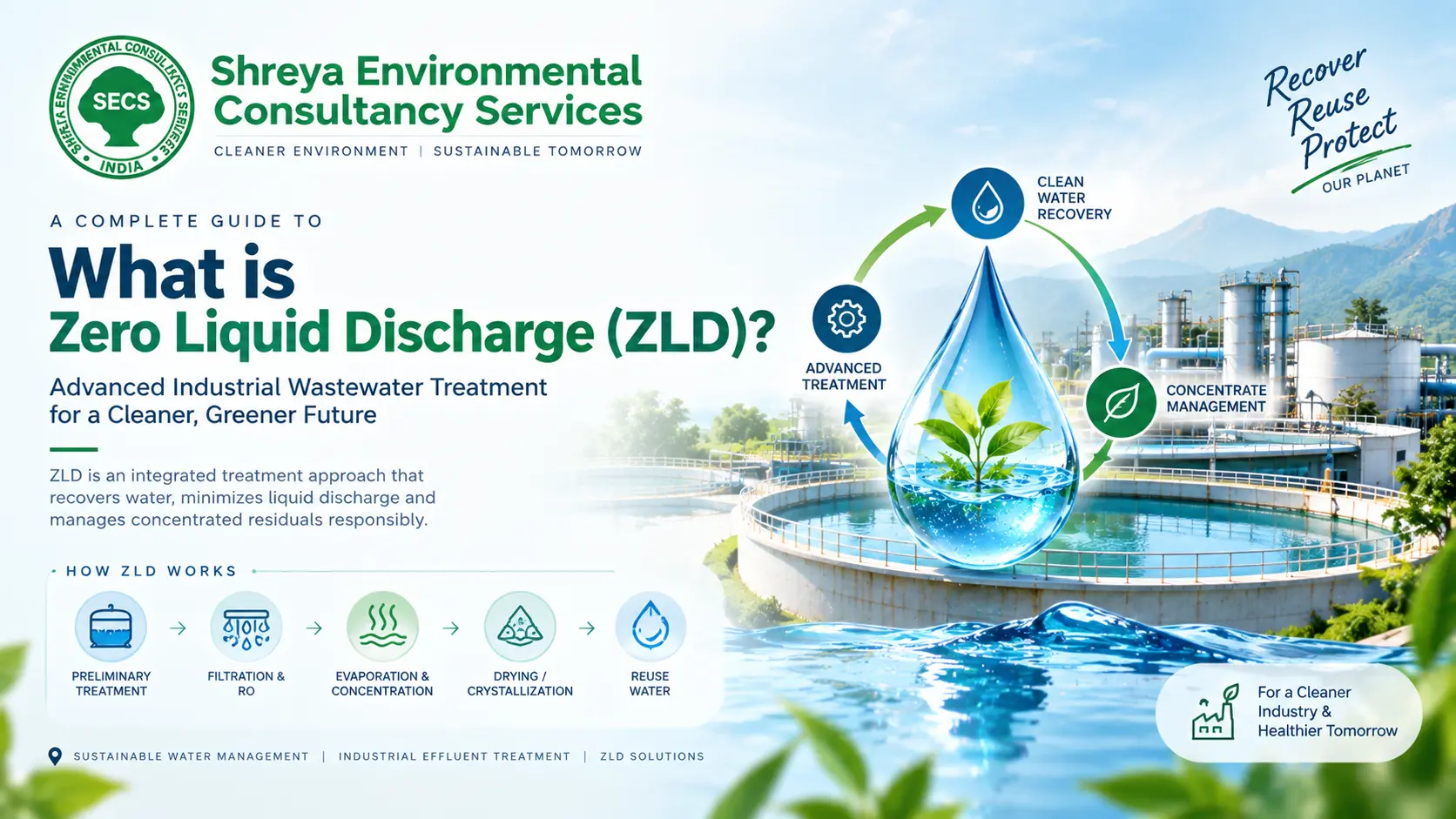
Zero Liquid Discharge (ZLD) is an advanced industrial wastewater treatment and water-recovery approach designed to recover water from wastewater while minimizing or eliminating liquid effluent leaving the treatment system. Instead of treating wastewater only for discharge, a ZLD system is designed around water recovery, reuse and controlled management of the remaining concentrated solids or residual streams.
A ZLD system is not a single piece of equipment. It is normally an integrated treatment train that may combine conventional wastewater treatment, filtration, reverse osmosis (RO), evaporation, concentration, drying and, where required, crystallization or other residual-management technologies.
For industries in Baddi, Himachal Pradesh, and other industrial regions across India, understanding how ZLD works can help businesses evaluate whether advanced wastewater recovery and concentrate management are appropriate for their particular wastewater characteristics and water-reuse objectives.
What Is Zero Liquid Discharge?
Zero Liquid Discharge refers to a wastewater management approach in which treated water is recovered and reused while the remaining wastewater is progressively concentrated so that no, or very little, liquid effluent requires external discharge from the ZLD process.
The exact configuration of a ZLD plant varies from one industry to another. A pharmaceutical manufacturing facility, textile unit, chemical plant and food-processing facility can all produce wastewater with very different compositions. As a result, there is no single ZLD process that is suitable for every application.
Depending on the wastewater, a ZLD treatment system may include an Effluent Treatment Plant (ETP), tertiary treatment, filtration, reverse osmosis, evaporation, multiple-effect evaporation, mechanical vapour recompression, drying or crystallization.
The basic principle is straightforward: recover as much suitable water as practical and progressively concentrate the remaining contaminants for controlled management.
Why Is ZLD Important for Industrial Wastewater Treatment?
Traditional wastewater treatment generally focuses on reducing pollutants to a level suitable for the intended discharge or reuse route. ZLD takes the water-management objective further by attempting to recover a greater proportion of usable water and manage the remaining concentrated material without relying on a conventional liquid discharge route.
This can be particularly relevant where industries face challenges associated with high-TDS wastewater, limited discharge options, water scarcity, strict site-specific requirements or the need to recycle treated water within the manufacturing process.
However, ZLD should not automatically be considered necessary for every industrial facility. The suitability of ZLD depends on factors such as wastewater composition, flow rate, treatment objectives, water-reuse requirements, available utilities, site conditions, regulatory requirements and overall project economics.
In India, the Central Pollution Control Board describes ZLD in terms of recycling or reusing industrial effluent and converting dissolved substances into a residual solid form through processes such as concentration, evaporation and drying. CPCB also recognizes that ZLD may not be technically or economically feasible in every situation.
How Does a ZLD System Work?
A ZLD system generally works by treating wastewater in stages. Each stage prepares the water for the next treatment process while reducing the volume of the remaining concentrated stream.
A simplified ZLD treatment sequence can be represented as:
- Industrial wastewater collection
- Equalization and preliminary treatment
- Physical, chemical and/or biological treatment
- Tertiary filtration and polishing
- Reverse osmosis or other membrane treatment
- Permeate recovery and reuse
- Concentrate or RO reject treatment
- Evaporation and further concentration where required
- Drying or crystallization of the final concentrated stream where required
- Controlled management of the resulting solids or residual material
The actual process flow depends on the characteristics of the wastewater and the required quality of recovered water.
1. Wastewater Collection and Equalization
Industrial wastewater can vary considerably throughout the day depending on production schedules, cleaning operations and process conditions. An equalization system can help balance variations in flow and wastewater characteristics before the main treatment stages.
Equalization can provide a more consistent feed to downstream treatment equipment, helping the overall system operate more predictably.
2. Primary and Physico-Chemical Treatment
Depending on the wastewater, primary treatment may involve screening, oil and grease removal, pH correction, coagulation, flocculation and clarification.
The purpose is to remove or reduce suspended solids, oils, precipitable contaminants and other substances that could interfere with subsequent treatment stages.
For wastewater containing specific contaminants, chemical treatment may also be used to improve the quality of the water before biological or membrane treatment.
3. Biological Treatment
Where biodegradable organic matter is present, biological treatment may form part of the overall wastewater treatment train.
Biological processes are commonly used to reduce biodegradable organic loading before advanced treatment. The exact biological process depends on the wastewater characteristics, required treatment performance and overall plant design.
This is one reason why ZLD should be considered an integrated wastewater treatment strategy rather than simply an evaporator-based system.
4. Tertiary Treatment and Filtration
After primary and secondary treatment, additional filtration or polishing may be required before membrane or thermal treatment.
Depending on the application, this can include pressure sand filtration, activated carbon filtration, cartridge or micron filtration, ultrafiltration or other suitable polishing technologies.
Effective pretreatment can help protect downstream membranes and equipment and can contribute to more stable operation of the complete treatment system.
5. Reverse Osmosis in ZLD
Reverse Osmosis (RO) is frequently used in industrial water-recovery systems because it can separate a substantial portion of dissolved salts and other contaminants from treated wastewater.
In a typical RO system, the feed water is separated into a relatively lower-salt permeate stream and a more concentrated reject stream.
The permeate may be suitable for selected reuse applications depending on its quality and the requirements of the receiving process. The reject contains a higher concentration of dissolved substances and may require additional treatment.
This is where the connection between ETP, RO and ZLD becomes important. An ETP can reduce the contaminant load, RO can recover water and concentrate dissolved substances, and downstream concentration technologies can further process the reject when required.
Industries looking for membrane-based water treatment can also explore Shreya Environmental's Reverse Osmosis solutions as part of a broader industrial water-treatment strategy.
6. Evaporation and Concentration
When a concentrated wastewater stream cannot be economically or technically treated further using membrane processes alone, thermal concentration may be considered.
Evaporation removes water from the concentrated stream by converting it into vapour. When that vapour is recovered and condensed, it can produce a relatively clean water stream, while the remaining liquid becomes progressively more concentrated.
Multiple Effect Evaporators (MEE) are one type of evaporation technology used in suitable industrial applications. The selection of an evaporator depends on factors such as wastewater composition, evaporation load, scaling potential, available energy and required operating conditions.
7. MVR and Energy-Efficient Evaporation
Mechanical Vapour Recompression (MVR) is another technology that may be incorporated into suitable evaporation systems.
MVR works by compressing vapour generated during evaporation and reusing its thermal energy within the process. This can reduce the requirement for external heating energy in appropriate applications.
However, MVR is not automatically the correct choice for every ZLD project. Its suitability depends on factors such as feed characteristics, evaporation duty, operating conditions, utility availability, equipment configuration and project economics.
8. Final Concentration, Drying and Crystallization
As wastewater becomes increasingly concentrated, the remaining stream may eventually require additional drying or crystallization.
An Agitated Thin Film Dryer (ATFD) may be used in suitable applications to further concentrate or dry a concentrated liquid or slurry stream. Depending on the wastewater chemistry and process design, crystallization can also be used to convert dissolved substances into solid crystals.
The final residual material still needs appropriate handling, storage, recovery or disposal according to its characteristics and applicable requirements.
EPA technical documentation describes crystallization as a process capable of separating water from highly concentrated wastewater while forming solid salt crystals, illustrating why evaporation and crystallization can form the final stages of some ZLD configurations.
What Are the Main Components of a ZLD Plant?
A ZLD plant can contain several different treatment units depending on the wastewater and project objectives. Common components may include:
- Collection and equalization systems
- pH correction and chemical dosing systems
- Clarification and physico-chemical treatment
- Biological treatment where required
- Pressure filtration and polishing systems
- Ultrafiltration or other membrane pretreatment where appropriate
- Reverse osmosis systems
- RO reject collection and concentration systems
- Multiple Effect Evaporators
- Mechanical Vapour Recompression systems where suitable
- Agitated Thin Film Dryers
- Crystallization systems where required
- Condensate collection and reuse systems
- Instrumentation and process-control systems
- Residual solids handling and storage arrangements
Not every ZLD plant needs all of these components. A properly engineered system should contain only the treatment stages required for the particular wastewater and intended treatment outcome.
What Is the Difference Between ZLD and an ETP?
An Effluent Treatment Plant (ETP) and a Zero Liquid Discharge system are related but they do not necessarily have the same objective.
An ETP is primarily designed to treat industrial effluent by reducing pollutants and improving wastewater quality for the intended discharge, reuse or downstream treatment route.
ZLD goes further by incorporating additional water-recovery and concentrate-management stages intended to minimize or eliminate liquid effluent leaving the system.
In many industrial applications, an ETP can actually be an important part of a ZLD system rather than an alternative to it.
A simplified relationship can be understood as:
- ETP: Reduces pollutants and treats industrial effluent.
- RO: Recovers water and concentrates dissolved substances.
- MEE/MVR: Further concentrates suitable high-TDS or reject streams.
- ATFD/Crystallization: Can handle highly concentrated residual streams in suitable applications.
- ZLD: Integrates appropriate treatment and recovery stages into an overall water-recovery and residual-management strategy.
Industries can explore Shreya Environmental's Effluent Treatment Plant solutions when evaluating the treatment stages that may form part of an industrial wastewater management system.
What Are the Benefits of a ZLD System?
The potential benefits of ZLD depend on the industry, wastewater characteristics and system design. Some of the main objectives and advantages include the following.
Higher Water Recovery and Reuse
One of the primary reasons industries consider ZLD is to recover treated water for suitable reuse applications.
Depending on the final water quality, recovered water may be considered for applications such as cooling, washing, utilities or selected process requirements. The suitability of reuse should always be determined through water-quality assessment and the requirements of the receiving process.
Reduced Liquid Effluent Discharge
A ZLD system is designed to minimize or eliminate the liquid effluent leaving the treatment system by progressively recovering water and concentrating the remaining material.
This can be useful where liquid discharge options are limited or where an industry has a specific requirement for extensive wastewater recycling.
Management of High-TDS Streams
High-TDS wastewater and concentrated RO reject can present challenges for conventional wastewater treatment. ZLD provides additional concentration and residual-management stages for suitable high-salinity streams.
Improved Industrial Water Management
ZLD encourages industries to look at wastewater as part of an overall water balance rather than treating it only as a waste stream.
By recovering water and controlling the remaining concentrated material, an industrial facility can potentially improve the efficiency of its water-management strategy.
Support for Water Conservation
Where recovered water can be safely reused, a ZLD system may reduce the facility's requirement for fresh water for suitable applications. The actual reduction depends on the site's water balance, treatment performance, production process and available reuse opportunities.
Where Is ZLD Used?
ZLD can be considered across a wide range of industries where wastewater characteristics and water-management requirements justify advanced recovery and concentrate treatment.
Potential applications include:
- Pharmaceutical manufacturing
- Chemical manufacturing
- Textile and dyeing industries
- Food and beverage processing
- Specialty chemical manufacturing
- Power generation
- Metal and surface-treatment industries
- Other industrial facilities generating concentrated wastewater streams
However, the treatment requirements can differ substantially between these industries. A pharmaceutical wastewater stream may have different organic and chemical characteristics from textile wastewater, while a chemical manufacturing facility may generate highly variable process streams.
Therefore, an industry should not select a ZLD configuration simply because a similar industry uses a particular technology. The process should be developed around the actual wastewater.
ZLD for Pharmaceutical and Chemical Industries
Pharmaceutical and chemical manufacturing can produce complex wastewater streams containing combinations of organic matter, dissolved salts, process chemicals and other contaminants.
For these industries, the treatment train may need to combine several processes before the water reaches advanced membrane or thermal treatment.
A possible configuration may include ETP treatment, filtration, RO, evaporation and final concentrate management, but the exact arrangement depends on the wastewater analysis and treatment objectives.
For pharmaceutical wastewater in particular, wastewater characterization and appropriate pretreatment are important because the composition of wastewater can vary significantly depending on the products and manufacturing processes involved.
Shreya Environmental Consultancy Services provides water and wastewater treatment solutions for industrial applications where treatment requirements need to be evaluated according to the specific process and wastewater characteristics.
Why ZLD Is Relevant for Industries in Baddi, Himachal Pradesh
Baddi, Himachal Pradesh, is part of an important industrial region with manufacturing activities across sectors such as pharmaceuticals, chemicals, food processing and other industries.
Because different manufacturing processes generate different wastewater streams, industrial wastewater management in the Baddi region requires solutions based on the actual characteristics of each facility.
For some facilities, conventional wastewater treatment may meet the required treatment objective. For others, water reuse, high-TDS reject management or specific discharge conditions may justify evaluating a more advanced treatment approach such as ZLD.
A ZLD plant in Baddi should therefore be considered as part of the facility's overall water balance and wastewater-management strategy rather than as an isolated piece of equipment.
The same principle applies to industrial facilities across India. Shreya Environmental Consultancy Services can evaluate wastewater treatment requirements based on the industry's process, wastewater characteristics, recovery objectives and project conditions.
How Is a ZLD Plant Designed?
There is no universal ZLD plant design that can be applied to every industry. The treatment configuration should be developed after understanding the wastewater and the intended reuse or discharge strategy.
Important design considerations can include:
- Daily wastewater generation and flow variation
- pH and conductivity
- TDS and individual dissolved salts
- COD, BOD and suspended solids
- Hardness, silica, chloride and sulphate where relevant
- Specific process chemicals and contaminants
- RO feed-water quality
- Expected RO recovery and reject characteristics
- Required recovered-water quality
- Potential water-reuse applications
- Evaporation and concentration requirements
- Energy and utility availability
- Available installation space
- Automation and monitoring requirements
- Final management of concentrated residue
Two facilities with similar wastewater flow rates can still require very different ZLD systems if their wastewater chemistry is different.
Why Wastewater Testing Should Come Before ZLD Selection
One of the most important steps before selecting a ZLD system is understanding the wastewater that the system will actually receive.
Laboratory testing can help identify parameters such as pH, TDS, conductivity, COD, BOD, TSS, hardness, chloride, sulphate, silica and other contaminants relevant to the particular industry.
This information helps engineers determine which pretreatment stages are required, whether membrane processes are appropriate, how the concentrate may behave during evaporation and what type of final residual management may be necessary.
It can also prevent industries from investing in unnecessary treatment equipment or selecting a technology that is poorly suited to the wastewater.
A good ZLD project starts with wastewater characterization, not with equipment selection.
Is ZLD Required for Every Industry?
No. ZLD should not be treated as a universal requirement for every industrial wastewater application.
The need for ZLD can depend on applicable environmental requirements, site-specific conditions, water availability, discharge options, wastewater characteristics, reuse objectives, technical feasibility and project economics.
CPCB guidance recognizes that adopting ZLD may not be feasible in every case because of technical and economic considerations. Therefore, industries should evaluate the requirement based on their particular situation rather than assuming that the same treatment configuration applies everywhere.
Where ZLD is being considered, a detailed wastewater assessment and process evaluation can help determine whether it is technically appropriate and how the system should be configured.
Operation and Maintenance of a ZLD Plant
A ZLD plant requires more than installation. Consistent operation and maintenance are important because the system can contain multiple interconnected treatment stages.
Membranes require monitoring and appropriate cleaning. Pumps and mechanical equipment need regular inspection. Evaporators may require monitoring for scaling and changes in operating conditions. Instruments and control systems also need proper calibration and maintenance.
Changes in production processes can also change wastewater characteristics. For this reason, industrial facilities should monitor the treatment system and investigate significant changes in flow, TDS, COD, scaling behaviour or other relevant parameters.
For facilities requiring continuing technical support, Shreya Environmental Consultancy Services also provides operation and maintenance services for industrial treatment systems.
Can ZLD Water Be Reused?
One of the main objectives of a ZLD system is to recover water that can potentially be reused within the facility.
The actual reuse application depends on the quality of the recovered water and the requirements of the receiving process. Water may potentially be reused for selected utility, cooling, washing or process applications when the relevant quality requirements are met.
It is important to remember that water recovery does not automatically mean that the recovered water is suitable for every application. Each reuse point should be evaluated according to its water-quality requirements.
Is ZLD an Expensive Treatment System?
ZLD systems can involve more treatment stages and equipment than conventional wastewater treatment, particularly when thermal concentration, evaporation or crystallization is required.
However, the overall cost cannot be determined from the term "ZLD" alone. Project cost depends on wastewater flow, contaminant concentration, treatment configuration, recovery target, energy requirements, equipment selection, materials of construction, automation, civil requirements, installation and operating conditions.
This is why comparing ZLD plants only on equipment price can be misleading. A technically appropriate system should be evaluated based on its complete process design and long-term operating requirements.
Can ZLD Be Used With an Existing ETP?
Yes, depending on the condition and performance of the existing treatment system, ZLD can potentially be integrated with an existing ETP.
The existing ETP may provide primary, secondary or tertiary treatment, after which additional membrane and concentration stages can be introduced to recover water and manage concentrated streams.
However, an existing ETP should be evaluated before integration. Its hydraulic capacity, treated-water quality, process stability and ability to provide suitable feed for downstream RO or other advanced treatment stages all need to be considered.
For industries reviewing their existing wastewater infrastructure, Shreya Environmental can also provide ETP and STP technology solutions as part of a broader treatment-system evaluation.
Why Professional ZLD Process Design Matters
A ZLD plant combines several treatment processes, and the performance of one stage can affect the operation of the next stage.
Poor pretreatment can increase membrane fouling. Incorrect chemical dosing can contribute to scaling or unstable operation. Inappropriate evaporation conditions can affect energy consumption and equipment performance. Inadequate residual management can create operational and storage challenges.
For this reason, ZLD should be designed as a complete process rather than as a collection of individually selected machines.
Professional process design considers wastewater chemistry, hydraulic loading, membrane protection, scaling potential, energy requirements, recovered-water quality, automation and the final management of concentrated material.
Turnkey ZLD and Wastewater Treatment Projects
For industries planning a new wastewater treatment project, turnkey execution can bring process engineering, equipment supply, installation, commissioning and related project activities together under a coordinated approach.
Where a complete project requires multiple treatment stages, a turnkey approach can help maintain better coordination between the different parts of the treatment system.
Shreya Environmental Consultancy Services provides turnkey project execution for industrial water and wastewater treatment requirements. Environmental planning and related technical support can also be considered through environmental consultancy services.
Frequently Asked Questions About Zero Liquid Discharge
What does Zero Liquid Discharge mean?
Zero Liquid Discharge (ZLD) is an industrial wastewater management approach designed to recover and reuse treated water while minimizing or eliminating liquid effluent discharge from the treatment system. The remaining dissolved substances are progressively concentrated and managed as a residual stream.
Is ZLD a single treatment technology?
No. ZLD is an integrated treatment strategy rather than a single machine. Depending on the application, a ZLD system may combine ETP treatment, filtration, RO, evaporation, MEE, MVR, ATFD, crystallization and other supporting processes.
What is the main purpose of a ZLD plant?
The main objectives are to recover water for suitable reuse and manage the remaining concentrated wastewater without relying on a conventional liquid discharge route. The exact objectives and configuration depend on the industrial application.
What is the role of RO in a ZLD plant?
RO can recover a portion of treated wastewater as permeate while concentrating dissolved salts and other contaminants into a reject stream. The reject can then be treated further through suitable concentration or thermal processes when required.
What is MEE in ZLD?
MEE stands for Multiple Effect Evaporator. It is a thermal concentration technology that can remove water from suitable concentrated wastewater streams and produce a more concentrated residual stream.
What is MVR in a ZLD system?
MVR stands for Mechanical Vapour Recompression. It can improve the energy efficiency of suitable evaporation processes by compressing and reusing vapour generated during evaporation.
What is ATFD used for in ZLD?
ATFD stands for Agitated Thin Film Dryer. In suitable ZLD applications, it can be used to further concentrate or dry concentrated liquid or slurry streams and produce a more manageable residual material.
Can an existing ETP be converted into a ZLD system?
An existing ETP may potentially be integrated with additional ZLD treatment stages, depending on its capacity, treated-water quality, process stability and the characteristics of the wastewater. A technical assessment should be completed before deciding on the required modifications.
Is ZLD suitable for every industry?
No. ZLD suitability depends on wastewater characteristics, applicable requirements, water-reuse objectives, discharge options, technical feasibility, energy availability and project economics. The treatment approach should be evaluated for each individual facility.
How is a ZLD plant selected for an industrial facility?
A ZLD plant should be selected after evaluating wastewater flow, TDS, COD, BOD, TSS, dissolved salts, scaling potential, required recovered-water quality, reuse objectives, energy availability, space and final residual-management requirements.
Can ZLD help industries reuse wastewater?
Yes. Water recovery and reuse are central objectives of many ZLD systems. The recovered water may be suitable for selected industrial applications depending on its quality and the requirements of the intended reuse point.
Conclusion
Zero Liquid Discharge (ZLD) is an advanced industrial wastewater treatment and water-recovery approach designed to recover suitable water while minimizing or eliminating liquid effluent discharge from the treatment system.
A ZLD plant is not simply an evaporator or a single piece of equipment. It is an integrated process that can combine ETP treatment, filtration, reverse osmosis, evaporation, MEE, MVR, ATFD and crystallization depending on the characteristics of the wastewater and the project's treatment objectives.
For industries in Baddi, Himachal Pradesh, as well as manufacturing facilities across India, the right ZLD solution should be developed around actual wastewater conditions rather than a standard configuration. Wastewater characterization, process evaluation, water-reuse requirements, energy availability and residual management all play important roles in the final design.
Shreya Environmental Consultancy Services provides industrial water and wastewater treatment solutions for different applications, including ETP, RO, wastewater treatment and ZLD-related systems. The appropriate treatment approach can be evaluated according to the industry's wastewater characteristics and project requirements.
If your industry is evaluating a ZLD plant in Baddi, Himachal Pradesh, the right starting point is a detailed assessment of wastewater generation, composition, treatment objectives and potential water-reuse applications.
Explore Shreya Environmental's Zero Liquid Discharge solutions for industrial wastewater treatment and water recovery.