
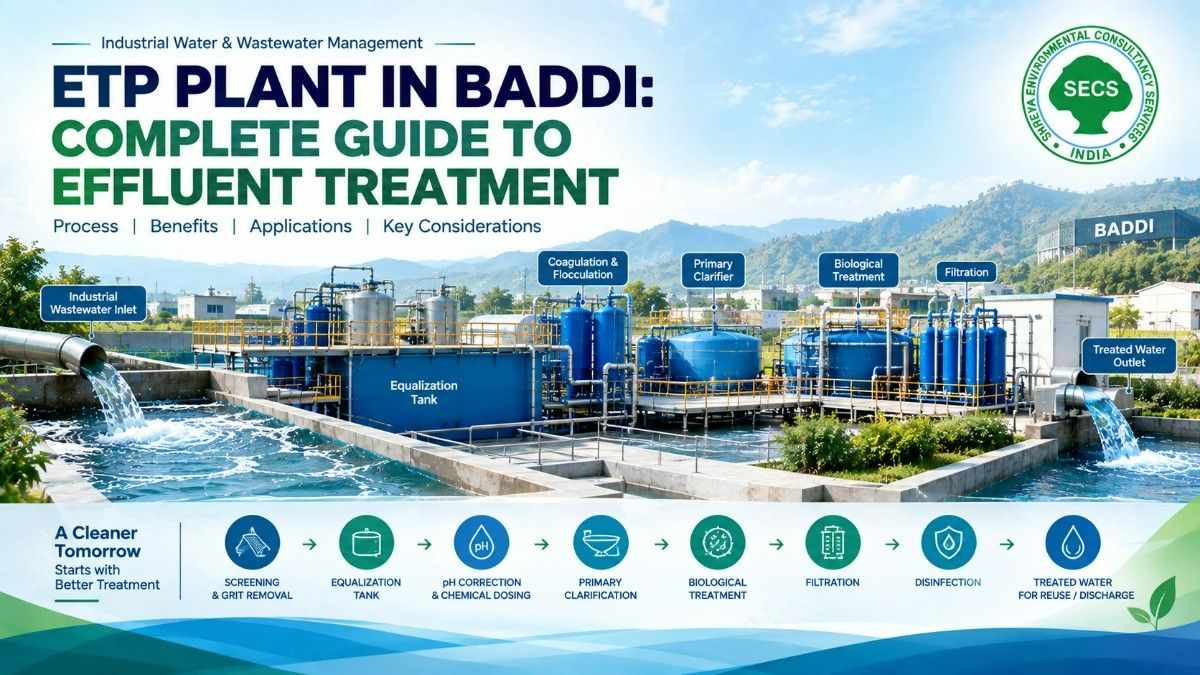
ETP Plant in Baddi: Complete Guide to Effluent Treatment
Industrial manufacturing processes generate wastewater in different forms. Cleaning, production, processing, washing, utilities and other industrial activities can produce effluent containing suspended solids, organic matter, dissolved substances, chemicals, oils and other contaminants. Because industrial wastewater varies significantly from one industry to another, it requires a treatment approach based on its actual characteristics and the intended treatment objective.
For industries operating in Baddi, Himachal Pradesh, proper wastewater management is an important part of responsible industrial operations. An appropriately designed ETP Plant in Baddi can help industries collect, treat and manage industrial effluent through a combination of physical, chemical, biological and, where required, advanced treatment processes.
An Effluent Treatment Plant (ETP) is not simply a collection of tanks, pumps and treatment equipment. It is an integrated wastewater treatment system designed around the industry's wastewater flow, pollutant characteristics, production process, water-reuse objectives and required treated-water quality.
In this complete guide, we will explain what an ETP plant is, why industries need it, how an ETP works, the major treatment stages, important design considerations, applications across different industries, common ETP problems, operation and maintenance requirements, and how ETP systems can be integrated with technologies such as RO and ZLD where required.
What Is an ETP Plant?
ETP stands for Effluent Treatment Plant. It is a wastewater treatment system specifically designed to treat effluent generated from industrial and manufacturing processes.
Unlike domestic sewage, industrial wastewater can have highly variable characteristics. A pharmaceutical manufacturing facility may generate wastewater containing different pollutants from a chemical plant, food-processing unit, textile facility or engineering industry.
For this reason, there is no single ETP configuration that is suitable for every industrial application.
Depending on the wastewater characteristics and treatment requirements, an ETP may include processes such as screening, equalization, pH correction, coagulation, flocculation, clarification, biological treatment, filtration, disinfection, membrane treatment and sludge management.
The objective is to progressively remove or reduce contaminants so that the treated water reaches the quality required for its intended discharge, reuse or further treatment.
Why Do Industries Need an Effluent Treatment Plant?
Industrial wastewater can contain pollutants that should not be released without appropriate treatment. The type and concentration of these pollutants depend on the manufacturing process, raw materials, chemicals, cleaning activities and production conditions.
An ETP provides industries with a structured system for managing this wastewater rather than allowing different wastewater streams to remain uncontrolled.
A properly planned ETP can help industries with:
- Industrial wastewater treatment
- Reduction of suspended solids and organic pollutants
- Control of wastewater pH
- Reduction of BOD and COD where applicable
- Management of oils, grease and other process contaminants
- Improvement of treated-water quality
- Water recovery and reuse opportunities
- Controlled sludge generation and management
- Integration with advanced treatment systems such as RO or ZLD
The actual performance and treatment capability of an ETP depend on its design, wastewater characteristics, operating conditions, treatment technology and maintenance.
Why ETP Is Important for Industries in Baddi
Baddi is a major industrial region in Himachal Pradesh with manufacturing activity across several sectors. Industrial facilities can generate wastewater from production processes, equipment cleaning, utility operations, floor washing, raw-material handling and other activities.
This makes proper wastewater treatment an important consideration for industries looking to manage their effluent in a controlled and responsible manner.
For an industry planning an ETP Plant in Baddi, the first step should not simply be selecting a plant capacity or purchasing treatment equipment. The wastewater itself needs to be understood first.
Important questions include:
- How much wastewater is generated every day?
- What is the peak wastewater flow?
- What processes generate the wastewater?
- What contaminants are present?
- How does wastewater quality change during production?
- What quality of treated water is required?
- Will the treated water be discharged, reused or sent for additional treatment?
- Is RO required after ETP?
- Is ZLD required for the overall wastewater management strategy?
Answering these questions helps in developing a treatment system that is suited to the actual industrial application.
How Does an ETP Plant Work?
An ETP normally works through a series of treatment stages, with each stage performing a particular function.
A simplified treatment sequence can be represented as:
Industrial Effluent → Screening → Equalization → pH Correction → Primary Treatment → Biological Treatment → Clarification → Tertiary Treatment → Treated Water
However, this is only a general representation. The actual treatment train can be different depending on the industry and wastewater characteristics.
Some industrial wastewater may require extensive chemical treatment before biological treatment. Other wastewater streams may require advanced filtration, RO, evaporation or other technologies after conventional ETP treatment.
This is why an ETP should be designed around the wastewater rather than treating the ETP as a standard package that can be applied identically to every industry.
1. Industrial Effluent Collection
The first stage of an ETP is the collection of wastewater generated by different industrial processes.
Wastewater may originate from manufacturing operations, process areas, equipment cleaning, floor washing, utility systems and other activities. Depending on the facility, different wastewater streams may be collected separately or combined before treatment.
Understanding the source of each wastewater stream can be important because different streams may have significantly different characteristics.
For example, a concentrated process stream may need different handling from a relatively dilute washing stream. Separating incompatible wastewater streams at the source can sometimes make treatment more manageable and improve overall process control.
2. Screening and Removal of Coarse Solids
Screening is generally used to remove larger physical materials from the incoming wastewater.
Industrial wastewater can contain plastics, fibres, packaging materials, process debris and other coarse solids. Removing these materials at the beginning of the treatment process helps protect downstream pumps, pipelines, mixers and treatment equipment.
The type and size of screening equipment depend on the nature of the wastewater and the solids expected from the industrial process.
3. Equalization of Industrial Wastewater
Industrial wastewater is not always generated at a constant rate or with a consistent composition.
Production schedules, batch operations, cleaning activities and changes in raw materials can cause significant variations in both wastewater flow and pollutant concentration.
An equalization tank helps balance these variations before the wastewater enters subsequent treatment stages.
Equalization can provide a more consistent feed to downstream treatment processes and reduce the impact of sudden changes in wastewater loading.
Mixing or aeration may also be incorporated into the equalization stage depending on the wastewater characteristics and overall treatment design.
4. pH Correction and Chemical Treatment
The pH of industrial wastewater can vary considerably depending on the manufacturing process and chemicals used at the facility.
pH correction is therefore an important stage in many ETP systems. Chemical dosing may be used to adjust the wastewater to a suitable range for subsequent treatment processes.
Stable pH conditions can be particularly important when biological treatment follows chemical treatment because microorganisms involved in biological processes can be affected by significant changes in operating conditions.
Chemical treatment can also be used for specific wastewater characteristics where coagulation, precipitation or other chemical processes are required.
5. Coagulation and Flocculation
Some industrial wastewater contains fine suspended particles that do not settle easily on their own.
Coagulation and flocculation can help bring these small particles together into larger aggregates called flocs, which can then be separated more effectively.
The appropriate chemicals and dosing conditions depend on the wastewater characteristics. Jar testing and other laboratory evaluations can help determine suitable chemical conditions for a particular wastewater stream.
Proper chemical dosing is important because insufficient dosing may result in poor treatment, while excessive dosing can increase chemical consumption and sludge generation.
6. Primary Clarification
After suitable chemical treatment, the wastewater may enter a clarification stage where suspended solids and generated flocs are separated from the liquid.
The separated solids become part of the sludge stream and require appropriate collection and management.
Primary clarification can reduce the solids load entering subsequent treatment stages and can improve the overall stability of the downstream treatment process.
7. Biological Treatment
Biological treatment is an important part of many industrial ETP systems where biodegradable organic matter needs to be reduced.
Biological treatment uses microorganisms under controlled conditions to break down biodegradable pollutants present in the wastewater.
The exact biological process depends on the wastewater characteristics, organic loading, treatment objectives, available space and operating requirements.
Depending on the selected system, important operating parameters can include dissolved oxygen, biomass concentration, pH, nutrient availability, loading conditions and sludge characteristics.
Biological treatment needs consistent operation. Sudden changes in wastewater composition, toxic substances, excessive loading or poor operating conditions can affect biological performance.
8. Secondary Clarification
Following biological treatment, the wastewater can contain biological solids that need to be separated from the treated water.
A secondary clarifier provides a controlled environment for these solids to settle.
Part of the settled biological sludge may be returned to the biological treatment process depending on the system configuration, while excess sludge is removed for further treatment and management.
Good settling performance is important because excessive sludge carryover can increase suspended solids in the treated water and affect downstream treatment stages.
9. Tertiary Treatment and Polishing
After primary and biological treatment, additional treatment may be required depending on the final water-quality objective.
Tertiary treatment can include processes such as:
- Pressure sand filtration
- Activated carbon filtration
- Fine filtration
- Disinfection
- Membrane treatment
- Other polishing processes
The selection depends on what contaminants remain after secondary treatment and what quality is required for discharge or reuse.
Where dissolved salts and other dissolved constituents need significant reduction, reverse osmosis systems may be integrated after suitable pretreatment.
Important Components of an ETP Plant
An ETP may contain different tanks, equipment and control systems depending on the selected treatment process.
Common components can include:
- Bar screens and screening systems
- Collection tanks
- Equalization tanks
- pH correction systems
- Chemical dosing systems
- Coagulation and flocculation units
- Primary clarifiers
- Biological treatment reactors
- Secondary clarifiers
- Filter systems
- Disinfection systems
- Sludge collection and dewatering systems
- Pumps and pipelines
- Blowers and aeration systems
- Instrumentation and control systems
Not every ETP requires every component listed above. The equipment should be selected according to the actual treatment process and wastewater characteristics.
What Parameters Are Considered in ETP Design?
Designing an ETP Plant in Baddi requires consideration of both wastewater quantity and wastewater quality.
Important parameters may include:
- Flow rate: The amount of wastewater generated over a specific period.
- pH: Indicates whether the wastewater is acidic or alkaline.
- BOD: Represents biodegradable organic loading.
- COD: Indicates the oxygen demand associated with oxidizable substances.
- TSS: Represents suspended solids present in wastewater.
- TDS: Represents dissolved substances and salts.
- Oil and grease: Important for industries generating oily wastewater.
- Temperature: Can affect chemical and biological treatment.
- Industry-specific contaminants: Certain industries may generate specific pollutants requiring specialized treatment.
Laboratory analysis of representative wastewater samples can help establish the treatment requirements and determine an appropriate process configuration.
Why Wastewater Testing Is Important Before ETP Design
One of the most important steps before designing an industrial wastewater treatment plant is understanding the wastewater itself.
Two factories may have the same wastewater flow but require completely different treatment systems because their wastewater compositions are different.
For example, one industrial facility may generate wastewater with a high biodegradable organic load, while another may generate wastewater with high dissolved solids and relatively low biodegradability.
These wastewater streams cannot necessarily be treated using the same process configuration.
Wastewater characterization therefore helps in identifying the treatment processes required and can also help avoid unnecessary treatment stages that do not contribute meaningfully to the desired treatment outcome.
ETP Plant Capacity: How Is It Determined?
ETP capacity is generally related to the quantity of wastewater generated by an industry, but simply using average daily flow is not always sufficient.
Capacity planning should consider:
- Average daily wastewater generation
- Peak flow
- Production schedules
- Batch manufacturing
- Cleaning operations
- Seasonal variations where applicable
- Future production expansion
- Equalization requirements
Understanding these factors can help in developing an ETP system that can handle actual operating conditions rather than only an ideal average flow.
ETP for Pharmaceutical Industries
Pharmaceutical manufacturing can generate wastewater with varying organic loads, dissolved substances, chemicals and process-specific contaminants.
The wastewater characteristics can depend on the products being manufactured, raw materials, production processes, cleaning operations and other facility-specific factors.
An ETP for a pharmaceutical industry therefore needs to be designed after understanding the actual wastewater profile.
Depending on the wastewater, the treatment system may involve physical, chemical, biological and advanced treatment stages.
Where higher water recovery is required, the ETP may also be integrated with RO treatment and, where appropriate, a Zero Liquid Discharge system.
ETP for Chemical Industries
Chemical manufacturing facilities can generate wastewater with varying pH, dissolved substances, organic compounds and other process-specific contaminants.
The complexity of the wastewater means that treatment cannot be selected based solely on the industry's name. The specific chemicals and processes involved need to be understood.
Chemical treatment, biological treatment, filtration, membrane processes and other technologies may be combined depending on the wastewater analysis and required treatment performance.
ETP for Food Processing Industries
Food-processing wastewater can contain biodegradable organic matter, suspended solids, fats, oils and grease.
Because organic loading can be significant, biological treatment can form an important part of the treatment process in suitable applications.
Screening, equalization, primary treatment, biological treatment, clarification and tertiary treatment may be incorporated depending on the wastewater characteristics.
ETP for Textile Industries
Textile and dyeing processes can generate wastewater containing colour, suspended solids, organic matter, dissolved substances and chemicals associated with the manufacturing process.
The treatment strategy may therefore involve a combination of chemical, biological and physical processes.
Where water recovery is an important objective, additional treatment technologies can be integrated with the ETP depending on the overall water balance.
ETP for Other Manufacturing Industries
ETP systems are also relevant to many other industrial applications, including engineering, manufacturing, packaging, processing and other facilities that generate industrial effluent.
The treatment process should always be selected according to the actual wastewater rather than assuming that a generic ETP design will provide the same results for every facility.
ETP vs STP: What Is the Difference?
ETP and STP are both wastewater treatment systems, but they are designed for different wastewater sources.
An ETP is primarily designed for industrial effluent generated by manufacturing and industrial processes.
An STP, or Sewage Treatment Plant, is primarily designed to treat domestic sewage generated from toilets, bathrooms, kitchens and other domestic activities.
The treatment processes are therefore designed according to the characteristics of the respective wastewater streams.
If your facility requires treatment of domestic sewage in addition to industrial wastewater, you can explore our Sewage Treatment Plant solutions.
ETP vs ZLD: What Is the Difference?
An ETP and a ZLD system are not the same thing, although they can form part of the same overall wastewater management strategy.
An ETP primarily focuses on treating industrial effluent and reducing pollutants to the required treatment level.
Zero Liquid Discharge (ZLD) focuses more broadly on maximizing water recovery and minimizing or eliminating liquid discharge from the treatment system.
A ZLD system may include ETP treatment as an upstream stage, followed by technologies such as RO, evaporation and crystallization depending on the wastewater.
Industries dealing with high-TDS wastewater, significant RO reject or strict water-recovery objectives may evaluate whether a ZLD approach is suitable for their facility.
You can learn more about this approach through our guide to ZLD in Baddi and industrial wastewater management.
When Can RO Be Integrated With an ETP?
Reverse osmosis can be considered when the treatment objective requires significant reduction of dissolved salts and other dissolved constituents.
However, RO should not be treated as a replacement for proper ETP treatment.
RO normally requires suitable pretreatment because suspended solids, biological growth, scaling compounds and other contaminants can affect membrane performance.
For this reason, an industrial wastewater system may use ETP treatment as an upstream process before RO.
RO also produces a concentrated reject stream that needs to be managed appropriately. In applications where minimizing liquid discharge is a major objective, this reject may become part of a larger ZLD strategy.
How Does RO Reject Affect Wastewater Management?
RO separates its feed water into a permeate stream and a concentrated reject stream.
The reject contains a higher concentration of dissolved substances than the original feed. Therefore, industries planning RO for wastewater treatment should consider reject management during the initial system design.
Simply installing RO without deciding how the reject will be handled can create another wastewater-management challenge.
Depending on the project, RO reject may require further concentration, recovery or other treatment. Where appropriate, advanced systems such as ZLD can be evaluated for managing these concentrated streams.
Sludge Management in an ETP
Sludge is a normal by-product of many wastewater treatment processes.
It can be generated during primary clarification, chemical treatment, biological treatment and other solids-separation processes.
The quantity and characteristics of sludge depend on the wastewater and the treatment technologies used.
Sludge management may involve:
- Sludge collection
- Thickening where required
- Sludge conditioning
- Mechanical dewatering
- Controlled storage
- Appropriate handling and disposal
Sludge management should be considered during the design stage because it forms an important part of the overall ETP operation.
ETP Operation and Maintenance
Installing an ETP is only one part of industrial wastewater management. Consistent operation and maintenance are equally important for maintaining treatment performance over time.
Routine ETP operation can involve:
- Monitoring wastewater flow
- Checking pH
- Monitoring chemical dosing
- Checking pumps and pipelines
- Monitoring blowers and aeration systems
- Checking biological treatment conditions
- Monitoring sludge levels
- Maintaining filtration systems
- Inspecting instrumentation
- Conducting wastewater testing
- Maintaining treatment records
Regular maintenance can also help identify problems before they affect the overall treatment process.
For facilities that require ongoing technical assistance, operation and maintenance support can form part of a long-term wastewater management strategy.
Common ETP Problems Industries May Face
Even a properly designed ETP can experience performance problems if operating conditions change or maintenance is not carried out correctly.
Some common issues include:
- High treated-water COD
- High BOD after biological treatment
- Excessive suspended solids in treated water
- Poor sludge settling
- Unstable pH
- Foaming in biological systems
- Frequent filter choking
- High chemical consumption
- Unstable biological performance
- Excessive sludge generation
These problems can have different causes. For example, poor settling may be associated with biological operating conditions, hydraulic loading, sludge characteristics or other process factors.
Effective troubleshooting therefore requires examination of the actual wastewater, operating parameters and treatment system rather than changing equipment without identifying the underlying cause.
How Can ETP Performance Be Improved?
Consistent ETP performance begins with stable wastewater conditions and proper process control.
Industries can consider several practices to support better treatment performance:
- Characterize wastewater regularly.
- Maintain proper equalization.
- Control chemical dosing carefully.
- Monitor biological treatment parameters.
- Avoid sudden high-strength wastewater shocks where possible.
- Maintain pumps, blowers, mixers and other equipment.
- Monitor sludge settling and sludge levels.
- Clean filters according to operating requirements.
- Maintain instrumentation and control systems.
- Investigate changes in treated-water quality promptly.
Operational discipline can make a significant difference to the long-term stability of an ETP system.
Can Treated ETP Water Be Reused?
Depending on the treatment process and final water quality, treated ETP water may be suitable for selected non-potable applications.
Potential reuse applications can include certain utility operations, washing, cooling, gardening or other industrial uses where the treated water meets the required quality.
However, treated wastewater should not automatically be considered suitable for every application.
The required water quality should first be defined according to the intended reuse. Additional treatment such as filtration, disinfection or reverse osmosis may be required where higher-quality water is needed.
ETP and Water Reuse: Moving Beyond Wastewater Disposal
Modern industrial wastewater management is increasingly focused not only on treating wastewater but also on understanding whether a portion of the treated water can be recovered and reused.
This changes the way industries look at wastewater.
Instead of treating the entire wastewater stream simply as waste, industries can evaluate where water is being consumed, where wastewater is generated and where treated water can potentially be returned to the process.
An ETP can therefore become one part of a broader industrial water-management strategy.
Where additional water recovery is required, ETP treatment can potentially be combined with RO and advanced wastewater treatment technologies according to the site's requirements.
ETP Design for Baddi Industries: Key Considerations
When planning an ETP Plant in Baddi, several factors should be evaluated before finalizing the treatment system.
These include:
- Industrial process and manufacturing activities
- Wastewater generation points
- Average and peak wastewater flow
- Wastewater characteristics
- Available land and plant layout
- Existing treatment infrastructure
- Required treated-water quality
- Water reuse opportunities
- Sludge management requirements
- Future production expansion
- Operation and maintenance requirements
- Potential integration with RO or ZLD
Considering these factors at the beginning can help prevent problems that may otherwise appear after the plant has been installed.
Why an ETP Should Be Designed for the Actual Industry
One of the most important principles of industrial wastewater treatment is that the treatment system should be based on the wastewater rather than on a generic industry label.
Even two pharmaceutical facilities can produce different wastewater because their products, raw materials, manufacturing processes and cleaning practices may differ.
Similarly, two chemical plants may have different wastewater characteristics despite operating within the same industrial sector.
Therefore, a technically appropriate ETP design should consider the actual wastewater generation and treatment requirements of the facility.
ETP Plant Installation and Project Execution
An ETP project can involve several stages beyond equipment supply.
Depending on the project scope, implementation may include wastewater assessment, process selection, engineering, equipment selection, fabrication, civil work coordination, installation, piping, electrical work, instrumentation, commissioning and operator support.
A turnkey wastewater treatment project can bring multiple stages of implementation together under a coordinated project approach.
The exact project scope depends on whether the facility is installing a completely new ETP, upgrading an existing plant, expanding capacity or integrating additional treatment technologies.
ETP Plant Upgradation and Existing System Improvement
Not every industrial facility needs to build a completely new ETP.
In some cases, an existing treatment system may have sufficient infrastructure but require process improvements, capacity expansion, equipment replacement, additional treatment stages or better operational control.
Before replacing an existing ETP, it can therefore be useful to evaluate:
- Current treatment performance
- Existing equipment condition
- Actual wastewater flow
- Changes in wastewater characteristics
- Current chemical consumption
- Sludge generation
- Existing RO or filtration systems
- Future production requirements
Based on this assessment, the facility may be able to improve the existing treatment system through targeted modifications rather than replacing every component.
ETP as Part of a Complete Water and Wastewater Solution
An ETP does not always operate as an isolated system within an industrial facility.
Depending on the site's requirements, the complete water cycle may include raw-water treatment, process-water treatment, industrial effluent treatment, sewage treatment, RO, water reuse and advanced wastewater recovery.
This is why industrial facilities may require a combination of Water Treatment Plant solutions, ETP, STP, RO and ZLD technologies.
The right combination depends on the site's water balance, wastewater characteristics and production requirements.
ETP Plant Manufacturer and Consultant in Baddi: What Should Industries Look For?
Choosing an ETP plant manufacturer or environmental engineering partner should involve more than comparing equipment prices.
Industries should consider whether the proposed treatment approach is actually suitable for their wastewater and whether the project covers the requirements that will matter after installation.
Important considerations can include:
- Understanding of the industrial process
- Wastewater characterization
- Appropriate treatment-process selection
- Equipment and process integration
- Plant layout and installation planning
- Instrumentation and monitoring
- Sludge-management planning
- Commissioning support
- Operator guidance
- Operation and maintenance support
- Ability to integrate RO or ZLD where required
The objective should be to develop a treatment system that can operate reliably under the actual conditions of the industrial facility.
ETP Solutions in Baddi and Across India
Although Baddi, Himachal Pradesh is an important industrial focus area, industrial wastewater treatment requirements are not limited to Baddi.
Industries across India can require ETP systems depending on their manufacturing processes and wastewater generation.
Shreya Environmental Consultancy Services supports industrial water and wastewater treatment requirements across India, including ETP, STP, WTP, RO, ZLD, environmental consultancy, turnkey project execution and operation and maintenance requirements.
The treatment approach is always dependent on the individual project's wastewater characteristics, capacity, site conditions and treatment objectives.
How Shreya Environmental Consultancy Services Can Help With ETP Projects
Industrial wastewater treatment requires more than selecting a treatment technology from a standard list. The system needs to be connected to the actual industrial process, wastewater characteristics, water balance and long-term operating requirements.
Shreya Environmental Consultancy Services provides environmental engineering and water and wastewater treatment solutions for industrial applications in Baddi, Himachal Pradesh and across India.
Depending on the project requirements, support can include wastewater assessment, ETP planning, treatment-system development, project execution, advanced wastewater treatment, operation and maintenance and integration with additional water-recovery technologies.
Where an industry requires broader wastewater management, an ETP can be evaluated together with RO, ZLD, WTP and other treatment systems.
Shreya's approach is focused on understanding the specific wastewater problem first and then identifying a treatment strategy suited to the facility.
For industries planning an ETP Plant in Baddi, upgrading an existing ETP or evaluating additional wastewater treatment technologies, the first step is a proper assessment of the wastewater and treatment requirements.
Contact Shreya Environmental Consultancy Services to discuss your industrial wastewater treatment requirements and explore a suitable ETP solution.
Frequently Asked Questions About ETP Plants
What is an ETP plant?
An ETP, or Effluent Treatment Plant, is a wastewater treatment system designed to treat industrial effluent generated from manufacturing and other industrial processes.
What is an ETP Plant in Baddi used for?
An ETP Plant in Baddi can be used by industries to treat wastewater generated from manufacturing, processing, cleaning, utility operations and other industrial activities. The treatment process depends on the characteristics of the wastewater.
How does an ETP plant work?
An ETP can combine physical, chemical, biological and tertiary treatment processes. A typical system may include screening, equalization, pH correction, primary treatment, biological treatment, clarification, filtration and sludge management.
What parameters are important for ETP design?
Important parameters can include wastewater flow rate, pH, BOD, COD, TSS, TDS, oil and grease, temperature and industry-specific pollutants. The required treated-water quality is also an important consideration.
Is an ETP required for every industry?
Wastewater treatment requirements depend on the industrial activity, wastewater generated, applicable requirements and intended discharge or reuse route. Industries should evaluate their specific wastewater-management requirements before selecting a treatment system.
What is the difference between ETP and STP?
ETP is primarily designed for industrial effluent, while STP is primarily designed for domestic sewage. The treatment processes are selected according to the characteristics of the respective wastewater.
Can an ETP include RO?
Yes. RO can be integrated into an industrial wastewater treatment system when reduction of dissolved salts and other dissolved constituents or higher-quality water recovery is required. Appropriate pretreatment is important for reliable RO operation.
Can an ETP be integrated with ZLD?
Yes. An ETP can form part of a larger ZLD treatment system. Depending on the wastewater characteristics, the overall system may include ETP, filtration, RO, evaporation, crystallization and other treatment technologies.
Why is wastewater testing important before ETP design?
Wastewater testing helps identify the physical and chemical characteristics of industrial effluent. This information is important for selecting suitable treatment processes, sizing equipment and developing an appropriate treatment strategy.
Can treated ETP water be reused?
Depending on its quality, treated ETP water may be suitable for selected non-potable applications. The required treatment level depends on the intended reuse application, and additional treatment may be required.
Does Shreya provide ETP solutions outside Baddi?
Yes. Baddi, Himachal Pradesh is an important focus area, while Shreya Environmental Consultancy Services also supports industrial water and wastewater treatment requirements across India.
Conclusion
An ETP Plant in Baddi is an important part of industrial wastewater management for facilities that generate effluent from manufacturing and other industrial processes.
From initial wastewater collection and screening to equalization, chemical treatment, biological treatment, clarification, filtration and sludge management, every stage of an ETP has a specific role in improving wastewater quality.
For more complex applications, an ETP can also form part of a broader treatment strategy involving RO, water reuse, advanced wastewater treatment or ZLD.
The most important principle is that an ETP should be designed around the actual wastewater rather than using a generic treatment configuration. Wastewater flow, BOD, COD, TSS, TDS, pH, industry-specific contaminants, water-reuse objectives and future production requirements should all be considered during planning.
For industries in Baddi and across India, a properly planned wastewater treatment system can provide a more controlled approach to industrial effluent management while creating opportunities for water recovery and reuse where technically appropriate.
Shreya Environmental Consultancy Services supports industrial wastewater treatment and environmental engineering requirements through ETP, STP, WTP, RO, ZLD, consultancy, turnkey project execution and operation and maintenance solutions.
If your industry is planning a new ETP, upgrading an existing treatment system or evaluating a complete wastewater treatment and recovery strategy, the right starting point is understanding the wastewater and defining the treatment objective.
Get in touch with Shreya Environmental Consultancy Services to discuss your industrial wastewater treatment requirements.