How Do Different Technologies Work Together in a ZLD Plant?
ZLD plant technologies are designed to work as an integrated treatment system rather than as isolated pieces of equipment. Depending on the wastewater characteristics and project requirements, a Zero Liquid Discharge system can combine pre-treatment, reverse osmosis, thermal evaporation, concentration, drying and crystallization to recover water and manage concentrated dissolved solids.
The main technologies commonly considered in a ZLD system include Reverse Osmosis (RO), Multiple Effect Evaporator (MEE), Mechanical Vapor Recompression (MVR), Agitated Thin Film Dryer (ATFD) and crystallization. Each technology performs a different function within the overall treatment process.
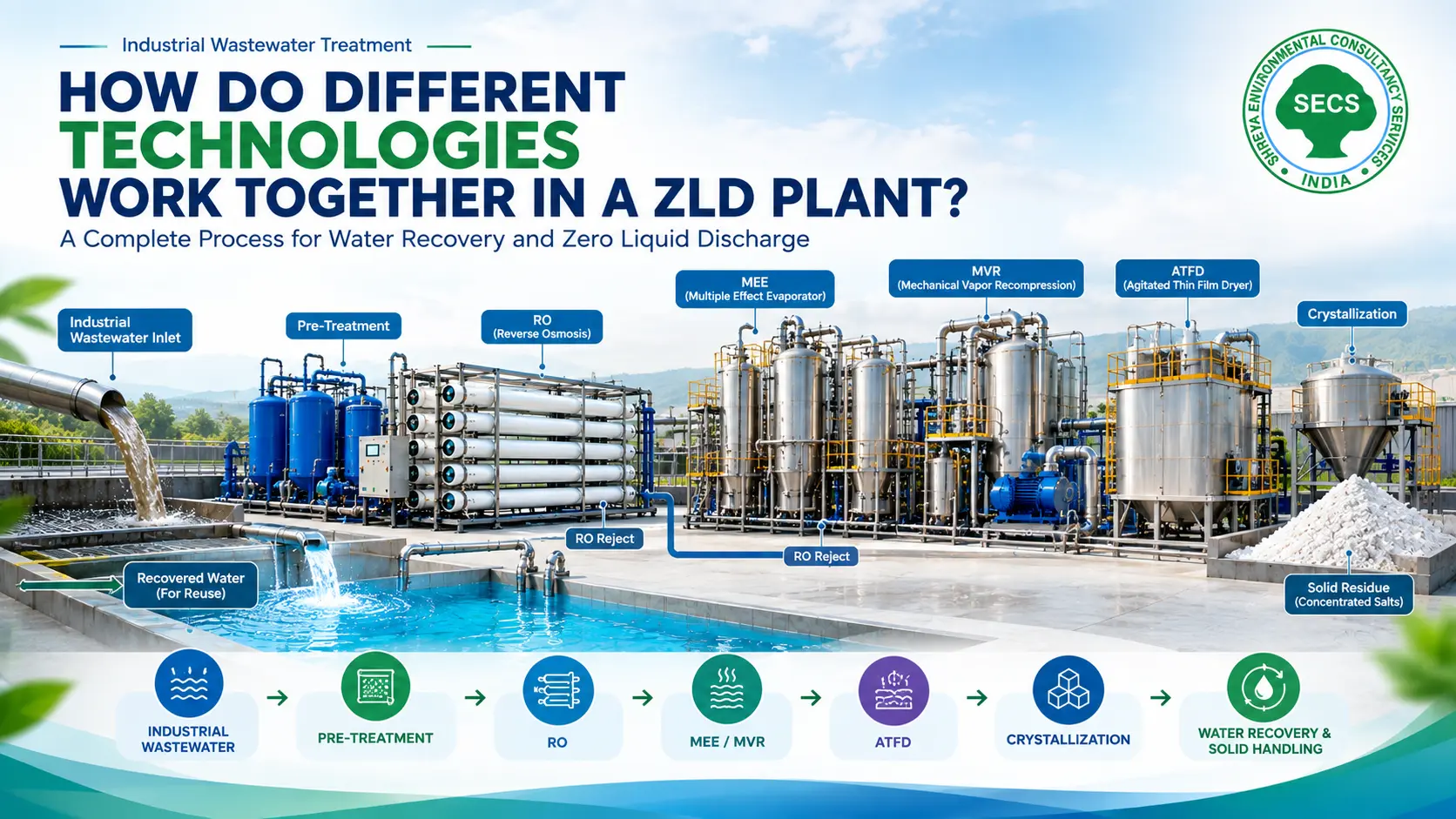
A simplified process sequence can be represented as:
Industrial Wastewater → Pre-Treatment → RO → RO Reject → MEE/MVR → Concentrate → ATFD/Crystallization → Water Recovery & Solid Handling
Not every ZLD plant uses exactly the same combination of technologies. The final configuration depends on wastewater flow, TDS, COD, hardness, scaling potential, dissolved salts, energy availability, required water recovery and the characteristics of the final residue.
This makes technology selection one of the most important parts of planning a ZLD plant in Baddi or at any other industrial location.
Reverse Osmosis (RO) in a ZLD Plant
Reverse osmosis is commonly used as an important water recovery stage before thermal concentration in a ZLD system. It uses pressure to push water through a semi-permeable membrane while retaining a large proportion of dissolved salts and other contaminants in the reject stream.
The RO system generally produces two main streams:
- RO permeate: The recovered water that can potentially be reused after achieving the required quality.
- RO reject: The concentrated stream containing higher levels of dissolved salts and other contaminants.
Using RO before thermal treatment can reduce the volume of wastewater that needs to enter an evaporator. This can be important because thermal evaporation generally requires substantially more energy than membrane-based water recovery.
However, RO recovery cannot be increased indefinitely. As dissolved solids become more concentrated, osmotic pressure, scaling, fouling and other operating limitations can affect membrane performance. The remaining concentrated stream can therefore require additional treatment through thermal technologies.
Industries evaluating membrane-based water recovery can also explore reverse osmosis systems as part of their broader industrial water and wastewater treatment strategy.
Why Is RO Used Before Thermal Treatment?
The main purpose of placing RO before thermal treatment is to recover a portion of the water while reducing the volume of concentrated wastewater that requires evaporation.
For example, instead of sending the complete wastewater flow directly to an evaporator, an appropriately designed RO system can recover a portion of the water as permeate. The smaller RO reject stream can then be directed toward the next stage of the ZLD process.
This approach allows membrane and thermal technologies to perform different roles within the same treatment train.
What Is MEE and How Is It Used in ZLD?
MEE stands for Multiple Effect Evaporator. It is a thermal evaporation technology used to remove water from concentrated wastewater streams. In ZLD applications, an MEE can be used after membrane-based treatment when the remaining RO reject requires further concentration.
The basic principle is relatively straightforward. Heat is supplied to the wastewater so that water evaporates. The generated vapor can then be utilized as a heating source in another effect, depending on the configuration of the evaporator.
A multiple-effect arrangement can therefore make use of vapor energy across several evaporation stages.
What Happens Inside an MEE?
Concentrated wastewater enters the evaporation system and comes into contact with heated surfaces. Water is converted into vapor while dissolved non-volatile components remain in the liquid phase.
As the process continues, the remaining liquid becomes progressively more concentrated.
The generated vapor is condensed to recover water, while the concentrated stream can move toward further treatment, drying or crystallization depending on the overall ZLD configuration.
Role of MEE in ZLD
MEE can perform several important functions within a ZLD process:
- Further concentration of RO reject
- Removal of water through thermal evaporation
- Reduction of the liquid volume requiring final treatment
- Recovery of condensate for potential reuse
- Preparation of concentrated streams for downstream drying or crystallization
The actual MEE configuration depends on wastewater chemistry, evaporation duty, scaling potential, required concentration and other project-specific factors.
What Is MVR and How Does It Work in ZLD?
MVR stands for Mechanical Vapor Recompression. It is a thermal evaporation technology that uses mechanical compression of vapor to support the evaporation process.
During evaporation, water is converted into vapor. Instead of simply allowing this vapor to leave the system, an MVR arrangement can compress the vapor and increase its pressure and temperature. The recompressed vapor can then be reused as a heating medium within the evaporator.
This allows energy contained in the vapor to be reused within the process.
Why Is MVR Considered for ZLD?
MVR can be considered where energy efficiency is an important part of the project design. By mechanically recompressing vapor and reusing it, the system can reduce the need for continuous external steam input under suitable operating conditions.
However, the suitability of MVR depends on the specific application. Wastewater composition, boiling characteristics, scaling behaviour, concentration range, capacity, electricity availability and overall plant economics all need to be considered.
MVR in Industrial Wastewater Treatment
MVR can be used for suitable concentrated wastewater streams where the process conditions allow effective vapor recompression.
As with other ZLD technologies, MVR should not be selected simply because it is an advanced technology. The correct choice depends on the wastewater and the complete process design.
MEE vs MVR: What Is the Difference?
MEE and MVR are both thermal evaporation technologies, but they use different approaches to utilize energy during evaporation.
| Parameter | MEE | MVR |
|---|---|---|
| Full form | Multiple Effect Evaporator | Mechanical Vapor Recompression |
| Basic principle | Uses multiple evaporation effects | Mechanically compresses vapor for reuse |
| Energy approach | Vapor can be reused across effects | Vapor is compressed and reused as a heating medium |
| Main consideration | Evaporation configuration and steam/energy requirements | Vapor compression and electrical energy requirements |
| Selection factors | Wastewater characteristics, capacity and process conditions | Wastewater characteristics, capacity, electrical availability and process conditions |
Neither technology is automatically suitable for every ZLD application. The selection between MEE, MVR or another evaporation arrangement should be based on wastewater analysis, required treatment capacity, energy conditions, scaling potential and the overall project design.
What Is ATFD and Why Is It Used in ZLD?
ATFD stands for Agitated Thin Film Dryer. It is a thermal drying technology that can be used for suitable highly concentrated wastewater streams where further moisture removal is required.
In an ATFD, the concentrated feed is distributed over a heated surface to form a thin film. Mechanical agitation helps maintain the film and supports heat transfer while water is evaporated from the concentrated material.
The process can significantly reduce the remaining moisture in suitable concentrated streams and produce a dry or highly concentrated residue depending on the feed and operating conditions.
Where Does ATFD Fit in a ZLD Process?
ATFD is generally considered toward the later stages of a ZLD process, after upstream treatment has already removed a significant portion of the water.
A simplified arrangement may look like:
RO → RO Reject → Evaporation → Concentrate → ATFD → Final Residue
The actual arrangement can vary. Some systems may use crystallization or other separation technologies depending on the chemistry and physical characteristics of the concentrated stream.
What Determines ATFD Suitability?
The suitability of an ATFD depends on factors such as:
- Feed solids concentration
- Viscosity
- Salt composition
- Scaling tendency
- Heat-transfer characteristics
- Required final moisture level
- Residue handling requirements
For this reason, ATFD selection should be based on actual wastewater and concentrate characteristics rather than using the same dryer configuration for every industrial application.
What Is Crystallization in a ZLD Plant?
Crystallization is a separation process used in suitable ZLD applications to convert dissolved substances in a highly concentrated solution into solid crystals.
As water is progressively removed from wastewater, the concentration of dissolved salts increases. Under appropriate conditions, the solution can reach a state where certain dissolved compounds begin to form crystals.
The resulting crystals can then be separated and collected for appropriate handling.
Why Is Crystallization Used in ZLD?
Crystallization can help manage highly concentrated streams where further liquid-phase treatment is no longer practical or where a solid final residue is required.
Depending on the wastewater chemistry and process design, crystallization can support:
- Final separation of dissolved salts
- Reduction of the remaining liquid fraction
- Conversion of dissolved materials into manageable solids
- Further water recovery
- Controlled handling of concentrated residues
The composition and quantity of crystals depend strongly on the original wastewater chemistry and the selected treatment process.
How RO, MEE, MVR, ATFD and Crystallization Work Together
The real strength of a ZLD system comes from combining technologies according to the requirements of the wastewater.
A representative process can be understood as follows:
Industrial Wastewater
↓
Pre-Treatment
↓
Reverse Osmosis (RO)
↓
RO Permeate → Water Reuse / Further Polishing
↓
RO Reject
↓
MEE or MVR
↓
Condensate → Water Recovery
↓
Highly Concentrated Stream
↓
ATFD and/or Crystallization
↓
Final Concentrated or Solid Residue
This sequence is only a simplified representation. Actual ZLD systems can contain additional pre-treatment, polishing, concentration or solid-separation stages depending on the wastewater.
The important point is that each technology has a specific role. RO focuses primarily on membrane-based water recovery, MEE and MVR provide thermal concentration, ATFD can provide further drying, and crystallization can support final separation of suitable dissolved solids.
How Is the Right ZLD Technology Selected?
Selecting the right ZLD technology starts with understanding the wastewater. Equipment should not be selected only because a particular technology is commonly used in the industry.
Important design considerations can include:
- Wastewater flow rate: Determines treatment capacity and equipment sizing.
- TDS and conductivity: Influence membrane performance and thermal concentration requirements.
- COD and organic load: Can affect pre-treatment and membrane operation.
- Hardness: Can contribute to scaling and influence upstream treatment requirements.
- Silica: Can create scaling challenges under certain operating conditions.
- Chlorides and sulphates: Can influence corrosion, scaling and final concentrate behaviour.
- Suspended solids and oils: May require effective pre-treatment before membrane treatment.
- Viscosity: Can influence evaporation and drying performance.
- Scaling potential: Important when selecting membranes, evaporators and final concentration equipment.
- Required water recovery: Influences the number and type of treatment stages.
- Energy availability: Important for selecting and operating thermal technologies.
- Final residue characteristics: Influence drying, crystallization, handling and disposal requirements.
A detailed wastewater analysis and process evaluation can therefore help determine whether the system should use RO alone, RO followed by MEE, MVR, ATFD, crystallization or a combination of these technologies.
ZLD Technologies for High-TDS Industrial Wastewater
High-TDS wastewater can present challenges for conventional treatment systems because dissolved salts remain in the water even after many biological and physical treatment processes.
In such applications, a properly designed ZLD system can combine membrane and thermal processes to progressively concentrate the dissolved components while recovering suitable water streams.
For example, an industrial wastewater treatment train may use pre-treatment followed by RO. The RO permeate can be directed toward reuse or additional polishing, while the RO reject can enter thermal concentration.
The thermal stage can then recover additional water while increasing the concentration of the remaining dissolved material. Depending on the final concentration and physical properties, ATFD or crystallization may be considered for the final stage.
This integrated approach can be particularly relevant for industries where RO reject treatment, water reuse and reduction of final liquid discharge are important parts of their wastewater management strategy.
Where a broader treatment system is required, ZLD can also be integrated with an effluent treatment plant and other industrial wastewater treatment processes.
ZLD Plant Technologies for Industries in Baddi
ZLD in Baddi can involve different technology combinations depending on the type of industry, wastewater generation, water reuse requirements and wastewater chemistry.
Industrial facilities in and around Baddi may have wastewater streams with different concentrations of TDS, COD, hardness, chlorides, sulphates, silica, suspended solids and other industry-specific contaminants. Because of these differences, there is no single ZLD configuration that is appropriate for every facility.
For example, one facility may require a strong pre-treatment and RO system before thermal concentration, while another may require additional treatment to control scaling or manage a particular concentrated residue.
Industries evaluating a ZLD plant in Baddi should therefore consider the complete treatment chain rather than selecting an individual technology in isolation.
The process may involve an ETP and STP technology, RO, thermal evaporation and final concentration stages depending on the project's requirements.
Can ZLD Technologies Be Integrated With Existing ETP and RO Systems?
Yes. Depending on the wastewater characteristics and existing infrastructure, ZLD technologies can be integrated with existing treatment systems.
A typical integration may involve an existing effluent treatment plant providing upstream treatment, followed by RO for water recovery and a ZLD thermal system for managing the concentrated reject.
However, successful integration requires evaluation of the existing system's capacity, treated-water quality, hydraulic flow, operating conditions and RO reject characteristics.
The existing RO system may also require assessment to determine whether its recovery, membrane condition and reject quality are suitable for connection to downstream thermal treatment.
For facilities planning a broader industrial wastewater solution, water and wastewater treatment solutions can be evaluated as an integrated system rather than treating each stage independently.
Benefits and Considerations of ZLD Technologies
Different ZLD technologies can provide different benefits within an integrated wastewater treatment system.
Potential Benefits
- Recovery of suitable water streams for reuse
- Reduction or elimination of final liquid wastewater discharge
- Management of high-TDS RO reject
- Progressive concentration of dissolved salts
- Potential reduction in freshwater requirements
- Integration with existing ETP and RO systems
- Controlled management of concentrated wastewater residues
Important Considerations
- Thermal systems can have significant energy requirements.
- Scaling and fouling can affect equipment performance.
- Corrosion potential must be considered for suitable materials and operating conditions.
- Recovered condensate may require additional polishing before certain reuse applications.
- Highly concentrated streams can create challenging viscosity and heat-transfer conditions.
- Final solids require appropriate collection, storage, handling and disposal.
- Regular operation and maintenance are important for maintaining system performance.
For these reasons, the goal of ZLD design should not simply be to install the largest or most advanced technology. The objective is to develop a treatment configuration that is appropriate for the actual wastewater and the facility's water recovery and discharge-management requirements.
How Shreya Environmental Consultancy Services Can Help With ZLD Projects
A successful ZLD project requires an integrated approach covering wastewater characterization, process selection, equipment sizing, water recovery, concentrate management and long-term operation.
Shreya Environmental Consultancy Services can support industries in evaluating wastewater treatment requirements and developing suitable solutions for industrial applications.
Depending on project requirements, the treatment strategy can combine Zero Liquid Discharge solutions with RO, ETP and other wastewater treatment technologies.
Where an existing wastewater treatment system is already operating, its performance and capacity can be evaluated before integrating additional treatment stages. This can help determine how reverse osmosis systems, evaporation and final concentration technologies can fit into the overall process.
For projects requiring complete implementation, turnkey project execution can provide an integrated approach from process planning through project implementation.
After commissioning, appropriate operation and maintenance services can also be important for maintaining equipment performance and managing issues such as scaling, fouling and changing wastewater conditions.
Environmental planning and regulatory considerations can also be addressed through environmental consultancy services as part of the wider project requirements.
The final technology combination should always be based on actual wastewater analysis and project conditions. RO, MEE, MVR, ATFD and crystallization each have different operating principles and applications, and their suitability depends on how they fit into the complete treatment system.
Frequently Asked Questions About ZLD Technologies
What technologies are commonly used in a ZLD plant?
Common ZLD technologies can include pre-treatment, reverse osmosis, Multiple Effect Evaporators, Mechanical Vapor Recompression, Agitated Thin Film Dryers and crystallization systems. The exact combination depends on wastewater characteristics, recovery requirements, energy availability and final residue management.
What is the role of RO in a ZLD system?
RO is commonly used for membrane-based water recovery before thermal concentration. It produces a permeate stream that can potentially be reused and a concentrated reject stream that can be sent to downstream ZLD treatment.
What is MEE in ZLD?
MEE stands for Multiple Effect Evaporator. It is a thermal evaporation system used to remove water from concentrated wastewater. Multiple effects can allow vapor energy to be utilized across different evaporation stages depending on the system design.
What is MVR in a ZLD plant?
MVR stands for Mechanical Vapor Recompression. It mechanically compresses generated vapor to increase its pressure and temperature so that the vapor can be reused as a heating medium within the evaporation process.
What is the difference between MEE and MVR?
MEE uses multiple evaporation effects to utilize vapor energy, while MVR mechanically compresses vapor and reuses it as a heating source. The appropriate technology depends on wastewater characteristics, capacity, energy availability, scaling potential and overall project requirements.
What is ATFD used for in ZLD?
ATFD stands for Agitated Thin Film Dryer. It can be used to further remove moisture from suitable highly concentrated streams after upstream evaporation. Its suitability depends on feed solids, viscosity, salt composition, scaling behaviour and the required final residue condition.
Why is crystallization used in ZLD?
Crystallization can be used to convert suitable dissolved salts in highly concentrated wastewater into solid crystals. It can support final separation and solid management when the wastewater reaches appropriate concentration and crystallization conditions.
How are ZLD technologies selected for industrial wastewater?
ZLD technologies are selected according to wastewater flow, TDS, COD, hardness, silica, dissolved salts, scaling potential, viscosity, required water recovery, energy availability, final water quality and residue characteristics. Wastewater analysis and process evaluation are important before finalizing the treatment configuration.
Can ZLD be integrated with an existing ETP and RO system?
Yes. A ZLD system can potentially be integrated with an existing ETP and RO system after evaluating the existing treatment capacity, treated-water quality, hydraulic conditions and RO reject characteristics. The integration should be designed according to the requirements of the individual facility.
Conclusion
ZLD plant technologies work together to progressively recover water and concentrate the dissolved components remaining in industrial wastewater. RO provides membrane-based water recovery, while MEE and MVR can provide thermal concentration. ATFD can support further drying of suitable concentrated streams, and crystallization can provide final separation of certain dissolved solids.
The important consideration is that these technologies are not selected independently. The right combination depends on wastewater chemistry, flow rate, recovery requirements, energy conditions, scaling potential and the intended management of the final residue.
For industries considering ZLD in Baddi, a detailed assessment of the wastewater and existing treatment infrastructure can help establish an appropriate process configuration. A properly integrated approach can combine RO, evaporation, drying and crystallization with existing wastewater treatment systems to support water recovery and controlled management of concentrated streams.
Shreya Environmental Consultancy Services works across industrial water and wastewater treatment applications, including ZLD, RO, ETP and environmental consultancy, with solutions planned according to individual project requirements.