
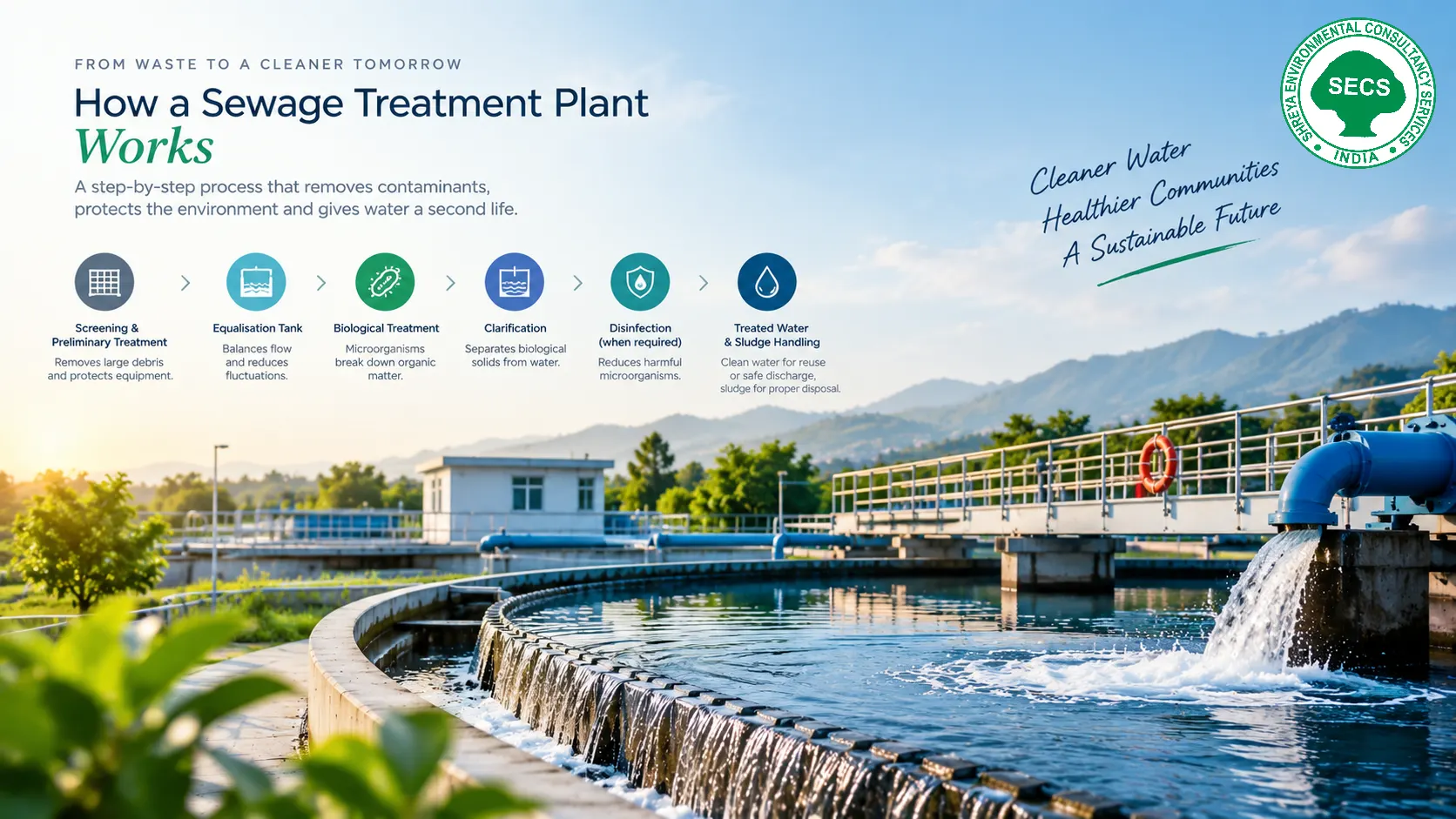
A sewage treatment plant (STP) is designed to treat wastewater generated from toilets, bathrooms, kitchens, wash areas and other domestic sewage sources before the treated water is discharged or reused for a suitable purpose. In residential buildings, industrial facilities, hotels, hospitals and commercial establishments, sewage treatment helps manage wastewater responsibly and supports compliance with applicable treatment and discharge requirements.
Understanding how an STP plant in Baddi works is important for businesses and facility managers planning a new installation or evaluating an existing treatment system. Although the exact arrangement varies with sewage quantity, wastewater characteristics, available space and treated-water quality requirements, most STPs follow a sequence of collection, preliminary treatment, biological treatment, solids separation and, where necessary, additional treatment and disinfection.
Shreya Environmental Consultancy Services provides water and wastewater treatment solutions for industrial and commercial requirements. This guide explains the main stages of sewage treatment, what happens at each stage, and which operating factors influence the performance of an STP.
What Is the Working Principle of an STP?
The working principle of a sewage treatment plant is to remove or reduce contaminants from sewage through a combination of physical, biological and, where required, chemical treatment processes. Physical processes remove materials such as plastics, rags and settleable solids. Biological processes use microorganisms to break down biodegradable organic matter, while subsequent separation processes remove the biological solids from the treated water.
Depending on the treatment design and intended use of the treated water, an STP may also include filtration, disinfection or other polishing stages. For example, water intended for toilet flushing or landscape irrigation may require additional treatment to achieve the quality needed for that application. The treatment sequence should therefore be selected according to the actual sewage load and applicable discharge or reuse requirements rather than using the same design for every facility.
It is also useful to distinguish sewage treatment from industrial effluent treatment. Domestic sewage and industrial wastewater can have different compositions and treatment requirements. Facilities generating process wastewater may need a separate effluent treatment plant (ETP) or an appropriately designed combination of treatment systems. The selection depends on the wastewater sources, their characteristics and the required outlet quality.
Step 1: Sewage Collection and Inlet Management
The treatment process begins when sewage from the facility is collected through a suitable drainage network and conveyed to the STP inlet. In residential complexes, this wastewater commonly comes from toilets, bathrooms, kitchens and washing areas. In commercial or institutional buildings, the sources may include washrooms, canteens and other domestic wastewater-generating areas.
Collection arrangements should prevent unwanted materials, stormwater and other unsuitable flows from entering the treatment system wherever the drainage design allows. Excessive stormwater inflow can increase hydraulic loading, while irregular sewage inflow can make treatment more difficult to control. The collection network, inlet chamber, pumps and associated piping should therefore be planned around the expected wastewater flow and site conditions.
At the inlet, operators may monitor incoming flow and observe changes in colour, odour or the presence of unusual materials. These observations do not replace laboratory testing, but they can help identify sudden changes that may affect plant operation. Where sewage is pumped to the treatment units, pump capacity and operating controls must also be appropriate for the incoming flow.
Step 2: Screening and Preliminary Treatment
Before sewage enters the main treatment stages, it generally passes through screening equipment that removes larger floating and suspended materials. These may include plastic pieces, sanitary waste, cloth, paper and other debris that could block pipes, damage pumps or interfere with downstream equipment.
Depending on the plant design, screening may use coarse screens, fine screens or other suitable arrangements. The collected screenings need to be removed and disposed of appropriately. If the screening system is neglected, accumulated waste can restrict flow, increase odour problems and affect the reliability of the treatment plant.
Some STPs also include grit removal or grease management where the incoming sewage characteristics make these stages necessary. Grit can cause wear or accumulation in pumps and tanks, while excess grease may interfere with treatment and create operational difficulties. These units are not identical in every installation; their inclusion depends on the sewage composition, plant capacity and design requirements.
Effective preliminary treatment protects the equipment that follows. It does not, by itself, remove all dissolved or biodegradable pollutants. Those contaminants must be addressed in the subsequent treatment stages.
Step 3: Equalisation and Flow Balancing
After preliminary treatment, some sewage treatment plants use an equalisation tank to balance variations in flow and wastewater characteristics. Sewage generation is rarely perfectly uniform throughout the day. Residential buildings, for example, may experience higher flows during morning and evening hours, while commercial facilities may have different operating patterns.
An equalisation tank temporarily stores incoming wastewater and helps deliver a more controlled flow to downstream treatment units. Mixing or aeration may be provided where required by the design to limit solids settling, reduce localised conditions and maintain a more uniform feed. The appropriate arrangement depends on the wastewater characteristics and the overall process selected for the STP.
Flow balancing can help prevent sudden hydraulic or organic loading changes from disturbing biological treatment. However, equalisation does not replace the biological treatment process, and it cannot compensate for an undersized or incorrectly operated plant. Tank volume, pumping controls and mixing arrangements must be suitable for the actual flow pattern.
For facilities planning a new installation, it is important to estimate average and peak sewage flows rather than selecting equipment based only on an assumed daily average. A properly assessed design provides a stronger basis for selecting the treatment process and operating equipment.
What Happens After Preliminary Treatment?
Once sewage has passed through the inlet and preliminary stages, it moves towards the main treatment process. In many conventional STPs, this is biological treatment, where microorganisms help reduce biodegradable organic matter under controlled conditions. The specific arrangement may use an activated sludge process, a moving bed biofilm reactor (MBBR), a sequencing batch reactor (SBR), a membrane bioreactor (MBR) or another suitable technology.
The choice of process depends on factors such as sewage quantity, available installation space, required treated-water quality, operating capability and maintenance requirements. These options are discussed in the next part of this guide, along with the role of clarification and biological solids separation.
Step 4: Biological Treatment of Sewage
Biological treatment is one of the most important stages in many sewage treatment plants. At this stage, microorganisms help break down biodegradable organic matter present in sewage. If this material is not adequately treated, it can contribute to oxygen depletion in receiving water bodies and affect the quality of the treated effluent.
In an aerobic biological treatment system, microorganisms use oxygen while consuming biodegradable pollutants. The process takes place in a biological reactor designed to provide suitable conditions for microbial activity. Depending on the selected technology, the reactor may contain suspended microorganisms, attached-growth media or a combination of treatment arrangements.
Aeration equipment, such as blowers and diffusers, may supply the oxygen required by the biological process. Proper mixing and oxygen transfer help maintain suitable operating conditions. However, the required aeration rate depends on the sewage load, reactor design and process requirements. Excessive or insufficient aeration can affect treatment performance and energy consumption.
Biological treatment performance is influenced by several factors, including incoming organic load, dissolved oxygen where applicable, temperature, pH, nutrient availability and the amount and condition of active biomass. Sudden changes in sewage characteristics, toxic substances or poor operating conditions may disturb microbial activity and reduce treatment efficiency.
Although the biological process reduces biodegradable pollution, it does not automatically produce water suitable for every reuse application. Biological solids and other remaining contaminants may need further separation and treatment. Facilities comparing different wastewater treatment arrangements can also review the industrial effluent treatment process to understand how treatment stages are selected for a different wastewater stream.
Step 5: Choosing the Right STP Treatment Technology
Not all sewage treatment plants use the same biological process. The technology is selected according to sewage flow, expected loading variations, site conditions, treated-water requirements, available operating resources and long-term maintenance considerations. Four commonly used approaches are the Activated Sludge Process (ASP), Sequencing Batch Reactor (SBR), Moving Bed Biofilm Reactor (MBBR) and Membrane Bioreactor (MBR).
1. Activated Sludge Process (ASP)
The Activated Sludge Process uses microorganisms suspended in an aerated wastewater mixture. After biological treatment, the mixture generally moves to a settling tank, where biological solids settle and treated water is separated. A portion of the settled sludge may be returned to the biological reactor to maintain the required biomass concentration, while excess sludge is removed for further handling.
ASP is an established treatment approach, but its performance depends on suitable aeration, sludge management, settling characteristics and consistent operation. The plant layout must provide adequate space for the biological reactor and solids separation equipment.
2. Sequencing Batch Reactor (SBR)
A Sequencing Batch Reactor performs different treatment stages in a tank according to a controlled operating cycle. Depending on the process design, the cycle can include filling, biological reaction, settling, treated-water decanting and a resting period. These stages occur in sequence rather than requiring every stage to operate continuously in separate tanks.
SBR systems can be useful where a compact process arrangement and controlled treatment cycles suit the site requirements. However, the cycle timing, controls, aeration and decanting equipment need to be managed correctly. Incoming flow patterns and the required treatment capacity should be considered when selecting the system.
3. Moving Bed Biofilm Reactor (MBBR)
A Moving Bed Biofilm Reactor uses specially designed carrier media within a biological tank. Microorganisms grow as a biofilm on the surface of these carriers, allowing biological treatment to take place on the attached growth. Mixing keeps the carriers moving through the reactor, while screens or retention arrangements prevent them from leaving the treatment tank.
MBBR systems may be considered where the process needs a compact biological treatment arrangement or where upgrading an existing system is being evaluated. Their suitability depends on the required capacity, reactor configuration, loading conditions and downstream solids separation. The presence of carrier media alone does not guarantee a particular outlet quality.
4. Membrane Bioreactor (MBR)
A Membrane Bioreactor combines biological treatment with membrane-based separation. The membranes retain suspended solids and biomass while allowing treated water to pass through, subject to the membrane system's operating characteristics. This arrangement can produce a low-solids effluent and may be suitable for projects with specific space or treated-water quality requirements.
MBR systems require appropriate membrane operation, cleaning and monitoring. Fouling control, energy use, replacement planning and operator capability should be assessed when comparing this technology with conventional alternatives.
How Should These Technologies Be Compared?
There is no single technology that is automatically best for every STP. The selection should consider hydraulic and organic loading, land availability, capital and operating costs, power requirements, sludge handling, automation needs and the intended use of treated water. A technology that suits one residential complex may not be the right choice for a factory, hotel or institutional facility.
For a broader overview of treatment options, readers can explore Shreya Environmental's ETP and STP treatment technologies page. The final process selection should be based on project-specific wastewater data and the required treatment outcome.
Step 6: Clarification and Biological Solids Separation
After biological treatment, the water usually contains biological solids that must be separated before it moves to the next stage. In conventional activated sludge systems, this separation commonly takes place in a secondary clarifier. The flow enters the settling tank under controlled conditions, allowing heavier biological flocs to settle towards the bottom while clarified water moves towards the outlet.
The settled material, commonly called activated sludge, may be partly returned to the biological reactor where the process requires it. This returned sludge helps maintain the population of microorganisms needed for treatment. The remaining excess sludge must be removed at an appropriate rate and sent for suitable handling, treatment or disposal.
Clarifier performance depends on factors such as sludge settling characteristics, hydraulic loading, solids loading and the condition of the biological process. Poor settling, excessive sludge accumulation or an unsuitable flow pattern can cause solids to escape with the outlet water. This may increase suspended solids and affect the performance of downstream filtration or disinfection units.
It is important to understand that not every STP uses a conventional secondary clarifier. Some systems use membranes or other process-specific separation arrangements. In an MBR, for example, membrane separation performs the solids-retention function instead of relying on a conventional secondary settling tank in the same way as an activated sludge plant.
Clarification and biological treatment perform different functions: biological treatment reduces biodegradable organic matter, while clarification separates much of the biological solids from the treated water. Both stages must work appropriately for the overall treatment system to perform as intended.
What Comes After Biological Treatment and Clarification?
Once biological solids have been separated, the water may proceed to additional treatment depending on the intended discharge or reuse. This can include filtration to reduce remaining suspended particles and disinfection where microbial control is required. The exact stages depend on the outlet-quality targets, the treatment technology already installed and the applicable requirements.
The next part explains tertiary treatment, disinfection, treated-water storage and reuse, sludge management, routine operating checks and factors to consider when selecting an STP plant in Baddi.
Step 7: Tertiary Treatment and Filtration
After biological treatment and solids separation, the treated sewage may require additional polishing before discharge or reuse. This stage is commonly called tertiary treatment or advanced treatment. Its purpose depends on the quality of water leaving the earlier stages and the requirements of the intended application.
Filtration can help remove remaining suspended particles that may pass through the clarification stage. Depending on the design, an STP may use pressure sand filters, activated carbon filters or other suitable filtration arrangements. The selection depends on the contaminants that need to be controlled, the required outlet quality and the performance of the upstream treatment process.
Some applications may require additional treatment beyond conventional filtration. For example, a facility planning a more advanced water recovery system may need membrane-based processes or other technologies selected according to the water characteristics and reuse objectives. Shreya Environmental's water treatment plant solutions page provides further information about treatment systems designed around different water-quality requirements.
Tertiary treatment should not be treated as a fixed set of equipment that every STP must include. The correct arrangement depends on the intended reuse or discharge, the performance of the biological stage and the applicable quality criteria. Regular inspection and maintenance of filters are also important because accumulated solids and unsuitable operating conditions can affect filtration performance.
Step 8: Disinfection of Treated Sewage
Disinfection may be provided after filtration or at another suitable point in the treatment process to reduce microorganisms in the treated water. The need for disinfection depends on the intended application, the treatment arrangement and applicable requirements. It is particularly important to evaluate microbial quality when treated water is planned for uses where people may come into contact with it.
Chlorination
Chlorination uses a controlled chlorine dose to disinfect treated water. Its effectiveness depends on factors such as the chlorine dose, contact time, water quality and chlorine demand. The system must be operated and monitored appropriately to achieve the intended result while controlling residual chlorine where necessary.
Ultraviolet (UV) Disinfection
UV disinfection exposes water to ultraviolet light to inactivate susceptible microorganisms. Its performance depends on factors such as UV intensity, exposure conditions, equipment maintenance and water clarity. Excessive suspended solids or poor UV transmission can reduce treatment effectiveness, so upstream treatment must be suitable for the selected system.
Chlorination and UV are not interchangeable in every situation. The choice depends on the required level of microbial control, operating conditions, downstream storage and distribution arrangements, and the intended use of the treated water. Disinfection should be selected as part of the complete treatment design rather than as a substitute for effective biological treatment and solids removal.
Step 9: Treated Water Collection, Storage and Reuse
After the required treatment stages, the treated water is collected in an outlet tank or suitable storage arrangement. Before the water is reused or discharged, its quality should be checked against the applicable requirements for the intended purpose. A clear-looking outlet does not necessarily mean that the water meets all chemical and microbiological quality criteria.
Depending on the achieved quality and applicable requirements, treated sewage may be considered for suitable non-potable uses such as landscape irrigation, gardening or toilet flushing. Each application needs an appropriate assessment of water quality, storage, distribution and potential human contact. Treated sewage should not be assumed suitable for drinking or any other high-quality application without the necessary treatment, verification and compliance.
Where a facility requires additional treatment to meet a specific reuse target, an appropriately designed polishing or membrane system may be considered. For example, reverse osmosis (RO) treatment can be part of certain advanced water-treatment arrangements, but it is not automatically required for every STP. Its suitability depends on dissolved contaminants, feed-water quality, recovery objectives, concentrate management and the final water-quality specification.
Water reuse planning should consider the complete system, including treatment, testing, storage tanks, pumps and distribution lines. Separate identification of reclaimed-water piping and suitable safeguards can help prevent unintended connections with potable-water systems. The operating team should also establish a monitoring plan appropriate for the reuse application.
Step 10: Sludge Management and Disposal
Sewage treatment produces sludge from the solids removed during preliminary treatment and biological or clarification stages. This material must be managed properly because it may contain concentrated organic matter, microorganisms and other contaminants. Sludge management is therefore an essential part of STP operation, not an optional activity that can be ignored after the water-treatment stages are completed.
Depending on the plant design, excess biological sludge may be thickened, dewatered or otherwise conditioned to reduce its volume and make handling easier. The actual arrangement depends on the quantity and characteristics of the sludge, available space, equipment selection and the applicable handling and disposal requirements.
Sludge should be removed at an appropriate frequency and managed through suitable, lawful routes. Allowing excessive accumulation can interfere with tank operation, reduce effective treatment capacity or contribute to process instability. The operating plan should identify responsibilities for sludge inspection, removal, storage, transport and recordkeeping as applicable.
Sludge generation varies with sewage characteristics, treatment technology, operating conditions and solids-removal practices. For this reason, a fixed sludge quantity or removal schedule should not be assumed for every STP. The plant should be monitored and its sludge-handling arrangements adjusted to actual operating needs.
How Is an STP Monitored During Routine Operation?
A sewage treatment plant requires routine monitoring to maintain stable operation. The exact checks depend on the treatment technology and equipment installed, but operators commonly inspect the inlet, pumps, blowers, aeration system, tanks, filters, disinfection equipment and sludge-handling arrangements.
Monitoring may include sewage flow, pH, dissolved oxygen where relevant, sludge condition, suspended solids and selected outlet-water quality parameters. Laboratory testing should be carried out at a frequency appropriate to the plant, its operating permit or consent conditions, and the intended reuse or discharge. Operating records help identify trends and make it easier to investigate changes in performance.
Typical operating problems include unpleasant odour, excessive foam, poor sludge settling, pump failures, low aeration, blocked screens and inconsistent outlet-water quality. These symptoms can have different causes, so operators should investigate the underlying process conditions rather than relying on a single corrective action.
For example, odour may be associated with stagnant wastewater, accumulated solids or inadequate process conditions. Poor settling may indicate a change in biological sludge characteristics or hydraulic loading. A sudden change in outlet quality may require checks of the inlet load, biological process, solids separation and downstream equipment. Corrective measures should be based on the observed problem and the plant's operating procedures.
Why STP Operation and Maintenance Matters
Even a properly designed sewage treatment plant needs regular operation and maintenance. Pumps, blowers, valves, screens, filters, instruments and control systems all require inspection and servicing according to the equipment manufacturer's instructions and actual operating conditions. Biological processes also need monitoring to maintain suitable treatment conditions.
A plant-specific maintenance schedule should define inspection tasks, responsible personnel, service intervals, monitoring requirements and records. Preventive maintenance can help identify equipment wear and developing process issues before they cause extended interruptions. It should be supported by outlet-water testing and appropriate operating procedures.
Businesses that need support beyond installation can review Shreya Environmental's operation and maintenance services for water and wastewater treatment systems. The required service arrangement depends on the plant design, the responsibilities of the facility team and the operating support needed.
Choosing an STP Plant in Baddi, Himachal Pradesh
When planning an STP for a factory, residential complex, hotel, commercial building or institutional facility in Baddi, the first step is to understand the sewage generation and the required treatment outcome. The design should account for average and peak flow, the sources of sewage, available space, drainage arrangements, treated-water reuse plans and applicable regulatory requirements.
Technology selection should then consider capital cost alongside long-term operating factors such as electricity use, consumables, sludge handling, equipment maintenance, automation and operator availability. A system should be selected for its ability to meet the required treatment objectives under realistic operating conditions, rather than on capacity or purchase price alone.
Site conditions and the capability of the operating team also matter. Access for equipment maintenance, safe handling of chemicals where used, sludge removal arrangements and availability of replacement parts can influence the long-term reliability of the installation. Where a facility has multiple wastewater sources, the design team should determine whether domestic sewage and industrial process effluent need separate treatment systems.
Shreya Environmental Consultancy Services provides sewage treatment plant solutions for project-specific requirements. Before finalising an STP, facilities should establish their flow estimates, treatment targets, site constraints and intended water reuse or discharge route.
Frequently Asked Questions About STP Working
1. What are the main stages of an STP plant?
A typical STP may include sewage collection, screening, equalisation where required, biological treatment, clarification or membrane separation, additional filtration where needed, disinfection where required, and sludge management. The exact sequence depends on the selected technology and outlet-quality requirements.
2. What happens during biological treatment in an STP?
During biological treatment, microorganisms help break down biodegradable organic matter in sewage under suitable operating conditions. Aerobic systems supply oxygen to support biological activity. The resulting biological solids must then be separated from the treated water.
3. Is disinfection necessary in every STP?
Not every STP uses the same disinfection arrangement. The need for disinfection depends on the treatment design, intended reuse or discharge, and applicable requirements. Where required, a suitable method such as chlorination or UV treatment may be included.
4. What is the difference between biological treatment and clarification?
Biological treatment uses microorganisms to reduce biodegradable organic pollution. Clarification separates biological solids from the water after treatment. Some systems use membranes or other separation methods instead of conventional clarification.
5. Can STP-treated water be reused?
Yes, treated sewage may be reused for suitable applications when its quality meets the relevant requirements. Potential uses include gardening, landscaping and toilet flushing. Appropriate treatment, testing, storage and distribution arrangements depend on the intended use.
6. How often should an STP be maintained?
Maintenance frequency depends on the technology, equipment, operating conditions and manufacturer's instructions. Routine activities may include screen cleaning, pump and blower inspections, process monitoring, sludge removal and outlet-water testing. A plant-specific maintenance schedule should be established and followed.
7. How do I select an STP plant in Baddi?
Start by establishing the expected sewage flow, wastewater characteristics, available space, intended treated-water use and applicable requirements. Then compare suitable technologies based on operating needs, power consumption, sludge management, maintenance capability and long-term costs.
Conclusion
An STP works through a series of connected stages that collect sewage, remove larger waste, support biological treatment, separate solids and provide additional treatment where required. Filtration, disinfection, treated-water storage and sludge management are selected according to the treatment design and the intended outlet quality. Each stage contributes to overall performance, so the system must be designed and operated as a complete process.
For facilities planning an STP plant in Baddi, a suitable design starts with accurate flow estimates, an understanding of sewage characteristics, clear treatment targets and a realistic operation and maintenance plan. These factors help determine which technology and equipment arrangement best suits the site.
To discuss your site's sewage treatment requirements, flow estimates or treated-water reuse objectives, contact Shreya Environmental Consultancy Services to discuss the project and identify the next steps.