
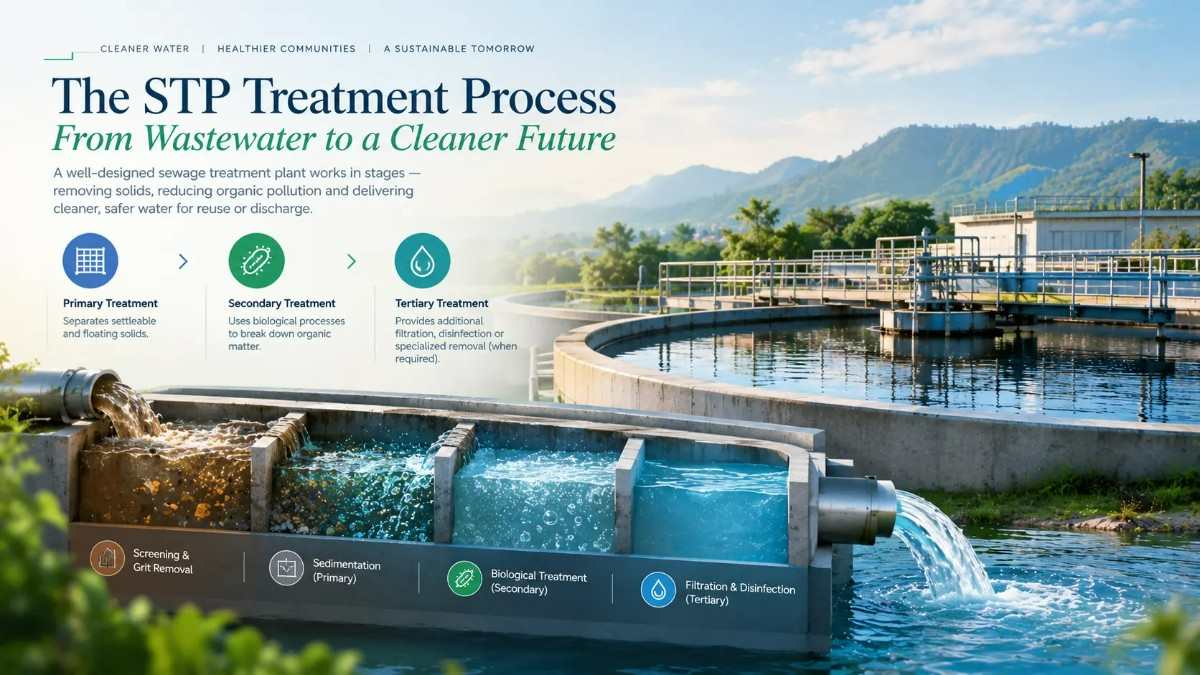
Wastewater treatment is not a single operation in which all contaminants are removed at once. It is a carefully designed sequence of processes, with each stage addressing different pollutants and preparing the water for the next level of treatment. In a sewage treatment plant (STP), primary, secondary and tertiary treatment form the core stages used to separate solids, reduce biodegradable pollution and achieve the required treated-water quality.
Understanding the STP treatment process is important when planning a new sewage treatment facility, upgrading an existing plant or evaluating options for treated-water reuse. Each stage has a specific purpose, and the overall performance of the plant depends on how effectively these processes work together. The appropriate configuration varies according to sewage characteristics, wastewater flow, available space, treatment objectives and applicable discharge or reuse requirements.
For businesses, residential developments, commercial buildings and industrial facilities in Baddi, Himachal Pradesh, selecting the right treatment arrangement is particularly important for reliable wastewater management. Shreya Environmental Consultancy Services provides sewage treatment plant solutions for project requirements, with its work extending beyond Baddi to suitable projects across India.
Understanding the Three Main Stages of STP Treatment
The three main stages of sewage treatment are designed to address different aspects of wastewater pollution. Primary treatment primarily separates settleable and floating solids, secondary treatment uses biological processes to reduce biodegradable organic matter, and tertiary treatment provides additional polishing or specific contaminant removal when required.
These stages should not be viewed as interchangeable options. Removing suspended solids does not necessarily eliminate dissolved organic pollutants, and biological treatment alone may not achieve every requirement for reuse or discharge. The treatment sequence must therefore be designed around the characteristics of the incoming sewage and the quality required at the outlet.
Primary Treatment: Physical Separation of Solids
Primary treatment focuses mainly on removing settleable solids and floating materials through physical separation processes. Depending on the plant design, this may involve sedimentation tanks or primary clarifiers, where heavier particles settle under gravity while floating substances can be separated from the wastewater surface.
Preliminary operations such as screening and grit removal are generally provided before primary clarification. Although they are closely associated with the initial stage of an STP, they are technically distinct from primary sedimentation. Their purpose is to remove coarse debris and abrasive inorganic particles that could obstruct pipes, damage equipment or interfere with subsequent treatment.
Secondary Treatment: Biological Reduction of Organic Pollution
Secondary treatment generally relies on microorganisms to break down biodegradable organic substances present in sewage. In processes such as activated sludge treatment, wastewater is brought into contact with a biological population under controlled conditions. Aeration may supply the oxygen required by aerobic microorganisms, while the resulting biological solids are separated from the treated water in a subsequent clarification stage or through another suitable separation method.
The performance of biological treatment depends on factors such as the incoming organic load, oxygen availability where required, temperature, pH, hydraulic conditions and the health of the biological population. The objective is to reduce biodegradable pollution and, depending on the selected process, achieve additional treatment functions such as biological nitrogen removal.
Tertiary Treatment: Additional Polishing for the Required Water Quality
Tertiary treatment refers to additional treatment provided after the main treatment stages to achieve specific water-quality objectives. Depending on the intended application, it may include filtration, disinfection, nutrient removal or advanced treatment technologies. The exact arrangement depends on which contaminants remain and what the treated water is expected to meet.
For example, water intended for a suitable non-potable reuse application may require additional suspended-solids removal and disinfection. More demanding reuse objectives may call for further treatment based on parameters such as dissolved salts or other contaminants. Technologies such as membrane treatment or reverse osmosis are not automatically necessary in every STP; their suitability must be evaluated against the water-quality requirement and overall project economics.
Preliminary Treatment: Preparing Sewage for the Main Treatment Stages
Before primary treatment begins, sewage normally passes through preliminary treatment units designed to protect downstream equipment and improve the reliability of the treatment process. This stage is important because wastewater arriving from toilets, bathrooms, kitchens and other domestic sources can contain a mixture of plastics, cloth, sanitary waste, grit and other unwanted materials.
Screening: Removing Coarse and Floating Debris
Screening uses bars, mesh or mechanical screening equipment to capture larger materials carried by incoming sewage. Depending on the screen opening and equipment design, it can remove items such as rags, plastics, sanitary products and other debris that could clog pumps, obstruct channels or interfere with mechanical equipment.
Screening does not remove dissolved pollutants and should not be confused with the removal of fine suspended particles. Its principal role is to protect equipment and prevent operational problems further along the treatment line. Screenings must also be collected and disposed of appropriately rather than allowed to re-enter the wastewater stream.
Grit Removal: Protecting Pumps and Mechanical Equipment
Grit removal targets heavier inorganic particles such as sand, gravel and similar abrasive materials. These particles can accumulate in tanks, wear pump components and reduce the effective capacity of channels and treatment units if they are not adequately controlled.
Grit chambers are designed to encourage these heavier particles to settle while allowing most organic material to remain in the wastewater stream. Their design and operating conditions determine the separation achieved. The collected grit requires suitable handling and disposal.
Why Preliminary Treatment Matters
Screening and grit removal do not replace primary, secondary or tertiary treatment. Instead, they help these subsequent processes operate more reliably. Effective preliminary treatment can reduce blockages, protect moving equipment, limit unwanted solids accumulation and reduce avoidable maintenance requirements.
The specific equipment installed depends on the sewage characteristics, expected flow, plant capacity and design approach. Smaller installations and large facilities may use different combinations of manual or mechanical screens, grit removal arrangements and pumping systems.
Primary Treatment in an STP: How It Removes Suspended Solids
Primary treatment is the first main solids-separation stage in many conventional sewage treatment configurations. After preliminary treatment, sewage may enter a settling tank or primary clarifier, where the flow conditions allow a portion of the suspended material to settle under gravity. Floating substances can also be skimmed from the surface where suitable collection equipment is provided.
The purpose is to reduce the amount of solids entering downstream biological treatment. However, primary clarification is not designed to remove every pollutant from sewage. Dissolved organic matter, fine particles and other contaminants may remain, which is why additional treatment is generally necessary.
How Primary Sedimentation Works
In a primary clarifier, wastewater enters a tank designed to distribute the flow and provide sufficient settling conditions. As the wastewater moves through the tank, settleable particles gradually collect at the bottom, forming primary sludge. Floating grease, oils and other scum may accumulate at the surface and be removed through suitable skimming arrangements.
The clarified wastewater leaves the tank for the next treatment stage. The effectiveness of this separation depends on factors such as particle characteristics, flow distribution, hydraulic loading, settling conditions and the design and operation of the clarifier.
Primary treatment can reduce the suspended-solids load and remove a portion of the organic matter associated with those solids. Its actual removal performance varies with the wastewater and plant design, so fixed removal percentages should not be assumed for every installation.
What Does Primary Treatment Remove?
Primary treatment mainly targets materials that can be separated through physical processes. These commonly include:
- Settleable suspended solids: Particles that can settle to the bottom under suitable tank conditions.
- Floating matter: Certain oils, grease and scum that can be collected from the wastewater surface.
- Particulate organic matter: A portion of the organic material carried by suspended particles.
- Some of the incoming solids load: Material whose removal helps reduce the burden on downstream biological treatment.
Primary treatment generally does not adequately remove dissolved salts, all dissolved organic compounds, pathogens or every fine suspended particle. These limitations must be considered when selecting the subsequent treatment processes and evaluating the final water quality.
Primary Sludge: A Necessary Part of the Process
The solids separated in a primary clarifier accumulate as primary sludge. This material contains concentrated suspended matter and organic substances removed from the sewage. It must be withdrawn at appropriate intervals or through a suitable sludge collection system to prevent excessive accumulation, deterioration of settling performance and operational difficulties.
Sludge management is an integral part of sewage treatment rather than a separate afterthought. Depending on the overall plant configuration, collected sludge may require thickening, stabilisation, dewatering and appropriate final handling or disposal. The exact arrangement depends on the quantity and characteristics of the sludge and the applicable requirements.
Why Primary Treatment Alone Is Not Enough
Although primary clarification can remove a meaningful portion of settleable solids, the water leaving the clarifier can still contain dissolved and fine particulate organic matter. These pollutants contribute to the remaining biochemical oxygen demand (BOD) and chemical oxygen demand (COD), depending on their composition and biodegradability.
If this wastewater were considered fully treated without checking the remaining pollution load, it could fail to meet the intended discharge or reuse requirements. The next stage therefore commonly uses biological treatment to reduce biodegradable organic matter further, followed by any additional polishing or disinfection required by the final treatment objective.
This distinction is important when evaluating an effluent treatment plant (ETP) as well. Industrial effluent may contain process-specific chemicals, dissolved contaminants or other pollutants that require a different treatment approach from domestic sewage. The treatment sequence must be selected according to the actual wastewater characteristics rather than assuming that the same process configuration is suitable for every application.
Secondary Treatment in an STP: Biological Removal of Organic Pollutants
After primary treatment, wastewater still contains dissolved and fine particulate organic matter that cannot be removed adequately through settling alone. Secondary treatment addresses much of this remaining biodegradable pollution through biological processes. Instead of relying only on physical separation, this stage uses microorganisms to convert biodegradable substances into new biomass, gases and other end products under controlled operating conditions.
In a conventional sewage treatment plant, biological treatment is often one of the most important stages for reducing biochemical oxygen demand (BOD). The exact process depends on the plant's capacity, wastewater characteristics, available space, operating requirements and treated-water quality objectives.
How Biological Treatment Works
Microorganisms naturally consume biodegradable substances present in sewage. In an engineered biological treatment system, these microorganisms are maintained under conditions that support their activity and allow them to treat the incoming wastewater consistently.
In aerobic processes, microorganisms use oxygen while breaking down biodegradable organic matter. The resulting biological growth forms solids that must subsequently be separated from the treated water. Other biological configurations may use different operating conditions or combine aerobic, anoxic and anaerobic environments to achieve additional treatment objectives.
The performance of a biological treatment system depends on more than simply introducing air into wastewater. Organic loading, dissolved oxygen where required, pH, temperature, nutrient availability, hydraulic retention time, solids retention time and biomass condition can all influence treatment performance. Poor control of these factors can result in unstable operation, inadequate pollutant removal or difficulties in separating biological solids.
Aeration: Supplying Oxygen for Biological Activity
In aerobic sewage treatment processes, aeration equipment transfers oxygen into wastewater so that aerobic microorganisms can remain active. Depending on the plant design, air may be supplied through diffusers, mechanical aerators or other suitable equipment.
Aeration also helps maintain mixing in many biological treatment systems, keeping the biomass and wastewater in contact. However, the oxygen requirement varies with the incoming organic load and the selected treatment process. Excessive aeration can increase energy consumption, while insufficient oxygen can compromise the performance of systems that depend on aerobic biological activity.
Effective aeration design therefore considers oxygen transfer, mixing requirements, operating conditions and energy use rather than selecting equipment based on tank size alone.
Activated Sludge Process: A Common Secondary Treatment Method
The activated sludge process is widely used in sewage treatment. In a typical arrangement, wastewater enters an aeration tank containing a suspension of microorganisms known as activated sludge. The microorganisms consume biodegradable organic matter, while the aeration system supplies oxygen and maintains suitable mixing conditions.
The mixture of treated wastewater and biological solids then flows to a secondary clarifier or another suitable solids-separation unit. The biological solids settle, allowing clarified water to leave the separation stage. A portion of the settled biomass may be returned to the aeration tank to maintain the required microbial population, while excess sludge is removed for further handling.
This arrangement requires appropriate control of the biological population and sludge inventory. Sludge settling characteristics, return sludge flow, excess sludge removal and aeration performance all affect the stability of the process. Activated sludge is therefore not simply a tank-and-blower arrangement; it is a biological system that requires suitable design, monitoring and operation.
Other Biological Treatment Approaches
Activated sludge is not the only way to carry out secondary treatment. Alternative biological technologies may be more suitable depending on the wastewater characteristics, available land, required treatment quality and operational preferences.
- Moving bed biofilm reactor (MBBR): Uses specially designed carrier media that support attached microbial growth within a treatment tank. The movement of the media helps maintain contact between wastewater and the biological film.
- Sequencing batch reactor (SBR): Carries out treatment phases such as filling, biological reaction, settling and decanting in a controlled sequence, commonly within the same tank.
- Membrane bioreactor (MBR): Combines biological treatment with membrane separation to retain biomass and produce treated water with low suspended-solids concentrations. Further treatment may still be needed for particular reuse objectives.
- Other attached-growth systems: Use microbial films growing on a fixed or structured surface to treat wastewater as it passes through the biological treatment unit.
These technologies are not interchangeable in every project. Their suitability depends on factors such as sewage strength, flow variation, footprint, energy consumption, sludge production, maintenance requirements and the quality expected from the treatment system. A suitable ETP and STP technology selection should be based on these project-specific considerations rather than choosing a technology by name alone.
Secondary Clarification: Separating Biological Solids
In treatment systems that produce suspended biological solids, the separation of biomass from treated water is an essential part of the process. A secondary clarifier allows biological flocs to settle under suitable conditions, producing clarified effluent and concentrated settled sludge.
Some of the settled sludge may be returned to the biological treatment stage, depending on the process configuration, while excess biomass must be removed and managed. If the sludge settles poorly, the clarifier is overloaded or the biological process is unstable, suspended solids can escape with the treated water.
For this reason, secondary treatment performance must be assessed by looking at both biological pollutant removal and solids separation. A biological reactor may reduce organic pollution effectively, but inadequate downstream separation can still affect the quality of its effluent.
What Secondary Treatment Can and Cannot Achieve
Secondary treatment is primarily intended to reduce biodegradable organic matter. Depending on the technology and operating conditions, it can also reduce suspended solids and may be designed to remove nitrogen or support other treatment objectives.
However, conventional biological treatment does not automatically remove all dissolved salts, every persistent contaminant, all pathogens or every nutrient. The extent of removal varies with the treatment process and wastewater composition. Where the final application requires additional contaminant removal, filtration, disinfection or other advanced treatment may be necessary.
Tertiary Treatment in an STP: Achieving the Required Treated-Water Quality
After secondary treatment, the wastewater may still contain fine suspended particles, microorganisms, nutrients or dissolved substances that need further attention. Tertiary treatment provides additional treatment to address the remaining contaminants and bring the water closer to its intended discharge or reuse requirements.
The term tertiary treatment does not refer to one fixed technology. It describes additional treatment processes selected according to the water-quality objectives of the project. Some plants require relatively straightforward filtration and disinfection, while others need more advanced treatment because the intended reuse application has stricter requirements.
Filtration: Reducing Residual Suspended Solids
Filtration can remove fine particles that remain after biological treatment and clarification. Depending on the required water quality, the system may use suitable media filters, pressure filters or other filtration technologies.
By reducing residual suspended solids and turbidity, filtration can improve the performance of subsequent disinfection processes. The filter media, operating rate, backwashing arrangement and maintenance schedule must be selected according to the water characteristics and expected solids loading.
Filtration does not necessarily remove dissolved salts or every dissolved contaminant. Where these are important to the intended reuse application, additional treatment may be required.
Disinfection: Controlling Microbial Risks
Disinfection is used to reduce the number of disease-causing microorganisms in treated wastewater. Depending on the project, suitable methods may include chlorination, ultraviolet (UV) disinfection or other validated disinfection approaches.
Chlorination uses a chemical disinfectant and requires appropriate control of dose, contact time and residual concentration where relevant. UV disinfection uses ultraviolet light to inactivate susceptible microorganisms as water passes through the treatment unit. Its effectiveness depends on factors including UV transmittance, turbidity, equipment condition and the delivered UV dose.
Neither method should be assumed to provide identical protection under every operating condition. The disinfection system must be selected and operated according to the intended use of the treated water, the relevant microbial requirements and the characteristics of the water entering the disinfection stage.
Nutrient Removal: When Nitrogen or Phosphorus Needs Additional Control
Some projects require additional control of nutrients such as nitrogen and phosphorus. Excess nutrients in receiving water bodies can contribute to eutrophication, including excessive algae growth and associated ecological problems.
Nitrogen removal may use biological processes such as nitrification and denitrification. Nitrification converts ammonia into oxidised nitrogen compounds under suitable aerobic conditions, while denitrification can convert nitrate into nitrogen gas under suitable anoxic conditions when the necessary carbon source and operating conditions are available.
Phosphorus may be removed through biological methods, chemical precipitation or a combination of processes. Whether these measures are required depends on the sewage characteristics, receiving environment, applicable requirements and the objectives of the treatment plant.
Advanced Treatment for Water Reuse
Where treated wastewater is intended for a particular reuse application, the required treatment depends on the quality needed for that use. Water intended for appropriate landscaping, flushing or certain utility applications may have different requirements from water intended for cooling systems or processes sensitive to dissolved minerals.
Where dissolved salts or specific dissolved contaminants must be reduced, membrane technologies may be considered. Reverse osmosis (RO), for example, can separate many dissolved substances from water, but it also generates a concentrated reject stream that requires suitable management.
RO is not a compulsory final stage in every sewage treatment plant. Its suitability depends on the source water, pretreatment requirements, intended use, recovery objectives, energy consumption and reject disposal options. Projects with more demanding water-recovery or wastewater-management requirements may also need an integrated approach involving reverse osmosis solutions or, where appropriate, zero liquid discharge (ZLD) systems.
These are related but distinct treatment objectives. An STP treats sewage to achieve its specified discharge or reuse quality, whereas a ZLD arrangement is designed around a broader water-recovery and liquid-discharge management objective. Not every STP needs ZLD, and neither RO nor ZLD should be specified without a clear technical justification.
Is Tertiary Treatment Always Necessary?
No. The need for tertiary treatment depends on the applicable discharge requirements, the intended reuse application and the quality achieved by the preceding stages. A plant discharging treated water under one set of requirements may need a different final treatment arrangement from a plant supplying water for a more demanding reuse application.
However, tertiary treatment should not be omitted simply to reduce installation costs if the final water quality would then be inadequate. The correct decision is based on the required treatment performance, applicable standards and the risks associated with the intended use.
Primary vs Secondary vs Tertiary Treatment: Key Differences
Each stage of an STP serves a distinct purpose. Understanding these differences helps explain why a treatment plant may need several processes rather than relying on a single treatment method.
1. Primary Treatment
- Main purpose: Separate settleable solids and floating matter from sewage.
- Principal mechanism: Physical separation, mainly through sedimentation.
- Typical equipment: Primary clarifier or settling tank.
- Main treatment targets: Settleable solids, floating matter and associated particulate organic material.
- Role in the treatment train: Reduces the solids load entering the biological treatment stage.
2. Secondary Treatment
- Main purpose: Reduce biodegradable organic pollution remaining after primary treatment.
- Principal mechanism: Biological treatment, usually followed by solids separation.
- Typical equipment: Biological reactor, aeration equipment and, where required, a secondary clarifier.
- Main treatment targets: Biodegradable organic matter and other pollutants where the selected process is designed for their removal.
- Role in the treatment train: Provides the main biological reduction of organic pollution and prepares the water for further treatment where necessary.
3. Tertiary Treatment
- Main purpose: Improve treated-water quality or remove specific contaminants that remain after earlier stages.
- Principal mechanism: Filtration, disinfection or other targeted treatment processes.
- Typical equipment: Media filters, disinfection units, membrane systems or specialised treatment equipment, depending on the requirements.
- Main treatment targets: Residual particles, microorganisms, nutrients or specified dissolved contaminants, depending on the process selected.
- Role in the treatment train: Helps achieve the required final discharge or reuse quality.
Preliminary treatment, including screening and grit removal, generally takes place before primary clarification. It is part of the broader treatment sequence but is not the same as primary sedimentation. Similarly, tertiary treatment is an additional treatment category rather than a universal set of mandatory units.
How Primary, Secondary and Tertiary Treatment Work Together
The treatment stages are most effective when they are designed as parts of one integrated system. Each unit should prepare the wastewater for the next process while reducing the risk of excessive loading, operational instability or poor final water quality.
- Preliminary treatment protects the equipment. Screens and grit removal units capture unwanted debris and abrasive particles before they can interfere with downstream operations.
- Primary treatment separates settleable solids. Clarification reduces the amount of suspended material entering the biological stage and collects primary sludge for appropriate handling.
- Secondary treatment reduces biodegradable pollution. Biological processes treat the remaining organic load, followed by suitable solids separation where required.
- Tertiary treatment addresses remaining quality requirements. Additional filtration, disinfection or specialised processes are applied when needed to achieve the required treated-water quality.
- Sludge and residuals are managed throughout the process. Screenings, grit, primary sludge, excess biological sludge and any treatment residuals need appropriate handling and disposal or further processing.
A weakness in one stage can affect the stages that follow. For example, inadequate solids removal can increase the load on biological treatment, while poor biological performance can leave excessive organic matter in the effluent. If clarification is ineffective, suspended biological solids may carry over into the next stage and affect filtration or disinfection performance.
For this reason, selecting an STP is not simply a matter of choosing three separate treatment units. The design must account for incoming sewage characteristics, flow variation, the interaction between processes, sludge handling, monitoring requirements and the final water-quality objective.
For projects requiring coordinated treatment beyond a single unit, Shreya's water and wastewater treatment solutions page provides a relevant starting point for understanding its broader treatment offerings.
How to Select the Right STP Treatment Process for Your Project
Selecting the right sewage treatment process requires more than deciding whether a plant should include primary, secondary and tertiary treatment. The treatment configuration must match the wastewater being generated, the quantity that needs to be treated, the space available and the quality required from the final effluent. A system designed around these factors is better positioned to achieve consistent performance without unnecessary treatment complexity or operating costs.
1. Understand the Source and Characteristics of Sewage
The first step is to understand where the wastewater originates and what it contains. Sewage from residential buildings, hotels, offices, hospitals and industrial premises can differ in flow patterns, organic strength, suspended solids and other characteristics. Facilities with kitchens, laundry operations or specialised activities may also introduce additional pollutants that need consideration.
Wastewater analysis helps establish the treatment requirements. Depending on the project, important parameters may include pH, biochemical oxygen demand (BOD), chemical oxygen demand (COD), total suspended solids (TSS), ammonia, nitrogen, phosphorus and other relevant contaminants. Testing should be selected according to the wastewater source and intended treatment objective.
Where industrial process wastewater is mixed with domestic sewage, its composition should be assessed carefully. Certain industrial contaminants may inhibit biological treatment or require dedicated pretreatment. An effluent treatment plant may be needed for industrial wastewater streams, while a sewage treatment plant addresses sewage according to its specific design requirements.
2. Estimate Average Flow and Peak Wastewater Generation
The plant must be designed for the quantity of sewage it is expected to receive, including variations throughout the day and changes in occupancy or facility operations. Residential complexes, hotels and commercial buildings may experience pronounced fluctuations depending on their usage patterns.
Designing only around average daily flow without considering peak conditions can lead to hydraulic overloading, inadequate settling or reduced treatment performance. Conversely, an unnecessarily oversized system can increase capital costs and may create operational challenges when the biological process receives consistently low loading.
Flow estimation should therefore consider the number of users, water consumption, expected wastewater generation, operating schedules, future expansion and appropriate design allowances. Reliable flow information supports the selection of suitable treatment tanks, pumps, aeration systems and downstream equipment.
3. Define the Required Treated-Water Quality
The intended destination or use of the treated water is one of the most important factors in determining the treatment sequence. A plant designed for a specified discharge requirement may not need the same final treatment arrangement as a plant intended to supply water for reuse.
Relevant considerations include the applicable discharge consent or regulatory requirements, the receiving environment, the proposed reuse application and any additional quality criteria imposed by the project. Parameters such as BOD, TSS, microbial quality and, where relevant, nutrients or dissolved salts should be considered when establishing treatment objectives.
Where reuse is planned, the requirements should be defined for the actual application rather than relying on a general statement that the water will be reused. Appropriate treatment for toilet flushing, landscaping, cooling or industrial processes may differ considerably. Final suitability should be established against applicable standards and the specific risks of the intended use.
4. Evaluate Space, Energy and Operating Requirements
Available land can influence the selection of biological treatment technology and the arrangement of tanks and equipment. Some processes offer a compact footprint but may require more specialised equipment, closer monitoring or higher energy consumption. Other configurations may provide operational simplicity but require more space.
Energy consumption, chemical requirements, membrane replacement where applicable, spare parts, operator skills, sludge production and maintenance access should all be considered during project planning. The lowest initial equipment cost does not necessarily produce the lowest lifetime operating cost.
A balanced design considers installation expenditure alongside recurring costs, process reliability, maintenance requirements and the ability of the facility to operate the plant consistently.
5. Plan for Sludge Handling and Residual Management
Every sewage treatment process that separates solids or generates biological growth produces residual material that must be managed. Depending on the treatment configuration, this may include screenings, grit, primary sludge, excess biological sludge, filter backwash and other treatment residuals.
Sludge quantity, characteristics, thickening and dewatering requirements, storage arrangements, transportation and final handling should be evaluated before the plant is commissioned. These activities affect the plant's operating costs and its long-term reliability.
Where a project also has significant industrial wastewater or water-recovery requirements, additional treatment and residual-management considerations may apply. Shreya's zero liquid discharge solutions may be relevant to projects where a broader water-recovery strategy is required, subject to a project-specific technical assessment.
6. Consider Future Expansion and Long-Term Performance
A sewage treatment plant should be evaluated against both current needs and reasonably anticipated changes in wastewater generation. Building occupancy, production capacity, facility expansion and changes in reuse objectives can affect the required treatment capacity or final water quality.
Provision for future expansion, appropriate instrumentation, sampling points, equipment accessibility and process monitoring can make an STP easier to operate and upgrade. These considerations should be balanced against the cost and practicality of the proposed design.
Why STP Operation and Maintenance Matter After Installation
Even a properly designed sewage treatment plant requires regular operation, monitoring and maintenance. Pumps, screens, aeration equipment, clarifiers, disinfection units and other components must function as intended for the treatment sequence to achieve its specified performance.
Routine monitoring helps identify problems before they significantly affect treated-water quality. Depending on the plant design, operational checks may include flow rates, pH, dissolved oxygen in aerobic treatment units, sludge settling behaviour, tank conditions, equipment performance and relevant laboratory water-quality results.
Biological treatment requires particular attention because changes in loading, oxygen availability, temperature or biomass condition can affect the microorganisms responsible for removing biodegradable pollutants. Similarly, accumulated sludge, poorly maintained filters or inadequate disinfection can reduce the effectiveness of later treatment stages.
A suitable maintenance programme should cover preventive inspections, equipment servicing, cleaning, calibration where applicable, spare-parts planning, recordkeeping and corrective action when performance falls outside the required range. The frequency of these activities depends on the technology, operating conditions and manufacturer's recommendations.
Facilities that require ongoing operational support can review Shreya's operation and maintenance services to understand the relevance of maintenance support to their treatment requirements.
STP Treatment Solutions in Baddi, Himachal Pradesh, and Across India
Choosing an appropriate sewage treatment plant involves understanding the wastewater source, the treatment stages required, the available site conditions and the intended quality of the treated water. These considerations apply whether the project is a residential development, commercial facility, institution or industrial premises generating domestic sewage.
Shreya Environmental Consultancy Services is based in Baddi, Himachal Pradesh, and serves projects across India. Its STP solutions are relevant to projects evaluating sewage treatment requirements, while the appropriate treatment configuration must be established according to project-specific wastewater characteristics and performance objectives.
For projects involving more than sewage treatment alone, Shreya also provides broader water and wastewater treatment solutions. Where a project requires coordinated implementation, its turnkey project execution services may also be relevant.
The objective is to select a treatment system that addresses the actual wastewater load, achieves the required treated-water quality and can be operated and maintained reliably over its service life. A project-specific assessment is the appropriate starting point for determining which treatment stages and technologies are necessary.
Frequently Asked Questions About the STP Treatment Process
1. What are the three main stages of STP treatment?
The three main stages are primary, secondary and tertiary treatment. Primary treatment mainly separates settleable and floating solids, secondary treatment reduces biodegradable organic pollution through biological processes, and tertiary treatment provides additional polishing or contaminant removal when required to achieve the intended discharge or reuse quality.
2. What is the difference between primary and secondary treatment in an STP?
Primary treatment mainly uses physical processes such as sedimentation to separate settleable solids and floating matter. Secondary treatment uses microorganisms to reduce biodegradable organic pollutants that remain after primary treatment. The two stages therefore address different parts of the wastewater pollution load.
3. Is preliminary treatment the same as primary treatment?
No. Preliminary treatment generally includes screening and grit removal to protect equipment from coarse debris and abrasive particles. Primary treatment typically follows and separates settleable solids through processes such as sedimentation in a primary clarifier. Both are important, but their functions differ.
4. What is the role of biological treatment in an STP?
Biological treatment uses microorganisms to break down biodegradable substances in sewage. In aerobic processes, oxygen supports microbial activity. Depending on the selected technology, biological treatment can reduce BOD and may also be designed to remove nutrients or achieve other specific treatment objectives.
5. Is tertiary treatment compulsory in every sewage treatment plant?
No. The need for tertiary treatment depends on the applicable discharge requirements, the quality achieved by the preceding stages and the intended use of the treated water. Additional filtration, disinfection or advanced treatment may be necessary where the required water quality cannot otherwise be achieved.
6. What is the difference between secondary clarification and tertiary filtration?
Secondary clarification typically separates biological solids produced during suspended-growth biological treatment, allowing the biomass to settle before the clarified water moves forward. Tertiary filtration provides additional particle removal to improve the treated-water quality. They serve different purposes and are not interchangeable.
7. Can treated STP water be reused?
Yes, treated sewage can be reused for suitable applications when the water quality meets the requirements for its intended use. Potential applications include toilet flushing, landscaping and certain industrial utility uses. The necessary filtration, disinfection or advanced treatment depends on the application, applicable standards and water-quality risks.
8. Does every STP require reverse osmosis?
No. Reverse osmosis is generally considered when dissolved salts or particular dissolved contaminants must be reduced to meet a defined water-quality objective. Many sewage treatment applications do not require RO. Its suitability depends on the source water, pretreatment needs, recovery targets, operating costs and management of the concentrated reject stream.
9. What factors determine the right STP treatment process?
The main factors include wastewater flow, organic strength, suspended solids, relevant nutrients and other contaminants, peak loading, available space, treated-water requirements, energy consumption, sludge management and maintenance needs. The selected treatment configuration should reflect these factors and the applicable regulatory requirements.
10. Where can businesses find STP solutions in Baddi?
Businesses and facilities evaluating sewage treatment requirements in Baddi, Himachal Pradesh, can explore Shreya Environmental Consultancy Services' sewage treatment plant solutions. Shreya also serves projects across India. The appropriate plant configuration should be determined from the project's wastewater characteristics, treatment objectives and site conditions.
Conclusion
The STP treatment process relies on a coordinated sequence of treatment stages, each addressing a different part of the wastewater pollution load. Primary treatment separates settleable solids, secondary treatment reduces biodegradable organic matter through biological processes, and tertiary treatment provides additional polishing when required by the final discharge or reuse objectives.
Understanding these differences helps project owners and facility managers evaluate treatment requirements more effectively. However, reliable performance depends on more than selecting the right equipment: the treatment sequence, hydraulic and organic loading, sludge handling, monitoring and ongoing maintenance must all be considered together.
For projects in Baddi, Himachal Pradesh, and across India, Shreya Environmental Consultancy Services can be explored as a potential partner for sewage treatment requirements. To discuss a project, review the STP solutions or contact Shreya Environmental Consultancy Services to discuss the wastewater characteristics, site conditions and treated-water quality objectives.