What Is a ZLD Plant and Why Does It Matter for Industries in Baddi?
Industrial wastewater management is becoming an increasingly important part of responsible manufacturing, particularly in industrial regions where water use, effluent generation and wastewater treatment need to be managed carefully. Zero Liquid Discharge (ZLD) is an advanced wastewater treatment approach designed to maximize water recovery and minimize or eliminate liquid effluent leaving the treatment system.
For industries operating in Baddi, Himachal Pradesh, understanding ZLD can be particularly useful when wastewater contains high dissolved solids, concentrated pollutants or RO reject streams that require additional treatment before reuse or final management. A properly engineered ZLD plant in Baddi can combine multiple treatment stages to recover usable water while concentrating the remaining dissolved substances into a manageable residual stream.
However, ZLD is not simply one piece of equipment. It is an integrated treatment strategy in which the process is selected according to the industry's wastewater characteristics, flow rate, contaminants, water-reuse objectives and operating requirements.
What Is Zero Liquid Discharge (ZLD)?
Zero Liquid Discharge refers to a wastewater treatment approach in which treated water is recovered for reuse while the remaining concentrated wastewater is further processed so that little or no liquid effluent requires external discharge.
A typical zero liquid discharge system may combine conventional wastewater treatment with membrane processes and thermal concentration technologies. Depending on the application, a ZLD system can include clarification, biological or chemical treatment, filtration, reverse osmosis (RO), evaporation and final solids or concentrate management.
The objective is not simply to treat wastewater once. The objective is to create a controlled treatment and recovery cycle in which wastewater is progressively separated into recoverable water and concentrated residual streams.
Why ZLD Is Relevant for Industries in Baddi, Himachal Pradesh
Baddi and the surrounding Baddi–Barotiwala–Nalagarh industrial belt have a diverse industrial base, including pharmaceutical, chemical, textile, food and other manufacturing activities. Environmental monitoring and industrial effluent management are important considerations for industries operating in the region.
Different industries generate very different wastewater streams. Pharmaceutical and chemical manufacturing, for example, may produce wastewater with varying levels of dissolved solids, organic matter, salts and other process-specific contaminants. This means wastewater treatment cannot always follow a single standard configuration.
For some industries, a conventional Effluent Treatment Plant (ETP) may be sufficient for the required treatment objective. For other applications, additional membrane treatment, RO reject management and thermal concentration may be required.
This is where a properly evaluated ZLD system in Baddi can become relevant. Instead of treating the wastewater stream only for conventional discharge requirements, the system can be designed around water recovery, wastewater recycling and concentrate management.
How Does a ZLD Plant Work?
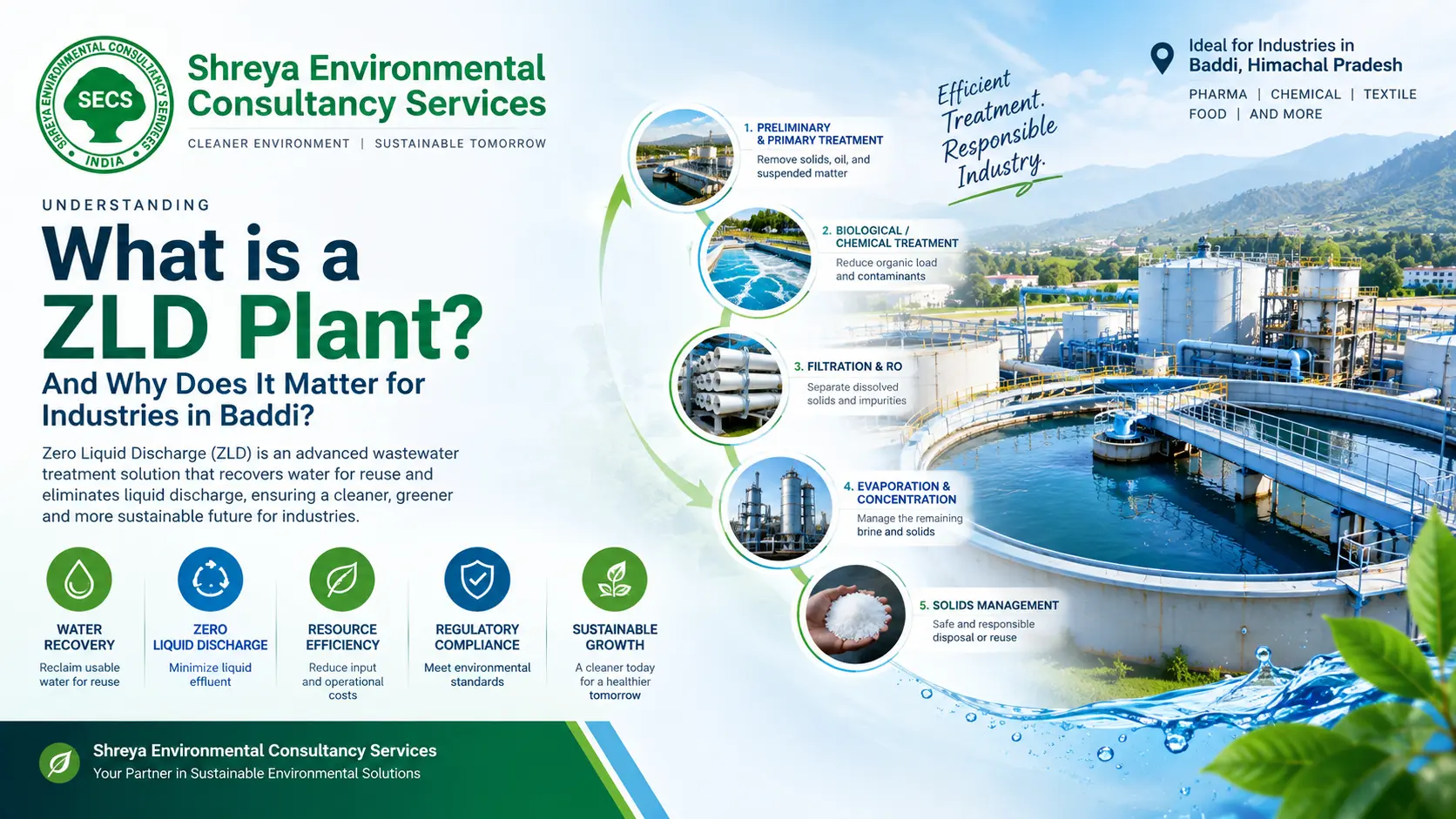
A ZLD plant normally works through a sequence of treatment and concentration stages. The exact process varies from project to project, but the basic concept is to remove contaminants progressively and recover as much usable water as practical before concentrating the remaining wastewater.
1. Primary and Preliminary Wastewater Treatment
The first stage generally focuses on removing larger solids, oil, suspended matter and other contaminants that could interfere with downstream treatment equipment.
Depending on the wastewater characteristics, this stage can include screening, equalization, oil and grease removal, pH correction, coagulation, flocculation and clarification. Proper pretreatment is important because membrane and thermal systems perform more reliably when the incoming wastewater has been appropriately conditioned.
2. Biological or Chemical Treatment
Where biodegradable organic matter is present, biological treatment may be incorporated into the overall treatment train. Chemical treatment can also be used where specific contaminants require precipitation, oxidation or other forms of conditioning.
The objective is to reduce the contaminant load before advanced treatment stages such as filtration and reverse osmosis.
3. Tertiary Treatment and Filtration
After the primary and secondary stages, additional filtration may be required to produce water quality suitable for the next treatment step. Depending on the design, this may involve pressure sand filtration, activated carbon filtration, micron filtration, ultrafiltration or other polishing processes.
Good pretreatment helps protect downstream membranes and can improve the stability of the overall industrial wastewater treatment system.
4. Reverse Osmosis (RO)
Reverse osmosis is an important component in many ZLD configurations because it can separate a substantial portion of dissolved salts and contaminants from treated wastewater.
The RO process generally produces two important streams: permeate and reject. The permeate can potentially be reused within the facility, depending on its quality and the intended application. The reject stream contains a higher concentration of dissolved substances and therefore requires further management in a ZLD system.
For this reason, RO reject treatment is an important part of many industrial water recovery projects.
5. Evaporation and Concentration
When RO reject or another concentrated wastewater stream cannot be economically treated through conventional membrane processes alone, evaporation can be used to further concentrate the dissolved solids.
A Multiple Effect Evaporator (MEE) is one technology that may be used for this purpose. The evaporator separates water from the concentrated wastewater by using thermal energy, producing a condensate stream and a concentrated residual stream.
Depending on the wastewater and project requirements, other evaporation technologies may also be considered.
6. MVR Technology
Mechanical Vapour Recompression (MVR) can be used in suitable applications to improve the energy efficiency of evaporation by compressing and reusing vapour generated during the evaporation process.
MVR selection depends on factors such as wastewater composition, evaporation load, operating conditions, energy availability and project economics. It should therefore be evaluated as part of the complete process design rather than selected independently.
7. ATFD and Final Concentrate Management
An Agitated Thin Film Dryer (ATFD) may be used as a final concentration or drying stage in certain ZLD configurations. It can help convert concentrated liquid or slurry into a more manageable solid or semi-solid residue.
The final residual material still needs appropriate handling, storage, recovery or disposal according to its characteristics and applicable requirements.
Typical ZLD Process Flow
Although every project requires its own process design, a simplified ZLD treatment sequence can look like this:
- Industrial wastewater collection
- Equalization and preliminary treatment
- Physico-chemical and/or biological treatment
- Tertiary filtration and polishing
- Reverse osmosis
- Permeate recovery and reuse
- RO reject concentration
- MEE or another suitable evaporator system
- Further concentration or drying using technologies such as ATFD where required
- Final concentrate or solid residue management
The actual configuration should always be developed from wastewater analysis, flow data, process requirements and the intended water-reuse strategy.
What Are the Main Benefits of a ZLD System?
The value of a zero liquid discharge plant is not limited to the treatment of wastewater. A well-designed system can support broader water-management objectives within an industrial facility.
Water Recovery and Reuse
One of the primary objectives of ZLD is to recover treated water for suitable reuse applications. Depending on the final water quality, recovered water may potentially be reused for utilities, cooling, washing, process applications or other non-potable requirements.
Reduced Liquid Waste Discharge
ZLD can significantly reduce the quantity of liquid wastewater requiring external discharge by progressively concentrating the residual stream and recovering water during treatment.
Better Management of High-TDS Wastewater
High-TDS wastewater and RO reject can be challenging to manage using conventional treatment alone. A properly engineered ZLD system provides additional treatment and concentration stages for these streams.
Improved Water-Management Strategy
Instead of viewing wastewater only as waste, ZLD encourages industries to consider wastewater as a stream from which water can be recovered and reused while the remaining contaminants are concentrated for controlled management.
Support for Industrial Water Conservation
Recovering and reusing treated water can reduce dependence on fresh water for suitable industrial applications. The actual savings depend on the facility's water balance, wastewater characteristics and reuse opportunities.
ZLD for Pharmaceutical and Chemical Industries
Pharmaceutical and chemical manufacturing can generate wastewater with complex and variable characteristics. Depending on the production process, wastewater may contain organic compounds, dissolved salts, process chemicals and other contaminants.
For such facilities, pharmaceutical wastewater treatment and chemical wastewater treatment often require a treatment train designed around the specific wastewater rather than a generic plant configuration.
A potential ZLD approach may combine an ETP, tertiary treatment, RO, MEE, MVR and ATFD, but not every project requires every technology. Laboratory analysis, pilot testing where appropriate and process engineering are important for determining the practical configuration.
For industries looking for a broader treatment solution, Shreya Environmental Consultancy Services also provides water and wastewater treatment solutions designed around industrial treatment requirements.
How to Select a ZLD Plant Manufacturer in Baddi
Selecting a ZLD plant manufacturer in Baddi should involve more than comparing equipment prices. A ZLD plant is an integrated process system, and the performance of one stage can directly affect the next stage.
Before finalizing a ZLD project, industries should evaluate the following factors:
- Wastewater quantity and daily flow variation
- pH, TDS, COD, BOD, TSS and other relevant parameters
- Specific chemicals and contaminants present in the wastewater
- RO feed-water quality and expected reject characteristics
- Required treated-water quality
- Potential water-reuse applications
- Energy availability and operating cost
- Evaporation requirements and concentrate characteristics
- Space available for the treatment plant
- Automation, monitoring and control requirements
- Operation and maintenance requirements
- Final management of concentrated residue or solids
A good ZLD project begins with understanding the wastewater, not with selecting a machine from a standard catalogue.
ZLD Plant Design Should Be Based on Wastewater Characteristics
There is no single ZLD configuration that is ideal for every industry. Two factories with the same wastewater flow may still require completely different treatment systems because their wastewater chemistry and production processes are different.
For example, a pharmaceutical facility may have a different organic and salt profile from a textile, chemical or food-processing facility. Similarly, an RO reject stream may require a different concentration strategy depending on its TDS, scaling potential, silica, hardness and other characteristics.
For this reason, a professional ZLD wastewater treatment design should begin with wastewater characterization and a proper process evaluation.
ETP, RO and ZLD: How Are They Connected?
ETP and ZLD should not be considered competing technologies. They can be different stages of a broader industrial wastewater treatment strategy.
An ETP system can provide the initial treatment required to reduce pollutants and improve wastewater quality. RO can then be used for advanced separation and water recovery where appropriate. The concentrated RO reject may subsequently require additional treatment through evaporation or other concentration technologies as part of a ZLD system.
This relationship can be summarized as:
- ETP: Treats industrial effluent and reduces the contaminant load.
- RO: Separates dissolved contaminants and produces a recoverable permeate stream.
- MEE/MVR: Concentrates suitable high-TDS or reject streams.
- ATFD: Can provide final drying or concentration in suitable applications.
- ZLD: Integrates these and other treatment stages into a water-recovery and residual-management strategy.
Why Professional Process Design Matters
ZLD systems can involve multiple treatment technologies, pumps, membranes, heat exchangers, evaporators, instruments and control systems. Poor integration between these stages can increase energy consumption, membrane fouling, scaling, downtime and maintenance requirements.
Professional process design therefore considers the entire treatment chain rather than optimizing only one piece of equipment.
Important design considerations include hydraulic loading, chemical compatibility, scaling control, membrane protection, evaporation load, heat recovery, automation and the quality of recovered water.
Operation and Maintenance of a ZLD Plant
Installing a ZLD plant is only one part of achieving consistent wastewater treatment performance. Regular operation and maintenance are equally important.
Membranes need appropriate cleaning and monitoring. Pumps and mechanical equipment require inspection. Evaporators need attention to scaling and operating conditions. Instruments and sensors need calibration, and the complete process should be monitored to identify changes in wastewater characteristics.
For facilities requiring ongoing plant support, operation and maintenance services can help keep the treatment system operating according to its design requirements.
Why Wastewater Testing Should Come Before ZLD Selection
Before investing in a ZLD system, industries should understand exactly what is present in their wastewater.
Important parameters can include pH, TDS, conductivity, COD, BOD, TSS, hardness, chloride, sulphate, silica and other industry-specific contaminants. The exact testing requirements depend on the process and wastewater source.
Wastewater analysis helps engineers determine which treatment stages are necessary and whether membrane or thermal processes are technically suitable.
This approach can prevent unnecessary equipment, reduce process risks and create a more practical long-term wastewater treatment solution.
Turnkey ZLD Project Execution
For industries planning a complete wastewater treatment project, turnkey execution can bring process engineering, equipment supply, installation, commissioning and related project activities together under one coordinated approach.
Shreya Environmental Consultancy Services also provides turnkey project execution for industrial water and wastewater treatment requirements.
Where required, environmental planning and regulatory support can also form part of the overall project approach. Industries can explore environmental consultancy services alongside their treatment-system requirements.
Choosing the Right ZLD Solution for Your Industry
The right ZLD plant in Baddi should be selected according to the actual wastewater problem rather than simply choosing the most complex treatment system available.
A practical evaluation should answer several questions:
- How much wastewater is generated each day?
- What contaminants are present?
- How much treated water can realistically be reused?
- What is the expected RO recovery and reject load?
- Does the reject require thermal concentration?
- What evaporation technology is suitable?
- What will happen to the final concentrated residue?
- What are the expected energy and chemical requirements?
- How will the plant be operated and maintained?
Answering these questions before equipment selection helps create a treatment system that is technically appropriate and operationally practical.
Frequently Asked Questions About ZLD Plants
What is a ZLD plant?
A ZLD plant is an advanced wastewater treatment system designed to recover water and minimize or eliminate liquid effluent discharge by treating and concentrating the remaining wastewater streams.
Is ZLD required for every industry in Baddi?
No single ZLD configuration should be assumed to be necessary for every industry. The requirement depends on the industry's wastewater characteristics, applicable requirements, discharge or reuse objectives and technical and economic feasibility. A wastewater assessment should be completed before selecting a ZLD system.
What technologies are used in a ZLD system?
Depending on the application, a ZLD system may include ETP treatment, filtration, reverse osmosis, MEE, MVR, ATFD and other supporting treatment technologies. The exact combination depends on the wastewater and required treatment objective.
What is the role of RO in ZLD?
RO can recover a significant portion of treated wastewater as permeate while concentrating dissolved salts and other contaminants into the reject stream. The reject can then be sent for further treatment or concentration where required.
What is MEE in a ZLD plant?
MEE stands for Multiple Effect Evaporator. It is a thermal concentration technology that can be used to evaporate water from suitable concentrated wastewater streams and produce a more concentrated residual stream.
What is MVR in wastewater treatment?
MVR stands for Mechanical Vapour Recompression. It can improve evaporation energy efficiency in suitable applications by compressing and reusing vapour generated during the evaporation process.
What is ATFD used for?
ATFD stands for Agitated Thin Film Dryer. In suitable ZLD applications, it can be used for further concentration or drying of concentrated liquid or slurry streams to produce a more manageable residual material.
Can ZLD water be reused?
Recovered water from a ZLD system may be suitable for selected industrial reuse applications depending on its quality and the requirements of the intended reuse point. The final reuse decision should be based on water-quality testing and process requirements.
How is a ZLD plant designed for an industry?
A ZLD plant should be designed using wastewater flow data, laboratory analysis, contaminant characteristics, recovery objectives, available utilities, space, operating conditions and the required final water quality. Process engineering should be completed before final equipment selection.
Conclusion
Zero Liquid Discharge can be an important part of an industrial water-management strategy where wastewater recovery, RO reject treatment and reduction of liquid discharge are key objectives. For industries in Baddi and the wider Himachal Pradesh industrial region, the right ZLD approach depends on the specific wastewater generated by the facility.
A successful ZLD wastewater treatment project brings together pretreatment, advanced filtration, RO, concentration and residual-management technologies in a coordinated process. Technologies such as MEE, MVR and ATFD can play important roles in suitable applications, but they should be selected based on actual wastewater characteristics and process requirements.
Shreya Environmental Consultancy Services provides industrial water and wastewater treatment solutions, including ETP, RO and ZLD-related treatment systems, with solutions developed around the requirements of individual industrial applications.
If your industry is evaluating a ZLD plant in Baddi, Himachal Pradesh, start with wastewater characterization, process evaluation and a clear water-recovery objective. A properly engineered system can then be developed around those requirements.
Explore the complete Zero Liquid Discharge solutions available for industrial wastewater treatment.