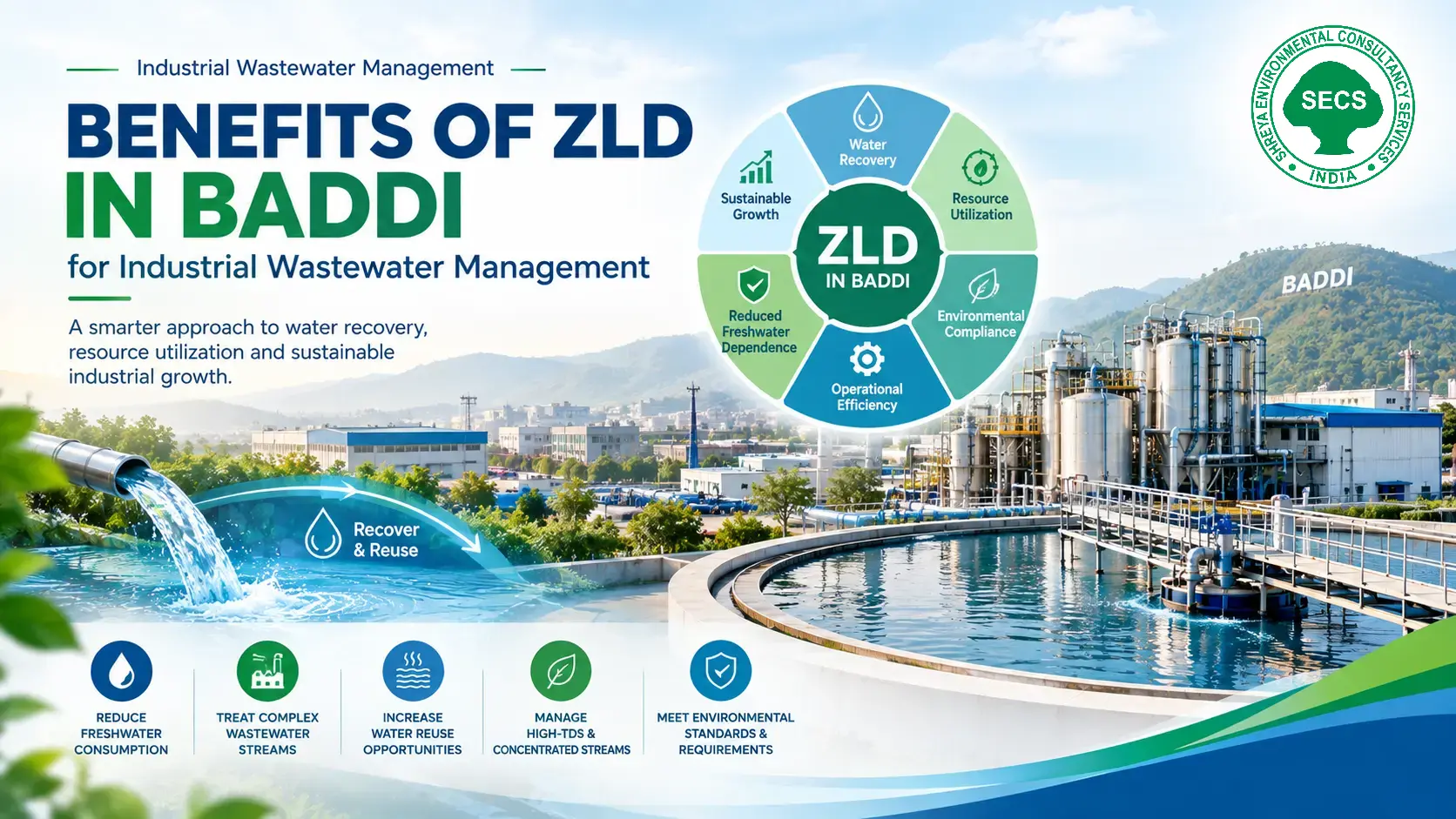
Benefits of ZLD in Baddi for Industrial Wastewater Management
For industries operating in Baddi and other industrial regions of India, managing wastewater is no longer only about treating effluent before disposal. Increasing water demand, complex industrial wastewater streams, high dissolved solids and the need for responsible water management are pushing industries toward more advanced treatment and recovery strategies.
This is where ZLD in Baddi becomes an important consideration for industries that need to minimize liquid discharge while recovering water from difficult wastewater streams. A well-designed Zero Liquid Discharge (ZLD) system is not simply an additional treatment unit. It is an integrated approach that combines wastewater treatment, water recovery, concentrate management and reuse.
For industrial facilities, the value of a ZLD plant in Baddi therefore extends beyond the treatment process itself. It can help industries reduce freshwater dependence, manage concentrated wastewater, improve resource utilization and develop a more controlled wastewater management strategy.
Shreya Environmental Consultancy Services works with industries on wastewater treatment and environmental engineering requirements across India, with Baddi and Himachal Pradesh serving as an important industrial focus area. The right ZLD approach, however, always depends on the industry's wastewater characteristics, water balance, production requirements and treatment objectives.
Why Industrial Wastewater Management Is Becoming More Challenging
Industrial wastewater is rarely a single, simple stream. Depending on the manufacturing process, it can contain organic matter, suspended solids, dissolved salts, chemicals, colour, oils, heavy metals or other contaminants. The wastewater profile can also change with production volume, raw materials, cleaning cycles and process modifications.
This makes industrial wastewater management different from simply installing a standard treatment plant and expecting the same performance under every operating condition.
Industries in industrial clusters such as Baddi may also need to balance several requirements at the same time:
- Reducing freshwater consumption
- Treating wastewater generated during production
- Increasing the amount of water available for internal reuse
- Managing high-TDS and concentrated wastewater streams
- Reducing dependence on external wastewater disposal
- Maintaining consistent treatment performance
- Meeting applicable environmental and discharge requirements
For some industries, conventional treatment may be sufficient for the intended application. For others, particularly where water recovery and minimization of liquid discharge are important objectives, a ZLD-based approach can provide a more comprehensive wastewater management framework.
Before selecting any treatment technology, industries should therefore understand their complete wastewater profile and water balance. A properly planned Effluent Treatment Plant (ETP) may form an important part of this strategy, while additional treatment and recovery stages can be integrated where required.
Where Conventional Wastewater Management Can Reach Its Limits
Conventional wastewater treatment is primarily designed to reduce pollutants to the required treatment level. However, treatment does not necessarily mean that every component of the wastewater disappears.
After biological, physical or chemical treatment, certain dissolved substances can remain in the treated stream. Reverse osmosis can further recover water, but the process produces a concentrated reject stream that still requires appropriate management.
This is one of the areas where a ZLD strategy becomes different.
Instead of considering the treatment plant and the concentrated reject as separate problems, ZLD approaches the wastewater stream as a complete system. Water that can be recovered is separated for reuse, while concentrated streams are further managed through appropriate treatment, evaporation and solids-handling stages.
The exact configuration varies from industry to industry. There is no single ZLD process that is suitable for every wastewater composition.
How ZLD Changes the Industrial Wastewater Management Approach
The most important change introduced by ZLD is the shift from a discharge-oriented approach toward a recovery-oriented approach.
In a conventional wastewater management model, the main objective may be to treat wastewater to the required quality before its permitted discharge or reuse. In a ZLD-oriented model, the objective is broader: recover as much usable water as practical while managing the remaining concentrated material in a controlled manner.
This means a ZLD system can become part of an industry's overall water management strategy rather than functioning as an isolated piece of equipment.
A properly designed system may integrate existing treatment infrastructure such as an ETP or RO system with additional concentration and solids-management stages. This integrated approach allows the treatment system to be designed around the actual industrial process instead of forcing every industry into the same configuration.
Major Benefits of ZLD for Industrial Wastewater Management
The benefits of a Zero Liquid Discharge system should be evaluated from both environmental and operational perspectives. Depending on the wastewater characteristics and plant design, the major benefits can include improved water recovery, reduced liquid discharge, better management of concentrated wastewater and reduced dependence on external water resources.
1. Greater Water Recovery and Reuse
One of the most important reasons industries consider ZLD is the opportunity to recover treated water and return it to suitable industrial applications.
Instead of treating wastewater as a one-way stream, the system can be designed around a water-reuse cycle. Recovered water may be suitable for selected applications depending on its quality and the industry's process requirements.
This can help industries reduce the amount of freshwater required for operations where recovered water is technically suitable.
Water recovery is especially valuable for water-intensive industries where production processes require a continuous and reliable water supply. The actual recovery level depends on wastewater quality, pretreatment, membrane performance, evaporation technology and the overall process design.
2. Reduced Liquid Wastewater Discharge
The defining objective of ZLD is to minimize or eliminate liquid discharge from the ZLD system by recovering water and managing the remaining concentrated material as a controlled stream.
This can be particularly relevant for industries where discharge options are limited or where wastewater contains high concentrations of dissolved solids that make direct discharge or conventional treatment more challenging.
Rather than relying entirely on an external discharge route, the industry can manage the wastewater internally through a planned treatment and recovery system.
3. Better Management of RO Reject
Reverse osmosis is widely used for industrial water recovery, but RO does not eliminate dissolved salts. Instead, it separates the feed into a permeate stream and a concentrated reject stream.
For industries using RO as part of their wastewater treatment strategy, managing this reject stream is therefore an important consideration.
A ZLD system can incorporate appropriate downstream treatment for RO reject, depending on its composition and volume. Concentration and evaporation technologies may be used to further reduce the liquid fraction, while the remaining solids or crystallized material can be handled according to the project requirements.
This makes RO reject treatment an important part of the overall ZLD planning process rather than something that should be addressed after the RO system has already been installed.
4. Reduced Dependence on Freshwater Sources
Water recovery can have an important effect on an industry's overall water balance.
When suitably treated water is reused within the facility, the demand for fresh water can potentially be reduced. The actual reduction depends on the industry's production process, existing water consumption, reuse opportunities and the quality requirements of individual applications.
This approach can support a more efficient industrial water cycle in which water is recovered, treated and reused multiple times where technically appropriate.
For water-intensive manufacturing facilities, improving the internal water balance can become an important part of long-term operational planning.
5. Improved Control Over Difficult Wastewater Streams
Some industrial wastewater streams become increasingly difficult to manage as contaminants become concentrated during treatment.
High-TDS wastewater, RO reject and other concentrated streams require treatment strategies that are different from conventional low-strength wastewater.
ZLD provides a framework for managing these streams as part of the complete wastewater treatment chain. Rather than treating concentrated wastewater as an afterthought, its generation, movement, treatment and final handling can be considered during the initial plant design.
This can improve the overall predictability of wastewater management and help industries plan for concentrate handling before the plant is commissioned.
6. More Controlled Concentrate and Salt Management
When water is progressively removed from a concentrated wastewater stream, dissolved salts and other non-volatile substances become increasingly concentrated.
Depending on the wastewater characteristics and system configuration, evaporation and crystallization technologies can be used to further reduce the liquid fraction and produce a more manageable solid output.
Technologies such as Multiple Effect Evaporators (MEE), Mechanical Vapour Recompression (MVR) and Agitated Thin Film Dryers (ATFD) can form part of a ZLD system where technically appropriate.
The selection of these technologies should not be based simply on the name of the equipment. Feed characteristics, flow rate, scaling potential, energy requirements, desired recovery and solids properties all need to be evaluated during engineering.
For a deeper understanding of the technologies used in ZLD systems, industries can also explore our guide on ZLD plant technologies including RO, MEE, MVR, ATFD and crystallization.
7. Better Resource Utilization
ZLD can support a more resource-conscious approach to industrial wastewater management by focusing on what can be recovered from the wastewater stream.
The primary resource is water, but the overall system can also improve the way concentrated materials are identified, collected and managed.
Where the recovered water meets the required quality, it may be returned to suitable industrial uses. Concentrated solids can then be managed through an appropriate disposal or handling route based on their characteristics and applicable requirements.
This creates a more structured relationship between production, water consumption, wastewater generation and waste management.
How ZLD Can Support Environmental Protection
Industrial wastewater management has implications beyond the factory boundary. Poorly controlled wastewater can create risks for surrounding water resources, soil and the broader environment.
A ZLD approach is designed to minimize liquid discharge from the treatment system and maximize water recovery. This can help industries reduce their dependence on discharge-based wastewater management where ZLD is technically and economically appropriate.
However, ZLD should not be viewed as a replacement for good wastewater treatment practices. Proper pretreatment, process control, monitoring and operation remain essential.
Environmental performance depends on the complete treatment system, not simply on installing a ZLD unit.
For industries that need broader environmental planning alongside wastewater treatment, environmental consultancy services can help connect wastewater management with the wider environmental requirements of an industrial facility.
Which Industries Can Benefit From ZLD?
ZLD can be considered across several industrial sectors where water consumption is significant, wastewater contains difficult-to-manage dissolved solids, or minimizing liquid discharge is an important project objective.
Pharmaceutical Industries
Pharmaceutical manufacturing can generate wastewater with varying chemical characteristics depending on production processes, cleaning operations and product streams. Integrated wastewater treatment and water-recovery systems can therefore play an important role in responsible water management.
Chemical Industries
Chemical manufacturing may generate wastewater with high dissolved solids, complex contaminants or variable compositions. ZLD can be considered where conventional treatment and discharge management do not adequately address the industry's water-recovery or concentrate-management objectives.
Textile and Dyeing Industries
Textile processes can generate substantial wastewater volumes containing colour, dissolved solids and other process-related contaminants. Water recovery and concentrate management can become important components of a broader wastewater strategy.
Food and Beverage Industries
Food-processing wastewater can vary significantly depending on raw materials, cleaning processes and production methods. While not every food-processing facility requires ZLD, water-intensive operations may evaluate advanced recovery systems where water reuse is a major objective.
Power and Other Water-Intensive Industries
Power generation and other large industrial operations can produce significant wastewater streams and may have complex water-management requirements. Depending on the site-specific water balance, advanced treatment and recovery systems may be considered.
The suitability of ZLD should always be established through wastewater characterization, process analysis and engineering evaluation rather than by industry category alone.
What Should an Industry Evaluate Before Implementing ZLD?
A successful ZLD plant in Baddi or anywhere else in India begins with understanding the wastewater before selecting the equipment.
Important considerations include:
- Wastewater flow: Daily and peak wastewater generation should be established.
- Wastewater characteristics: TDS, COD, BOD, suspended solids, pH, hardness, silica, chlorides and other relevant parameters should be evaluated according to the wastewater source.
- Existing treatment infrastructure: Existing ETP, RO or other treatment systems should be assessed before deciding whether modification, expansion or integration is required.
- Water reuse requirements: The intended application of recovered water should be defined because different processes can require different water qualities.
- Concentrate characteristics: Scaling, fouling and crystallization potential can influence technology selection.
- Energy availability: Evaporation and thermal concentration stages can have significant energy requirements, so utility availability and efficiency should be evaluated.
- Space and plant layout: Equipment arrangement, access, storage, piping and maintenance requirements need to be considered.
- Operation and maintenance: ZLD systems require appropriate monitoring, cleaning, maintenance and operational control.
- Future production: Planned expansion should be considered so that the system is not designed only around today's wastewater generation.
These factors demonstrate why ZLD should be approached as an engineering project rather than as a standard equipment purchase.
Designing ZLD Around the Industry, Not the Other Way Around
There is no universal ZLD configuration that works identically for every industrial facility.
A pharmaceutical plant, chemical facility, textile unit and food-processing plant can generate very different wastewater streams. Even two factories from the same industry can have different water balances because of differences in raw materials, production processes, cleaning procedures and operating schedules.
A practical ZLD project should therefore begin with wastewater assessment and process understanding.
The treatment strategy may involve a combination of existing and new systems, such as an ETP, RO system, evaporation, crystallization and other supporting treatment stages.
Where required, operation and maintenance support can also form part of the long-term project strategy to help maintain treatment performance after commissioning.
This project-specific approach is particularly important when the objective is not simply to install a ZLD plant, but to create a reliable water-recovery and wastewater-management system for the facility.
ZLD vs Conventional Wastewater Management: A Practical Perspective
The difference between conventional wastewater management and ZLD is best understood through their overall objectives rather than by comparing individual pieces of equipment.
| Conventional wastewater management | ZLD-oriented wastewater management |
|---|---|
| Primarily focuses on treating wastewater to the required level for discharge or reuse. | Focuses on water recovery and minimizing liquid discharge. |
| Concentrated reject may remain as a separate management challenge. | Concentrated streams are incorporated into the overall treatment strategy. |
| Water and wastewater can be managed as separate operational streams. | Water recovery becomes part of the broader industrial water balance. |
| Suitability depends on applicable discharge and reuse requirements. | Useful where minimizing liquid discharge and maximizing recovery are key objectives. |
This does not mean that ZLD is automatically required for every industry. The appropriate solution depends on wastewater characteristics, regulatory requirements, water availability, reuse objectives, energy considerations and project economics.
When Should an Industry Consider a ZLD System?
ZLD may become particularly relevant when an industry has one or more of the following requirements:
- High freshwater consumption
- Significant wastewater generation
- High-TDS or difficult-to-manage wastewater
- Large RO reject volumes
- Limited wastewater discharge options
- A strong requirement for internal water reuse
- Need for improved control over concentrated wastewater
- Long-term water conservation objectives
However, the presence of one of these conditions does not automatically mean that a particular ZLD configuration will be suitable. A technical assessment should be carried out to determine the appropriate treatment sequence, recovery targets and operating requirements.
Why ZLD Planning Should Include the Complete Wastewater System
One of the most common mistakes in industrial wastewater projects is looking at the final ZLD stage without considering the treatment stages that come before it.
The performance of a ZLD system depends heavily on the quality and consistency of its feed stream. Effective pretreatment can influence membrane performance, scaling potential, evaporation performance and overall system reliability.
This is why ZLD planning should be connected with the complete wastewater treatment strategy.
Depending on the site requirements, this can involve ETP design or upgradation, RO treatment, water recovery, concentrate management, monitoring and long-term operation and maintenance.
Industries looking for a complete wastewater treatment strategy can also explore STP solutions where sewage treatment is part of the site's broader water and wastewater infrastructure.
How Shreya Environmental Consultancy Services Can Support Your ZLD Project
A ZLD project is not limited to the installation of an evaporation or crystallization system. Successful implementation requires the wastewater source, treatment stages, water-recovery objectives, plant layout, operation requirements and long-term environmental management to work together.
Shreya Environmental Consultancy Services provides environmental engineering and wastewater treatment solutions for industrial requirements, with a focus on projects in Baddi, Himachal Pradesh as well as clients and projects across India.
With 20+ years of experience in environmental and wastewater-related projects, Shreya can support industries through different stages of their treatment requirements — from understanding the wastewater problem to planning, execution, commissioning and ongoing operational support.
Our Approach to Industrial Water and Wastewater Projects
- Wastewater Assessment: Understanding wastewater sources, flow and relevant characteristics.
- Treatment Planning: Developing an appropriate treatment strategy based on the site's requirements.
- ETP Integration: Evaluating existing or proposed ETP systems as part of the overall wastewater treatment train.
- RO and Water Recovery: Integrating RO treatment where membrane-based water recovery is appropriate.
- ZLD Integration: Planning appropriate concentration, evaporation and solids-management stages for the project.
- Environmental Consultancy: Connecting wastewater treatment with the broader environmental requirements of the facility.
- Turnkey Project Execution: Supporting projects from engineering and planning through implementation and commissioning.
- Operation & Maintenance: Providing ongoing support where required to help maintain system performance.
Shreya's experience also extends beyond a single wastewater technology. Industrial facilities may require a combination of ETP, STP, WTP, RO, ZLD and environmental consultancy services depending on the site's requirements.
This integrated approach is especially useful for industries that want to look beyond a single treatment unit and develop a complete water and wastewater management strategy.
Whether your facility is located in Baddi, Himachal Pradesh or another industrial region of India, the right ZLD solution should be developed around your wastewater characteristics, production requirements, water-reuse objectives and long-term operating conditions.
Planning a ZLD project or evaluating your existing wastewater treatment system? Connect with Shreya Environmental Consultancy Services to discuss your industrial wastewater requirements and explore a suitable treatment and water-recovery approach.
Frequently Asked Questions About ZLD
What is ZLD in industrial wastewater management?
Zero Liquid Discharge (ZLD) is an approach to wastewater management designed to maximize water recovery and minimize or eliminate liquid discharge from the treatment system. The remaining concentrated material is managed through appropriate concentration, evaporation, crystallization or solids-handling processes depending on the project.
What are the main benefits of a ZLD plant?
Major benefits can include increased water recovery, reduced liquid wastewater discharge, better management of RO reject and concentrated wastewater, reduced freshwater dependence and improved control over industrial water and waste streams.
Is ZLD suitable for every industry?
No. ZLD is not automatically required for every industrial facility. Suitability depends on wastewater characteristics, water consumption, discharge requirements, reuse objectives, available utilities, energy requirements, space and overall project feasibility.
Why is RO reject important in a ZLD system?
RO reject contains a higher concentration of dissolved substances than the original RO feed. If the industry needs to minimize liquid discharge, this concentrated stream may require additional treatment and management. ZLD can incorporate suitable downstream processes for handling RO reject.
Does ZLD completely eliminate wastewater?
ZLD is designed to minimize or eliminate liquid discharge from the ZLD system by recovering water and managing the remaining concentrated material. It does not mean that contaminants disappear; they are concentrated into manageable solid or other residual streams that still require appropriate handling.
How is water recovered in a ZLD plant?
Water recovery can involve multiple treatment stages depending on the wastewater quality. Membrane processes such as RO can recover a significant portion of suitable feed water, while evaporation and other downstream processes can recover additional water from concentrated streams.
What technologies are used in ZLD?
A ZLD system can include technologies such as pretreatment, RO, evaporators including MEE or MVR, ATFD and crystallization. The actual combination should be selected according to wastewater characteristics, flow, recovery objectives and operating requirements.
Can an existing ETP be integrated with ZLD?
Yes, in many projects an existing ETP can form part of the overall ZLD treatment train. However, the existing plant should first be evaluated for capacity, treatment performance, wastewater quality and compatibility with the proposed downstream recovery system.
Is ZLD available only for industries in Baddi?
No. While Baddi is an important industrial focus area for Shreya Environmental Consultancy Services, ZLD and wastewater treatment solutions can be developed for suitable industrial projects across India. The treatment approach is determined by the individual project's wastewater and operational requirements.
How do I know whether my industry needs a ZLD plant?
The first step is to evaluate wastewater quantity, quality, water consumption, existing treatment infrastructure, discharge requirements, reuse objectives and concentrate management requirements. A technical assessment can then determine whether ZLD is appropriate and what treatment configuration may be required.
Conclusion
The value of ZLD in Baddi goes beyond simply reducing wastewater discharge. For industries facing high water consumption, difficult wastewater streams or increasing requirements for water recovery, ZLD can provide a structured approach to recovering usable water and managing concentrated waste.
Its benefits can include improved water reuse, reduced freshwater dependence, better RO reject management, controlled concentrate handling and a more integrated approach to industrial wastewater management.
At the same time, ZLD should never be treated as a one-size-fits-all technology. The right solution depends on the wastewater characteristics, production process, water balance, recovery objectives, available utilities and long-term operating requirements.
For industries in Baddi and across India, working with an experienced environmental engineering partner can help connect ETP treatment, RO, ZLD, water recovery, environmental consultancy and ongoing operation and maintenance into a more complete wastewater management strategy.
Shreya Environmental Consultancy Services supports industrial wastewater and environmental projects with a focus on practical, application-specific solutions designed around the needs of each facility.