
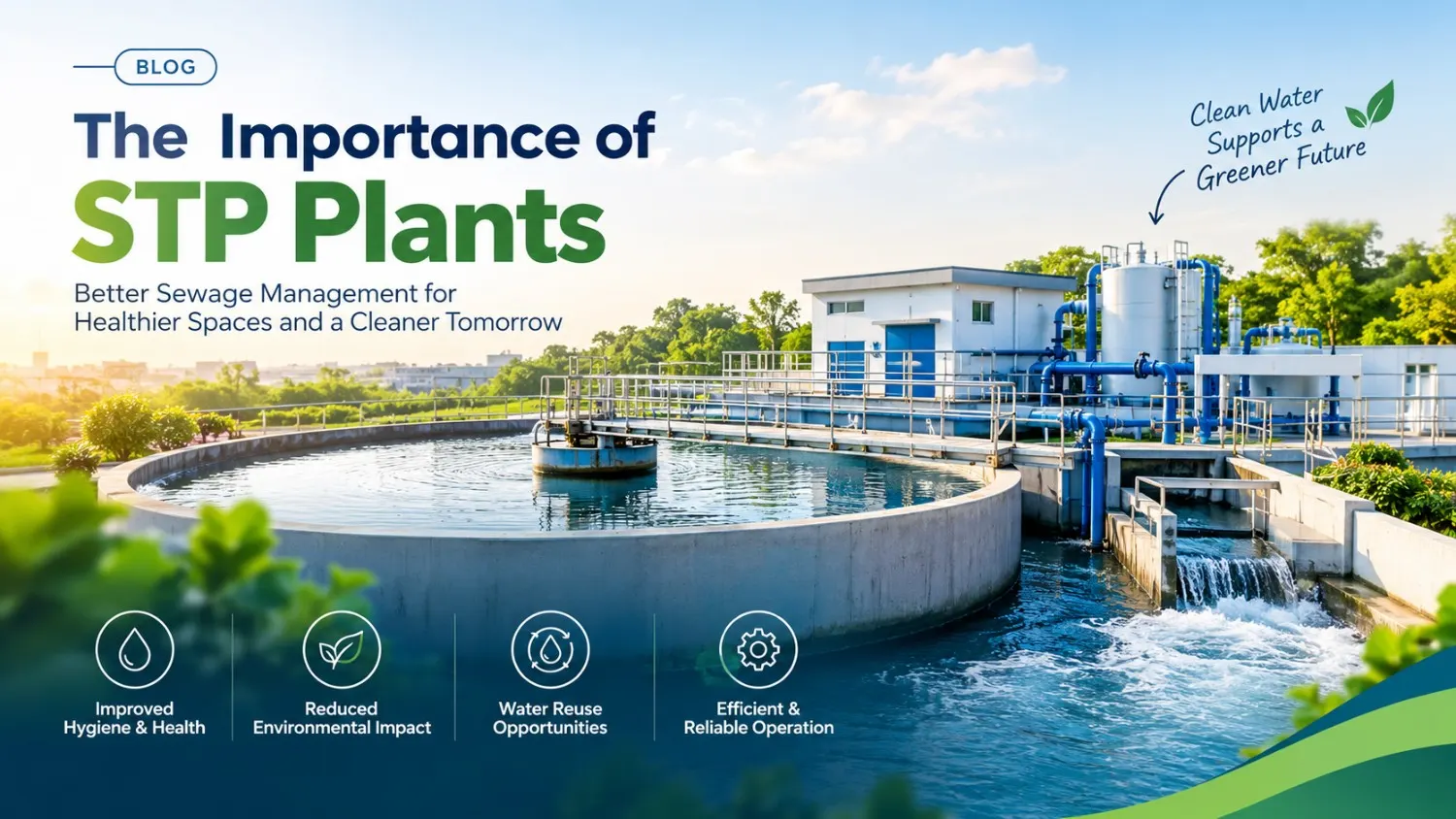
Buildings and industrial facilities generate wastewater every day through toilets, bathrooms, kitchens, washing areas, canteens and other domestic-use facilities. When this wastewater is not managed properly, it can create hygiene problems, unpleasant odours, drainage issues and environmental risks. A well-planned sewage treatment system helps manage this wastewater responsibly and can make treated water available for suitable non-potable applications.
For property owners, builders, facility managers and industrial operators, understanding the importance of an STP plant is an essential part of planning reliable water and wastewater infrastructure. Choosing the right STP service in Baddi can help projects address their sewage management requirements according to site conditions, wastewater quantity, intended reuse and applicable regulations.
Why Is Sewage Management Important for Buildings and Industries?
Sewage management involves collecting wastewater, treating it appropriately and directing the treated water or residual waste towards a suitable reuse, discharge or disposal route. It is an important part of maintaining hygienic premises and reducing the environmental impact of everyday water use.
In residential buildings, sewage mainly comes from toilets, bathrooms, kitchens and laundry areas. Commercial facilities such as hotels, offices, schools and hospitals may generate wastewater from additional activities, including kitchens, washrooms, cleaning operations and staff facilities. Industrial campuses can also produce domestic sewage from administrative buildings, changing rooms, canteens and other common facilities.
Domestic sewage should be distinguished from industrial process wastewater. Wastewater generated during manufacturing may contain chemicals, oils, process residues or other contaminants that require a separate assessment and treatment approach. An appropriate sewage treatment plant is planned around the actual characteristics and quantity of the wastewater it is intended to handle.
What Can Happen When Sewage Is Not Managed Properly?
Inadequate sewage management can affect the daily operation of a property and create avoidable environmental and maintenance concerns. The severity of these issues depends on the volume and characteristics of the wastewater, site conditions and how it is handled.
- Unhygienic surroundings: Poorly managed sewage can contribute to unsanitary conditions around buildings, drains and wastewater collection areas.
- Unpleasant odours: Stagnant wastewater and poorly maintained collection systems may produce odours that affect occupants, employees, visitors and nearby properties.
- Drainage and overflow problems: Inadequate capacity, blockages or poor system planning can result in wastewater overflow and operational disruption.
- Environmental contamination: Releasing inadequately treated sewage can affect receiving water bodies and may contaminate surrounding soil or groundwater, depending on local conditions.
- Missed water reuse opportunities: When wastewater is not treated for an appropriate reuse application, a potential alternative source of water may be lost.
- Maintenance difficulties: Systems that are poorly designed or operated can require additional troubleshooting, cleaning and repairs.
These concerns make sewage treatment an important consideration during the planning of new developments and the improvement of existing facilities. The objective is not simply to move wastewater away from a building, but to manage it through a suitable treatment and handling system.
Why Should Sewage Treatment Be Planned Early?
Planning an STP plant during the design stage can help property developers and facility managers make better decisions about space, drainage connections, equipment access and future operating requirements. Retrofitting a treatment system after a building becomes operational may involve additional civil work, changes to existing pipelines or adjustments to the available utility area.
Early planning also helps establish the expected sewage flow, the variation in wastewater generation throughout the day and the intended destination of treated water. For example, a residential complex may have different peak flow patterns from a hotel, school or industrial campus. These differences influence the capacity and arrangement required for a practical treatment solution.
Where the project requires broader water and environmental planning, environmental consultancy services can help assess the site's requirements and identify relevant considerations before implementation. Project-specific decisions should be based on actual site conditions, applicable approvals and the intended wastewater management route.
How Does an STP Plant Support Better Site Management?
An STP plant provides a planned approach to treating domestic sewage before the treated water is considered for reuse or discharge. When the system is appropriately designed, installed and maintained, it can help a facility manage its wastewater more consistently instead of relying on unplanned or unsuitable handling methods.
For buildings and industrial campuses, this can support more organised utility management, better coordination between drainage and treatment infrastructure, and clearer responsibility for routine operation. It also gives facility teams a defined system to monitor, maintain and review as occupancy or operational needs change.
However, installing an STP alone does not guarantee that every wastewater concern has been resolved. Treatment performance depends on the system design, incoming sewage characteristics, operating conditions, maintenance practices and the quality requirements for the intended reuse or discharge. Treated water must only be used for applications for which it is suitable.
For this reason, sewage treatment should be considered as part of the property's wider water and wastewater management strategy, rather than as an isolated piece of equipment.
Major Benefits of Installing an STP Plant for Buildings and Industries
An STP plant can provide several practical benefits when it is designed around a property's sewage generation, water demand and operating requirements. For residential societies, commercial buildings and industrial campuses, the value of sewage treatment extends beyond wastewater disposal. It can also support water conservation, more organised facility management and responsible environmental practices.
1. Better Management of Daily Sewage Generation
Buildings generate sewage continuously as residents, employees, visitors and other occupants use toilets, bathrooms and washing facilities. Without an appropriate management system, handling this wastewater can become difficult as occupancy increases or daily activities change.
A properly planned STP provides a designated system for collecting and treating domestic sewage. This helps facility managers organise wastewater handling around the expected flow and the site's infrastructure. It is particularly useful for residential societies, hotels, educational institutions and industrial campuses where sewage generation can vary throughout the day.
For a new development, the system should be planned according to expected occupancy and future requirements. For an existing property, an assessment of actual sewage flow and current operating problems can help determine whether a new plant, capacity improvement or system upgrade is appropriate.
2. Opportunities to Reuse Treated Wastewater
One of the most valuable benefits of sewage treatment is the opportunity to reuse treated water for suitable non-potable purposes. Depending on the quality achieved and the applicable requirements, treated wastewater may be considered for activities such as landscape irrigation, gardening, toilet flushing or other approved utility applications.
For example, a residential complex with landscaped areas may be able to use appropriately treated water for gardening instead of relying entirely on freshwater for irrigation. A commercial building may evaluate treated water for toilet flushing if its plumbing, storage and water quality arrangements are suitable.
Reuse should always be planned around the intended application. Treatment requirements, water quality testing, storage, distribution and any additional disinfection must be considered before treated water is supplied for reuse. Water that is suitable for one application should not automatically be assumed suitable for another.
Businesses looking to improve overall water efficiency can also evaluate their wider water treatment requirements alongside sewage treatment. This helps distinguish the water quality needed for different purposes across a facility.
3. Reduced Dependence on Freshwater for Suitable Applications
Where treated wastewater can reliably replace freshwater for selected non-potable uses, a facility may reduce its demand for fresh water. The actual benefit depends on how much suitable treated water is generated, whether there is consistent demand for it and how effectively the reuse system is operated.
Residential buildings, hotels, offices and industrial campuses may have recurring water requirements for flushing, landscaping or other utility purposes. Matching these requirements with an appropriate treated-water supply can help make better use of the water already entering the property.
However, water reuse is not automatic. A project should assess the daily sewage volume, seasonal demand, required treatment quality and available storage before estimating potential freshwater savings. If treated-water production and demand do not match, additional planning may be needed to manage surplus water appropriately.
4. Improved Environmental Protection
Domestic sewage contains organic matter, suspended solids, nutrients, microorganisms and other pollutants that can affect the receiving environment if wastewater is inadequately treated. An appropriately designed and operated STP helps reduce relevant contaminants before the treated water is reused or discharged through an authorised route.
Effective sewage management can therefore contribute to protecting nearby water bodies and reducing the risks associated with uncontrolled wastewater release. It also supports more responsible water management practices across residential, commercial and industrial developments.
Environmental protection depends on actual treatment performance, monitoring and proper handling of the residual sludge generated during treatment. The treatment system and its operating procedures must be suitable for the incoming sewage and the applicable discharge or reuse requirements.
Facilities that generate both domestic sewage and manufacturing wastewater should assess these streams separately where their characteristics require different treatment. An industrial effluent treatment plant may be required for process wastewater, depending on its composition and the project's treatment needs. An STP should not be assumed to replace an ETP when industrial effluent requires separate treatment.
5. Better Hygiene and a More Organised Facility
Proper sewage collection and treatment can help reduce the risk of wastewater accumulation, uncontrolled overflow and unpleasant odours associated with poorly managed systems. These improvements matter in occupied environments where residents, staff, customers and visitors expect clean and functional surroundings.
However, the presence of an STP does not by itself guarantee an odour-free site. Odour control also depends on the condition of collection tanks, ventilation, sludge management, housekeeping, equipment operation and timely maintenance. A well-maintained plant is more likely to support comfortable and orderly site conditions than a neglected or incorrectly operated one.
Facility managers should therefore include routine inspections, cleaning schedules, equipment checks and clear operating responsibilities in their sewage management plan.
6. More Predictable Long-Term Water and Wastewater Management
A treatment plant designed for the site's actual needs can help facility teams establish a more structured approach to wastewater handling. When operating procedures, monitoring records and maintenance schedules are followed, problems can often be identified earlier and managed more systematically.
Long-term operating costs depend on several factors, including the treatment capacity, electricity consumption, equipment condition, chemical requirements where applicable, sludge handling, staffing and maintenance. A plant with an unsuitable design or inconsistent operation may create additional expenses instead of delivering the expected benefits.
For this reason, project evaluation should consider the full operating lifecycle rather than only the initial installation cost. Reliable STP operation and maintenance support can help keep the system aligned with its intended performance, provided the service scope matches the facility's needs.
Are STP Plants Useful for Small Buildings as Well as Large Facilities?
STP requirements are not limited to large industrial campuses or high-rise developments. Smaller residential projects, hotels, schools, offices and other facilities may also need a suitable sewage treatment arrangement, depending on their wastewater generation, available infrastructure and applicable local requirements.
The correct solution depends on factors such as the number of occupants, expected sewage flow, space availability, water reuse plans and the level of treatment required. A smaller facility may need a compact arrangement, while a large development may require a higher-capacity system with more extensive monitoring and operational support.
The key is to assess the actual requirement instead of selecting a plant based only on the building's size or choosing equipment solely because it has a lower purchase price. Proper planning helps ensure that the treatment system is practical to install, operate and maintain over its service life.
Why Do Different Buildings and Industries Need STP Plants?
Although the basic purpose of sewage treatment remains the same, wastewater requirements vary from one facility to another. Occupancy, daily water consumption, operating schedules, available space and the intended use of treated water all influence the type of solution a project needs.
Residential Buildings and Housing Societies
Apartment complexes and residential societies generate sewage from toilets, bathrooms, kitchens and laundry activities. Wastewater flow generally changes with occupancy and daily routines, making it important to assess both average generation and peak flow when planning a treatment plant.
A suitable STP can help manage sewage from multiple residential units and may provide treated water for approved applications such as gardening or toilet flushing. The project should also account for plant access, odour management, sludge handling and the responsibilities of the maintenance team.
For residential developments in Baddi and other growing urban areas, planning sewage infrastructure early can help reduce the difficulty of accommodating a treatment system after the property becomes operational.
Hotels, Hospitals, Schools and Commercial Buildings
Commercial and institutional properties can experience considerable changes in wastewater generation depending on their activities and occupancy. Hotels may have kitchens, laundry facilities and guest washrooms, while schools and offices may experience pronounced peak flows during working hours. Hospitals may generate wastewater streams that need additional assessment because of their specific activities and potential contamination risks.
These differences should be considered before selecting an STP capacity and treatment arrangement. The design should reflect the actual wastewater characteristics and any additional requirements applicable to the facility. Where treated water is intended for reuse, the system should also include appropriate provisions for water quality verification and distribution.
Industrial Campuses and Manufacturing Facilities
Industrial premises often contain administrative offices, staff washrooms, canteens and other facilities that generate domestic sewage. An STP can help manage these domestic wastewater streams independently of the wastewater produced during manufacturing processes, where separate treatment is appropriate.
This distinction is important because industrial process wastewater may contain substances that are not normally present in domestic sewage. Depending on its composition, it may require specialised treatment before discharge or reuse. A combined site assessment helps determine whether separate treatment systems, dedicated collection networks or additional pretreatment measures are needed.
For industrial projects, a coordinated turnkey project execution approach can help align treatment infrastructure with site layout, installation requirements and operational planning. The scope should be clearly defined according to the project's technical and regulatory needs.
What Should You Check Before Selecting an STP Service in Baddi?
Selecting an STP service provider involves more than comparing equipment prices. The system should be appropriate for the property's wastewater, practical to operate and supported by a maintenance plan that fits the facility's requirements.
1. Assessment of Sewage Quantity and Characteristics
The first step is to estimate the wastewater generated by the building or facility. Occupancy, water consumption, operating hours and the nature of daily activities all help determine the expected flow. Where wastewater characteristics are uncertain or unusual, appropriate sampling and analysis may be necessary.
Accurate assessment helps avoid selecting a plant that is too small for the actual load or unnecessarily large for the requirement.
2. Available Space and Site Conditions
The proposed location should provide sufficient space for the treatment units, access for maintenance, ventilation where required, electrical arrangements and safe movement around equipment. Existing buildings may need additional consideration because underground utilities, drainage connections and limited plant rooms can affect installation options.
Access to equipment and provision for sludge removal should also be considered during planning. A plant that fits within the available area but cannot be maintained conveniently may create operational challenges later.
3. Treated Water Quality and Intended Use
Before finalising the treatment arrangement, identify whether the treated water will be discharged through an authorised route or reused for specific applications. Different uses may require different water quality levels and additional treatment or disinfection.
The project team should establish appropriate testing and monitoring procedures to verify that the treated water meets the relevant requirements. Reuse arrangements should also include suitable storage, distribution and safeguards to prevent confusion between potable and non-potable water supplies.
4. Installation, Testing and Handover
Installation planning should cover civil works, piping, electrical connections, equipment placement and coordination with the site's existing utilities. Before the plant is put into routine operation, the relevant equipment and systems should be checked, and operating procedures should be established.
Clear documentation and operator guidance can help facility teams understand routine checks, maintenance responsibilities and the response required if the plant experiences a fault or unusual wastewater load.
5. Ongoing Maintenance and Technical Support
An STP requires continued attention after installation. Routine responsibilities may include inspecting pumps and blowers, checking treatment performance, cleaning relevant units, monitoring water quality and arranging appropriate sludge handling. The exact schedule depends on the plant design and operating conditions.
Before engaging a service provider, clarify which activities are included in the maintenance scope, how operational issues are reported, what monitoring records are maintained and whether periodic performance reviews are available. A clear service arrangement helps the owner understand the responsibilities of both the provider and the facility's operating team.
STP Services in Baddi for Projects Across India
Baddi is an important industrial location, and its residential, commercial and manufacturing developments have different water and wastewater management requirements. A practical sewage treatment solution should account for the individual project's flow, site conditions, reuse objectives and applicable regulatory requirements rather than relying on a standard design for every facility.
Shreya Environmental provides water and wastewater treatment solutions for different project requirements. Its services cover sewage treatment, effluent treatment and related environmental solutions, with the appropriate scope determined by the needs of each project. You can explore the company's project portfolio to learn more about its work and capabilities.
For projects requiring broader wastewater planning, treatment requirements should be reviewed alongside site conditions, the proposed discharge or reuse route and the relevant approval process. Requirements can differ according to the location, type of development and applicable authorities, so they should be verified for the specific project rather than assumed to be identical everywhere.
Frequently Asked Questions
Why is an STP plant important for buildings?
An STP plant helps buildings manage domestic sewage through an organised treatment process. Depending on treatment performance and applicable requirements, the treated water may be reused for suitable non-potable applications or directed towards an authorised discharge route.
Do all buildings and industries require an STP plant?
Not necessarily. Requirements depend on the project's size, sewage generation, location, existing infrastructure and applicable regulations or approvals. The specific requirement should be verified before selecting a treatment system.
Can treated sewage water be reused?
Yes, treated sewage water may be reused for suitable non-potable applications when its quality meets the requirements of the intended use. Water quality testing, appropriate treatment, safe storage and suitable distribution arrangements are important.
What affects the cost of an STP plant?
Cost depends on treatment capacity, wastewater characteristics, site conditions, civil and electrical work, equipment selection, automation, installation scope and ongoing operating requirements. A site-specific assessment is the best starting point for estimating project costs.
How often does an STP plant need maintenance?
Maintenance frequency depends on the plant design, operating load, equipment and manufacturer's recommendations. Routine inspections and performance monitoring should follow a defined schedule, with additional attention whenever operating conditions change or a problem is identified.
Conclusion
An STP plant plays an important role in managing sewage from residential buildings, commercial facilities and industrial campuses. When appropriately designed and maintained, it can support better wastewater handling, reduce environmental risks and create opportunities to reuse treated water for suitable applications.
For anyone evaluating an STP service in Baddi, the priority should be to understand the project's actual sewage generation, site conditions, treatment requirements and long-term operating needs. Choosing a solution based on these factors helps establish a more practical and reliable wastewater management system.
To discuss your project's requirements, contact Shreya Environmental for further information about sewage treatment and related water and wastewater solutions.