
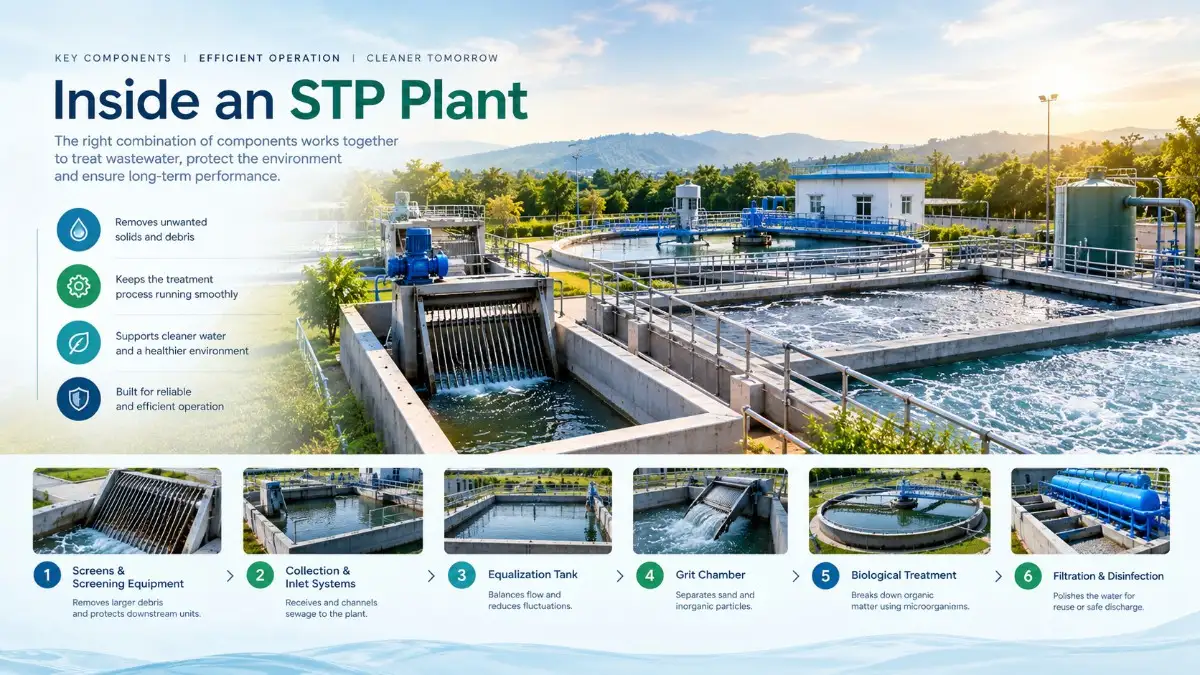
An STP (Sewage Treatment Plant) is made up of interconnected tanks, mechanical equipment and supporting systems that help manage sewage and prepare it for appropriate treatment. Each component has a specific function, from removing unwanted solids at the inlet to maintaining steady wastewater flow and protecting downstream equipment. Understanding these STP plant components helps businesses evaluate equipment requirements, plan maintenance and make informed decisions when installing or upgrading a sewage treatment facility.
The equipment required for an STP depends on sewage flow, wastewater characteristics, available space, operating conditions and the intended use of treated water. A residential complex may require a different configuration from a hotel, hospital, institutional campus or industrial facility. For businesses evaluating an STP plant in Baddi, selecting the right combination of components is essential for reliable operation and long-term performance.
1. Screens and Screening Equipment
Screening equipment is generally installed near the sewage inlet to remove larger unwanted materials before they enter pumps, pipelines and downstream treatment units. Sewage can contain cloth, plastic, paper, sanitary waste and other debris that may obstruct equipment, restrict flow or increase maintenance requirements if not removed at the appropriate stage.
Coarse Screens
Coarse screens capture relatively large solid materials from incoming sewage. They commonly consist of bars or openings designed to retain bulky debris while allowing wastewater to pass through. Depending on the plant's capacity and operating requirements, coarse screening may be performed using manually cleaned screens or mechanically operated equipment.
- Manual bar screens: Suitable for installations where the quantity of collected solids can be managed through routine manual cleaning.
- Mechanical screens: Use a mechanical cleaning arrangement to remove accumulated material and can be beneficial in facilities with higher flow rates or frequent solids accumulation.
- Screenings collection arrangements: Allow the removed waste to be collected and handled safely rather than accumulating around the inlet area.
Choosing between manual and mechanical screening depends on wastewater flow, the nature of incoming debris, available labour and the level of automation required. A screen that is undersized or poorly maintained may cause flow restrictions and operational problems even when the downstream treatment equipment is correctly designed.
Fine Screens
Fine screens capture smaller particles that may pass through coarse screening. They can provide additional protection for downstream equipment when the sewage characteristics and plant design call for a finer level of screening. The appropriate screen opening depends on the expected solids load and the requirements of the treatment system.
Fine screening is not necessary in every STP configuration. It should be selected according to actual operating needs rather than added without considering maintenance requirements, screenings disposal and the possibility of blockage.
Screening Equipment Maintenance
Regular inspection is essential because accumulated debris can reduce the effective opening area and obstruct the flow of sewage. Good operating practices include:
- Cleaning screens at suitable intervals and removing accumulated waste safely.
- Inspecting bars, mesh, mechanical drives and cleaning mechanisms for damage or wear.
- Monitoring unusual water-level differences across the screen, which may indicate blockage.
- Ensuring that collected screenings are handled and disposed of appropriately.
2. Collection Tanks, Equalization Tanks and Grit Chambers
Once larger debris has been removed, sewage may pass through collection chambers, equalization tanks or grit-removal units, depending on the plant's design. These components help manage incoming wastewater, reduce avoidable equipment problems and support more consistent operation. They perform different functions and should not be treated as interchangeable units.
Collection Tank or Inlet Chamber
A collection tank or inlet chamber receives incoming sewage and provides a controlled point for its movement into the treatment system. Where required, pumps transfer wastewater from this chamber to the next unit, particularly when gravity flow is not sufficient because of site levels or equipment layout.
The size and arrangement of the inlet chamber should account for expected sewage flow, incoming solids and the operating requirements of connected pumps. Access for inspection and cleaning is also important because settled debris and accumulated solids can interfere with normal operation.
Equalization Tank
An equalization tank helps balance variations in wastewater flow and, where relevant, variations in wastewater characteristics before sewage enters downstream treatment units. Incoming sewage is not always generated at a constant rate. Residential buildings may experience higher flows during particular hours, while commercial and institutional facilities can have changing usage patterns throughout the day.
By temporarily holding and releasing wastewater at a controlled rate, an equalization tank can reduce sudden hydraulic fluctuations and help downstream equipment operate under more stable conditions. Mixing equipment may be installed to limit solids settling and improve consistency, while aeration may be provided where the design specifically requires it.
Key considerations for equalization tank design include:
- Required holding capacity: Based on variations in incoming flow and the intended operating strategy.
- Mixing arrangements: Selected to manage solids settling and maintain suitable tank conditions.
- Level monitoring: Helps operators identify high levels, low levels and potential pumping issues.
- Odour management: May be necessary depending on wastewater characteristics, retention time and site conditions.
- Cleaning access: Allows accumulated solids and deposits to be inspected and removed when necessary.
An equalization tank does not, by itself, provide complete sewage treatment. Its primary role is to manage variations in the incoming wastewater so that subsequent treatment equipment can operate more consistently.
Grit Chamber
A grit chamber removes heavier inorganic particles, such as sand, grit and small mineral fragments, that may enter the sewage stream. If these materials accumulate in pumps, pipes and tanks, they can contribute to abrasion, blockages, reduced effective capacity and additional cleaning requirements.
Grit-removal equipment is designed to encourage heavier particles to settle while allowing most organic material to continue with the wastewater. The chamber's design and operating conditions influence how effectively grit is separated from the flow.
Depending on the plant configuration, grit may be removed manually or through a dedicated mechanical arrangement. Collected grit should be handled appropriately, and the chamber should be inspected to prevent excessive accumulation. A separate grit chamber is not required in every small-scale STP; its suitability depends on the incoming sewage and the overall engineering design.
How These Inlet Components Work Together
Screens, collection chambers, equalization tanks and grit-removal units perform complementary functions before wastewater reaches the main treatment equipment. Screening removes larger debris, the inlet chamber receives and directs sewage, equalization helps manage flow variations, and grit removal reduces the entry of heavy inorganic particles where that equipment is provided.
The exact sequence varies from one sewage treatment plant to another. Some installations combine functions or use a more compact arrangement, while larger or more demanding facilities may require additional equipment. The configuration should be selected after assessing the wastewater source, expected flow, site conditions and operational requirements.
For an overview of the treatment technologies that may influence equipment selection, explore Shreya Environmental's ETP and STP treatment technologies. The next part will examine aeration tanks, blowers, diffusers, clarifiers and filtration equipment in detail, focusing on what each component does and the factors that affect its selection and performance.
3. Aeration Tanks, Blowers and Diffusers
Aeration equipment is an important part of many biological sewage treatment systems. It supplies oxygen to microorganisms and helps maintain the conditions required to break down biodegradable organic matter. The aeration tank, blower and diffuser work together, but each performs a different function within the treatment plant.
Aeration Tank
An aeration tank provides space for wastewater and biological microorganisms to interact under controlled conditions. Its size, shape, mixing arrangement and operating volume are selected according to the treatment technology, sewage characteristics and required treatment capacity.
When evaluating an aeration tank, important considerations include:
- Tank capacity: Must suit the expected wastewater flow and the process requirements.
- Mixing: Helps maintain suitable contact between wastewater and biological solids and reduces unwanted settling where required.
- Oxygen transfer: Depends on the aeration arrangement, water depth, diffuser performance and wastewater characteristics.
- Access and maintenance: Equipment should be accessible for inspection, cleaning and servicing.
The aeration tank should not be selected by volume alone. Its performance also depends on the biological process, operating conditions and the equipment used to supply and distribute oxygen.
Air Blowers
Air blowers deliver air to the aeration system, typically through a network of pipes and diffusers. Their purpose is to provide the airflow needed by the selected treatment process. If the blower cannot deliver the required airflow and pressure, oxygen supply may become inadequate and treatment performance may deteriorate.
Common considerations when selecting STP blowers include:
- Airflow requirement: The quantity of air needed under the intended operating conditions.
- Operating pressure: Must account for water depth, diffuser resistance and losses across the air distribution system.
- Energy consumption: Blowers can contribute significantly to plant electricity use, so efficiency matters.
- Noise and vibration: Appropriate installation and equipment selection help manage operating noise and mechanical stress.
- Reliability: Standby capacity or alternative operating arrangements may be appropriate where uninterrupted treatment is important.
Blower selection should be based on engineering calculations rather than motor power alone. An oversized blower can waste energy, while an undersized unit may struggle to meet the system's oxygen and airflow requirements.
Diffusers and Air Distribution Pipes
Diffusers distribute air through the wastewater, often in the form of bubbles. Fine-bubble diffusers can provide efficient oxygen transfer under suitable conditions, while coarse-bubble arrangements may be selected where their mixing characteristics and operating requirements are more appropriate. The choice depends on the process design, wastewater properties, maintenance access and energy objectives.
Air distribution pipes carry air from the blower to the diffuser network. Leaks, damaged connections or uneven air distribution can reduce system performance and increase energy consumption.
Routine checks should include:
- Inspecting blower filters, belts, bearings and other serviceable components according to manufacturer recommendations.
- Monitoring unusual noise, vibration, overheating or changes in airflow.
- Checking air pipes and connections for leakage.
- Inspecting diffusers for fouling, blockage or uneven bubbling.
- Recording operating pressure and other available indicators to identify gradual performance changes.
4. Primary and Secondary Clarifiers
Clarifiers are tanks designed to separate settleable solids from wastewater by allowing particles to settle under controlled conditions. Their role depends on where they are installed in the treatment system. A primary clarifier, when included, generally separates settleable solids before biological treatment, whereas a secondary clarifier is commonly used after certain biological processes to separate biological solids from the treated water.
Primary Clarifier
A primary clarifier allows suspended and settleable material to collect at the bottom of the tank, while floating matter may be removed from the surface where the equipment provides for it. The settled material forms sludge that must be removed and managed appropriately.
Primary clarification may reduce the solids load entering downstream biological treatment. However, it is not included in every STP design. Some systems use alternative configurations, compact treatment arrangements or biological processes designed around a different sequence of equipment.
Important primary clarifier components may include:
- Inlet distribution: Helps introduce wastewater in a way that limits unnecessary turbulence.
- Settling zone: Provides the conditions required for settleable solids to separate from the water.
- Sludge collection and removal: Transfers accumulated solids for further handling.
- Outlet arrangement: Collects clarified wastewater while limiting the carryover of floating or settled material.
Secondary Clarifier
A secondary clarifier is commonly used with biological treatment systems that produce suspended biological solids, such as conventional activated sludge processes. It separates these solids from the treated wastewater after the biological stage. The clarified water moves forward, while settled biological sludge is collected for management or, in applicable processes, returned to the biological treatment stage.
Its performance affects the amount of suspended solids carried into downstream treatment. Poor settling, excessive sludge accumulation, hydraulic overloading or mechanical problems can lead to solids escaping with the outlet water.
Key equipment and operating considerations include:
- Sludge collection mechanism: Removes settled solids from the tank floor where mechanical collection is provided.
- Outlet weirs and launders: Collect clarified water and help maintain an even outlet flow.
- Sludge withdrawal: Must be managed to prevent excessive accumulation inside the clarifier.
- Surface scum removal: Helps remove floating material where required by the design.
- Settling performance: Should be monitored alongside biological process conditions and the quality of the outlet water.
Not all sewage treatment plants use a conventional secondary clarifier. Some technologies incorporate membrane separation or other solids-separation arrangements instead. Equipment requirements must therefore be matched to the selected process rather than assumed to be identical across all STPs.
5. Filters and Final Treatment Equipment
Filtration and other final-treatment equipment may be installed after the main treatment stages to reduce remaining suspended particles or help the treated water meet its intended quality requirements. The necessary equipment depends on whether the water will be discharged, reused for landscaping or flushing, supplied for another approved non-potable application, or sent for further treatment.
Pressure Sand Filters
A pressure sand filter passes water through a granular filter bed to capture suspended particles that remain after upstream treatment. The filter vessel contains the media and supporting components required to distribute water and collect the filtered outlet.
Its effectiveness depends on the incoming water quality, filter media, filtration rate and operating condition. Excessive solids loading can increase pressure loss and shorten the time between cleaning cycles. Backwashing is commonly used to remove accumulated material from the filter bed, provided the equipment is designed for this operation.
Activated Carbon Filters
Activated carbon filters use porous carbon media to adsorb certain dissolved organic compounds and substances that may contribute to colour or odour. Their suitability depends on the contaminants present and the quality objectives for the treated water. They do not remove every dissolved contaminant and should not be treated as a universal replacement for other treatment processes.
Activated carbon media gradually loses effectiveness as adsorption capacity is used. Depending on the application, the media may need replacement or regeneration according to the supplier's guidance and the plant's performance requirements.
Disinfection Equipment
Disinfection equipment is used where a reduction in microorganisms is required to meet the intended discharge or reuse criteria. Common options include chlorination and ultraviolet (UV) disinfection, although the appropriate method depends on water quality, operating requirements and applicable standards.
- Chlorination systems: Use controlled chemical dosing to achieve the required disinfection conditions. Dose management and chemical safety are essential.
- UV systems: Expose water to ultraviolet light. Performance depends on factors such as UV intensity, exposure conditions and water clarity.
- Monitoring: Operators should verify that the selected system is functioning as intended and that the treated water meets the relevant quality requirements.
Disinfection requirements should be determined from the intended use of the treated water and the applicable standards. Filtration or disinfection equipment cannot compensate for a poorly performing upstream treatment process.
When Is Advanced Filtration Required?
Some applications require more than conventional filtration and disinfection. Where the intended reuse application or water-quality target requires additional reduction of dissolved substances, a suitable membrane-based process may be considered after evaluating the feed-water quality and operating costs. For example, reverse osmosis water treatment may be appropriate for specific dissolved-contaminant removal requirements, but it is not automatically necessary for every STP.
The selection of filters and final-treatment equipment should be based on actual water-quality requirements, not simply on the number of treatment units installed. Appropriate sizing, routine cleaning, media replacement and performance monitoring all contribute to consistent operation.
6. Pumps, Pipelines, Valves and Chemical Dosing Systems
Pumps, pipelines and valves help wastewater move between different units of a sewage treatment plant. Their selection affects flow control, energy consumption and the reliability of the overall system. Chemical dosing equipment may also be required where the treatment design includes pH adjustment, coagulation, disinfection or other chemical processes.
STP Transfer Pumps
Transfer pumps move sewage or partially treated water between tanks and treatment units when gravity flow is not possible or practical. Depending on the application, the plant may require sewage pumps, submersible pumps, sludge pumps or other pump types designed for the fluid being handled.
Important selection considerations include:
- Flow rate and head: The pump must deliver the required flow against the total system resistance and elevation difference.
- Solids-handling capability: Pumps handling raw sewage or sludge must suit the expected solids and debris characteristics.
- Material compatibility: Wetted parts should be appropriate for the fluid and operating environment.
- Operating reliability: Standby pumps or alternative pumping arrangements may be required where interruptions could affect plant performance.
- Maintenance access: Pumps should be installed so they can be inspected, removed and serviced safely.
Repeated pump blockage, unusual vibration, leakage or a change in operating noise can indicate a developing problem. Routine inspection helps identify these issues before they lead to prolonged downtime.
Pipelines and Valves
Pipelines connect tanks, pumps, filters and other treatment equipment. Valves allow operators to isolate equipment, regulate flow or redirect water during maintenance and operating changes. Pipe diameter, material, routing and pressure rating should be selected according to the fluid, flow conditions and system design.
- Inspect pipelines and joints for leakage, corrosion, damage and signs of movement.
- Check valves for correct operation and ensure that isolation points remain accessible.
- Label important pipelines and valves to make operation and maintenance safer.
- Investigate recurring pressure loss or flow imbalance instead of relying only on adjustments at individual valves.
Chemical Dosing Systems
Some STPs use chemical dosing systems to support specific treatment requirements. A typical arrangement may include a chemical storage tank, dosing pump, injection point and associated controls. Depending on the treatment design, chemicals may be used for pH adjustment, coagulation, disinfection or other defined purposes.
The chemical, dose and injection location should be selected through appropriate process assessment. Operators should follow chemical handling instructions, use suitable protective equipment and maintain secure storage, spill-control arrangements and dosing records. Chemical dosing should not be added without understanding its purpose and effect on the treatment process.
7. Sludge Handling and Dewatering Equipment
Sludge is generated as solids are removed from sewage and, in biological treatment systems, as microorganisms grow and excess biological solids accumulate. Sludge handling equipment collects, transfers, stores and may dewater this material so it can be managed and disposed of or further processed in accordance with applicable requirements.
Sludge Collection and Transfer Pumps
Sludge collection arrangements remove accumulated solids from clarifiers or other treatment units. Suitable sludge pumps transfer the material to a storage, thickening or dewatering stage where provided. Because sludge can vary in solids concentration and consistency, equipment must be chosen for the expected material rather than selected in the same way as a pump for clean water.
Sludge Holding Tanks
A sludge holding tank provides temporary storage before further treatment, dewatering or removal from the site. Its required capacity depends on the quantity of sludge generated, the frequency of removal, the dewatering arrangement and the planned operating schedule.
Holding tanks should be inspected for excessive accumulation, leakage, odour issues and access or safety concerns. The sludge should not be allowed to build up indefinitely, as poor management can affect the plant's operation and create additional handling difficulties.
Sludge Dewatering Equipment
Where required, dewatering equipment removes a portion of the water from sludge to reduce its volume and make handling and transport more manageable. The appropriate equipment depends on sludge characteristics, the required solids content, operating capacity, available space and the resources available for operation.
Common options include:
- Filter press: Uses pressure and filter media to separate water from sludge and produce a dewatered cake.
- Decanter centrifuge: Uses centrifugal force to separate solids and liquid in suitable applications.
- Screw press: Uses a screw mechanism and screening arrangement to dewater sludge in applications for which it is suitable.
- Drying beds: Provide an area for water drainage and drying where site conditions, climate and operational requirements permit.
Not every STP requires mechanical dewatering equipment. The choice depends on sludge production, available space, operating resources and the applicable sludge management requirements. Dewatering reduces the amount of water in the sludge but does not, by itself, make the resulting material safe for unrestricted disposal or reuse.
8. Electrical Panels, Sensors and Monitoring Instruments
Electrical and control systems coordinate equipment operation and help operators monitor the condition of the sewage treatment plant. Depending on the installation, these systems may range from basic motor control panels to automated control arrangements with sensors, alarms and programmable logic controllers (PLCs).
Electrical and Control Panels
Control panels provide the electrical switching, protection and control functions required by pumps, blowers, mixers and other powered equipment. A panel may include motor starters, circuit protection, control relays, variable frequency drives or automation components, depending on the design.
Proper electrical protection, clear labelling and safe isolation arrangements are important for equipment reliability and operator safety. Inspection and servicing should be carried out by appropriately qualified personnel.
Sensors and Monitoring Instruments
Sensors provide information about operating conditions and help operators identify changes that may require attention. The instruments installed depend on the plant's process requirements and level of automation.
- Level sensors: Monitor liquid levels in tanks and can support pump control and high-level alarms.
- Flow meters: Measure wastewater or treated-water flow and help operators understand system loading.
- Dissolved oxygen meters: Measure oxygen levels in biological treatment systems where this parameter is used for process control.
- pH meters: Monitor acidity or alkalinity where pH is relevant to treatment performance.
- Pressure gauges: Help assess operating conditions in blower lines, pumps and filtration systems.
Instruments must be installed in suitable locations, checked regularly and calibrated according to manufacturer recommendations. Incorrect readings can lead to inappropriate adjustments, even when the mechanical equipment itself is functioning correctly.
9. How STP Plant Components Work Together
The equipment in a sewage treatment plant must operate as a coordinated system. A component may be correctly sized in isolation but still perform poorly if the equipment before or after it is unsuitable, incorrectly operated or inadequately maintained.
For example, a facility with variable sewage inflow may use the following general arrangement, depending on its design:
- Inlet screening: Removes larger debris that could obstruct pumps and downstream equipment.
- Collection and flow management: Receives incoming sewage and, where provided, balances flow variations before further treatment.
- Biological treatment equipment: Uses the selected process and its associated tanks, blowers, diffusers or other components to treat biodegradable pollution.
- Solids separation: Uses a clarifier, membrane system or another suitable arrangement to separate solids from treated water.
- Filtration and disinfection: Provides additional treatment when required to meet the intended water-quality targets.
- Sludge management: Collects and handles solids removed during treatment.
- Monitoring and control: Helps operators track performance, identify faults and maintain stable operation.
This is an illustrative arrangement, not a universal equipment list. The sequence and number of units vary with the selected treatment technology, wastewater characteristics, site constraints and intended treated-water use.
10. How to Select the Right STP Equipment
Selecting sewage treatment plant equipment should begin with a clear assessment of the wastewater and the facility's operating requirements. Choosing equipment based only on price or nominal capacity can result in unsuitable sizing, higher energy consumption, frequent maintenance or difficulty achieving the required treated-water quality.
Before finalising the equipment configuration, consider the following factors:
- Wastewater quantity: Establish average and peak flows, daily operating patterns and any significant variations in sewage generation.
- Wastewater characteristics: Assess relevant parameters such as suspended solids, organic load, pH and other contaminants that may influence the process design.
- Treatment objectives: Define whether the treated water is intended for discharge or a particular reuse application, and identify the applicable quality requirements.
- Technology compatibility: Ensure that tanks, pumps, blowers, clarifiers, filters and sludge equipment are compatible with the selected treatment process.
- Available space: Consider the plant footprint, equipment access, maintenance clearance and site layout.
- Energy and operating costs: Evaluate electricity consumption, chemical use, replacement parts, consumables and expected maintenance requirements.
- Automation and staffing: Match the control system to the site's monitoring needs and the availability of trained operating personnel.
- Future requirements: Consider realistic changes in sewage generation, capacity or reuse needs without assuming that future expansion will always be possible.
For facilities in Baddi and other industrial or commercial locations, equipment selection should be based on the actual wastewater source and site requirements. A qualified design assessment can help establish which components are necessary, which can be combined and which would add unnecessary complexity.
11. STP Equipment Maintenance and Common Problems
Routine maintenance helps keep sewage treatment plant equipment reliable and reduces the risk of unexpected interruptions. The maintenance schedule should follow the equipment manufacturer's recommendations, operating conditions and the plant's maintenance plan.
- Blocked screens: Clean the screening equipment and check whether unusual debris loads or cleaning intervals are contributing to repeated blockage.
- Pump failures: Investigate blockages, abnormal vibration, overheating, leakage and changes in flow rather than replacing components without diagnosis.
- Reduced aeration: Check blower performance, air-line leaks, diffuser fouling and other causes of reduced air delivery.
- Poor clarification: Review sludge accumulation, flow conditions, mechanical equipment and upstream process performance.
- Filter pressure increase: Check for solids loading, appropriate backwashing and the condition of the filter media.
- Unreliable sensor readings: Inspect instruments, verify readings and arrange calibration where required.
- Excessive sludge accumulation: Review sludge withdrawal frequency, storage capacity and the effectiveness of the sludge handling arrangements.
Operators should maintain records of inspections, faults, repairs, chemical consumption, equipment servicing and relevant operating readings. These records help identify recurring problems and support better maintenance planning. For facilities requiring continued technical support, STP operation and maintenance services can be considered according to the plant's needs.
12. STP Plant Components: Frequently Asked Questions
1. What equipment is commonly required in a sewage treatment plant?
Common equipment may include inlet screens, collection or equalization tanks, pumps, biological treatment tanks, blowers, diffusers, clarifiers or alternative solids-separation systems, filters, disinfection equipment, sludge handling units and control panels. The exact configuration depends on the treatment technology and site requirements.
2. Are all STP plant components required in every installation?
No. Equipment requirements vary according to sewage flow, wastewater characteristics, treatment objectives and the selected technology. For example, some plants may not need a separate grit chamber or primary clarifier, while membrane-based systems may use a different solids-separation arrangement.
3. What is the difference between an STP blower and a diffuser?
A blower supplies air at the required flow and pressure, while a diffuser distributes that air into the wastewater. Both must be compatible with the aeration system to support its intended operation.
4. Why are clarifiers used in sewage treatment plants?
Clarifiers separate settleable solids from wastewater. Depending on their position in the process, they may remove solids before biological treatment or separate biological solids from treated water after a suitable biological process.
5. Which filters are used in an STP?
Depending on the water-quality requirements, an STP may use pressure sand filters, activated carbon filters or other suitable filtration equipment. Filter selection should be based on the contaminants that need to be removed and the intended use of the treated water.
6. Does every STP require reverse osmosis?
No. Reverse osmosis is used when additional dissolved-contaminant removal is needed for a defined treatment objective. Many STPs can meet their intended requirements using a different combination of treatment processes.
7. What equipment is used to manage STP sludge?
Sludge management may involve collection mechanisms, sludge pumps, holding tanks and dewatering equipment such as filter presses or screw presses. The required arrangement depends on the amount and characteristics of the sludge and the planned handling method.
8. How often should STP equipment be maintained?
Maintenance frequency depends on the equipment type, operating conditions and manufacturer's recommendations. Screens may need frequent cleaning, while pumps, blowers, filters, sensors and electrical panels require planned inspections and servicing at suitable intervals.
9. What should be checked before purchasing STP equipment?
Review the wastewater flow and characteristics, treatment objectives, equipment capacity, compatibility with the selected process, energy requirements, maintenance access, automation needs and expected operating costs. The final selection should be supported by an appropriate engineering assessment.
10. How can businesses choose STP equipment in Baddi?
Businesses should begin by assessing their sewage generation, site conditions, treated-water requirements and applicable standards. They can then consult an experienced treatment provider to identify an appropriate system configuration and the equipment needed for installation, operation and maintenance.
Conclusion
STP plant components work together to manage incoming sewage, support treatment, separate solids, improve treated-water quality and handle the sludge generated during the process. Screens, tanks, pumps, blowers, diffusers, clarifiers, filters, sensors and control systems each have a distinct role, but their effectiveness depends on correct selection, compatibility and maintenance.
There is no single equipment list suitable for every sewage treatment plant. The right configuration depends on wastewater characteristics, flow requirements, site conditions, the chosen treatment technology and the intended use of the treated water. Shreya Environmental supports wastewater treatment requirements through its treatment solutions and project capabilities. Explore its turnkey project execution services to learn more about coordinated project delivery for suitable treatment applications.