
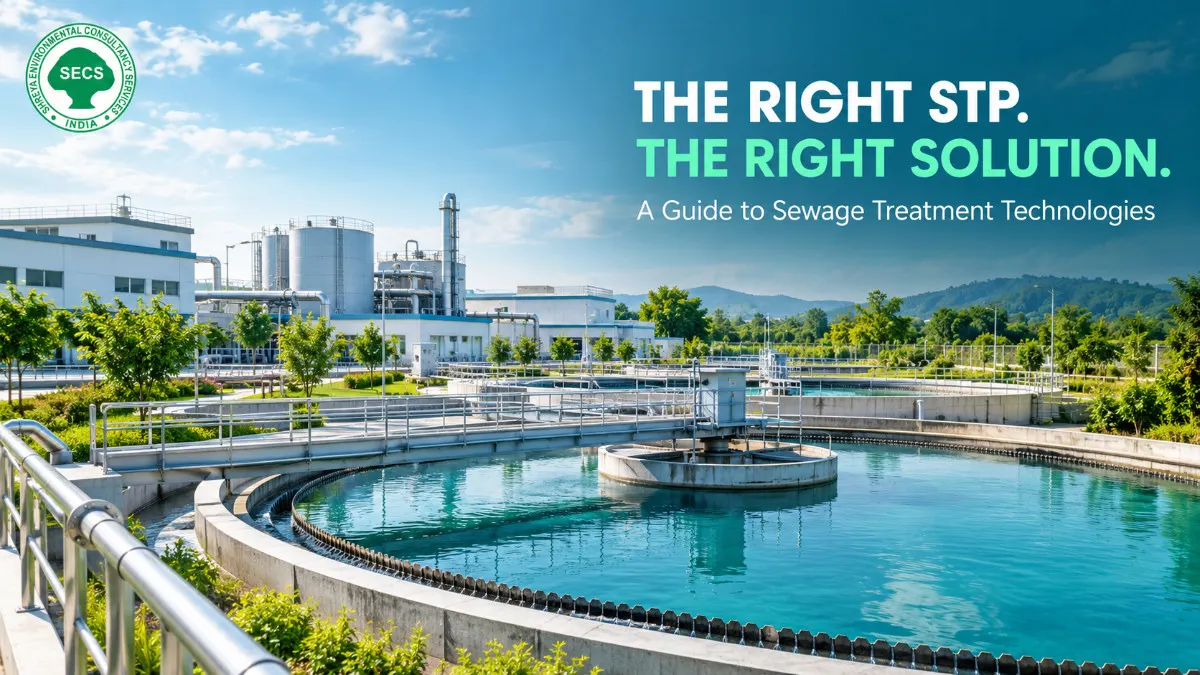
Choosing the right sewage treatment technology is an important decision for residential societies, hotels, hospitals, educational institutions, commercial buildings and industrial facilities. Although these establishments all generate sewage, their wastewater quantities, treatment requirements, available space and water reuse objectives can differ significantly. A treatment system that works well for one facility may not be the most practical choice for another.
For organisations looking for an STP in Baddi, understanding the different sewage treatment technologies can help make plant selection more informed. The right approach depends on factors such as daily sewage flow, wastewater characteristics, land availability, electricity consumption, maintenance requirements and the quality of treated water needed for reuse. These considerations are equally important for projects in other parts of India.
A modern sewage treatment plant may use biological treatment, settling, filtration, membrane separation or a combination of these processes. Technologies such as the Activated Sludge Process (ASP), Moving Bed Biofilm Reactor (MBBR), Sequential Batch Reactor (SBR) and Membrane Bioreactor (MBR) are commonly considered for different applications. Each technology has its own operating principles, advantages and limitations.
This guide explains the major types of STP plants, how their treatment technologies work, where they are commonly used and what should be evaluated before choosing a system. The objective is to help facility owners, project managers and consultants understand the available options before planning a new sewage treatment plant or upgrading an existing installation.
What Determines the Choice of an STP Technology?
Selecting a sewage treatment technology involves more than comparing equipment costs. The plant must be suitable for the wastewater it receives, operate reliably under expected conditions and produce treated water that meets the intended discharge or reuse requirements. The following factors should be evaluated before finalising the treatment process.
1. Daily Sewage Flow and Variation
The quantity of sewage generated each day is one of the first factors considered during STP planning. A residential complex may produce wastewater according to the number of occupied flats, while a hotel, school or office building may experience significant changes in flow throughout the day or week.
Engineers need to assess average flow, peak flow and expected variations rather than sizing the plant using a single estimated figure. Equalisation and suitable process design can help manage fluctuations where required. The selected technology must accommodate the facility's actual operating pattern without compromising treatment performance.
2. Wastewater Characteristics and Treatment Requirements
Sewage composition affects the biological and physical processes required for effective treatment. Important parameters may include biochemical oxygen demand (BOD), chemical oxygen demand (COD), total suspended solids (TSS), nutrients and other relevant characteristics. The exact parameters requiring control depend on the wastewater source and the applicable discharge or reuse requirements.
Domestic sewage is different from wastewater that contains significant industrial contributions. Where industrial wastewater enters the same treatment system, its composition and potential effects on biological treatment must be assessed carefully. In such cases, a facility may need appropriate preliminary treatment or a separate wastewater treatment arrangement before the sewage treatment process.
3. Available Land and Plant Layout
Land availability can influence the choice of STP technology, particularly in densely developed residential and commercial areas. Some treatment arrangements require larger tanks or additional space for settling and sludge handling, while more compact systems may be suitable where the installation area is restricted.
However, selecting the smallest possible footprint is not always the best decision. Equipment access, ventilation, sludge storage, maintenance clearances, future expansion and safe movement around the plant must also be considered during layout planning.
4. Treated Water Reuse Objectives
The intended use of treated water can significantly influence the treatment stages required. Water intended for gardening, toilet flushing, landscaping or certain industrial applications may require additional treatment and disinfection depending on the applicable quality requirements. Filtration or membrane-based treatment may also be considered when the reuse objective calls for improved water quality.
Reuse planning should begin during the initial design stage rather than after the plant has been installed. Understanding the expected demand for treated water helps determine the appropriate treatment configuration and supporting equipment.
5. Operating Costs, Electricity and Maintenance
The total cost of an STP includes more than the initial installation. Electricity consumption, pumps, blowers, chemical requirements, sludge handling, replacement parts, skilled operators and preventive maintenance all contribute to long-term operating expenses.
Highly automated or compact technologies may offer operational advantages in certain applications, but they can also introduce specific requirements for instrumentation, membrane cleaning or equipment maintenance. A practical selection should consider the availability of trained operators and the facility's ability to maintain the system consistently.
6. Regulatory and Site-Specific Requirements
The treatment process must be designed around the applicable environmental requirements, consent conditions and intended discharge or reuse arrangements. Requirements can vary according to the facility, location and receiving environment, so the necessary treatment performance should be established before selecting the technology.
For projects involving an STP plant in Baddi, site conditions, local compliance requirements, sewage characteristics and the facility's operating needs should be assessed together. The same engineering approach applies to projects elsewhere in India: technology selection should follow the project requirements rather than a one-size-fits-all recommendation.
Main Categories of Sewage Treatment Technologies
Sewage treatment plants generally combine several treatment stages to remove solids, reduce organic pollution and produce water suitable for the intended discharge or reuse. The precise arrangement depends on the incoming wastewater, design capacity and required treated-water quality.
Physical Treatment
Physical treatment removes materials such as plastics, rags, grit and suspended solids through processes including screening, grit removal and settling. These stages protect downstream equipment and help prepare sewage for further treatment. They are important supporting processes, although physical treatment alone generally cannot provide the level of treatment required for most sewage discharge or reuse applications.
Biological Treatment
Biological treatment uses microorganisms to break down biodegradable organic matter in sewage. Different systems support these microorganisms in different ways. In suspended-growth processes, microorganisms remain mixed within the wastewater; in attached-growth processes, they develop on suitable media. Some technologies combine both approaches.
ASP, MBBR, SBR and MBR are important examples of biological sewage treatment systems. Their differences relate to how microorganisms are maintained, how treatment and settling are organised, the equipment required and the quality of treated water that can be achieved under suitable operating conditions. We will examine each technology in detail in the next part.
Filtration, Disinfection and Advanced Treatment
After biological treatment, additional processes may be needed to reduce remaining suspended solids, improve water clarity or control microorganisms. Depending on the required outcome, these may include tertiary filtration, disinfection or membrane-based separation. Not every plant needs the same combination of stages; the final arrangement should be based on the applicable standards and intended water use.
Understanding these treatment categories provides the foundation for comparing individual sewage treatment plant technologies. In Part 2, we will explore how ASP, MBBR, SBR, MBR and other treatment approaches operate, along with their main advantages, limitations and suitable applications.
Major Types of STP Plants and Sewage Treatment Technologies
Different types of sewage treatment plants use different biological processes to reduce organic pollution and produce treated water. The most suitable option depends on the sewage characteristics, treatment capacity, available space, operating conditions and final water quality requirements. Understanding the main technologies helps project owners compare systems on practical grounds rather than choosing solely by name or initial cost.
1. Activated Sludge Process (ASP)
The Activated Sludge Process is a conventional biological treatment method used in many sewage treatment plants. It relies on microorganisms suspended in wastewater to break down biodegradable organic matter under controlled aeration conditions.
In a typical ASP system, sewage first passes through preliminary treatment to remove larger solids and other unwanted materials. It then enters an aeration tank, where air is supplied to support microbial activity. The wastewater and biological solids form a mixed liquor that moves to a secondary clarifier. Settled biological sludge is partly returned to the aeration tank to maintain the required microbial population, while excess sludge is removed for further handling.
Advantages of ASP:
- Well-established technology with widely understood operating principles.
- Can provide effective removal of biodegradable organic matter when properly designed and operated.
- Suitable for a range of sewage treatment capacities.
- Can be adapted to include additional treatment stages when required.
Limitations of ASP:
- Requires appropriate aeration equipment and a reliable electricity supply.
- Needs effective control of sludge concentration, settling performance and biological conditions.
- May require more space than some compact treatment configurations.
- Performance can be affected by hydraulic or organic loading variations and poor operational control.
ASP may be suitable for facilities that have sufficient installation space and access to trained operators. Its performance depends on correct process design, adequate aeration, sludge management and routine monitoring.
2. Moving Bed Biofilm Reactor (MBBR)
The Moving Bed Biofilm Reactor is a biological treatment technology in which microorganisms grow on specially designed plastic carrier media that move within the treatment tank. These carriers provide surfaces for biofilm development, allowing a population of microorganisms to remain within the system while sewage flows through the reactor.
Air or mixing equipment keeps the carriers moving, depending on the reactor configuration and treatment stage. In an aerobic MBBR tank, aeration supports biological activity and movement of the media. A screen or retaining arrangement prevents the carriers from leaving the reactor with the treated water. Downstream clarification or other separation processes are generally required to remove suspended solids.
Advantages of MBBR:
- Carrier media provides additional surface area for biofilm growth within the reactor.
- Can be useful where treatment capacity needs to be increased within an existing tank arrangement, subject to design limitations.
- Does not normally require the same routine return activated sludge arrangement used in conventional ASP.
- Can offer operational flexibility when sewage flow or loading changes within the system's design limits.
Limitations of MBBR:
- Requires suitable carrier media retention screens and appropriate mixing or aeration.
- Biological performance depends on correct media selection, filling ratio, oxygen transfer and wastewater characteristics.
- Downstream solids separation and sludge handling remain important.
- It does not automatically guarantee superior treated-water quality without suitable process design and additional treatment where necessary.
MBBR is often considered for residential, institutional and commercial applications where a biofilm-based process is appropriate. It can also be evaluated for upgrades to existing plants, but tank dimensions, existing equipment and discharge requirements must be checked before implementation.
3. Sequential Batch Reactor (SBR)
A Sequential Batch Reactor treats sewage in a controlled sequence of operating stages within a reactor tank. Rather than continuously moving wastewater through separate aeration and secondary settling tanks, an SBR typically carries out several treatment steps in the same tank at different times.
A typical operating cycle includes filling the reactor, biological treatment, settling, removal of treated water and, where required, an idle or preparation period. During the treatment phase, aeration and mixing conditions are controlled according to the process design. During settling, the biological solids separate from the treated water before the clarified water is decanted.
Advantages of SBR:
- Combines biological treatment and settling within the reactor cycle.
- Can reduce the need for separate secondary clarifiers in a properly designed configuration.
- Allows treatment cycles to be adjusted to suit defined flow and loading patterns.
- Can support nutrient removal when designed with suitable operating phases and process controls.
Limitations of SBR:
- Depends on reliable automation, level controls, valves and decanting equipment.
- Operating cycles must be coordinated with sewage inflow and the required treatment capacity.
- Equipment failure or poorly managed cycle timing can disrupt plant performance.
- Operators need to understand the sequence and monitor the process appropriately.
SBR may be appropriate for facilities that can support automated operation and where batch-based treatment fits the expected sewage flow. The number of reactors and cycle arrangement must be planned carefully to accommodate incoming flow while maintaining the required treatment performance.
4. Membrane Bioreactor (MBR)
A Membrane Bioreactor combines biological treatment with membrane-based separation of treated water from suspended biological solids. Instead of relying only on conventional secondary clarification, the system uses membranes to retain suspended solids and microorganisms while allowing treated water to pass through under the specified operating conditions.
MBR systems are available in different configurations, including submerged membranes installed within a treatment tank and arrangements where membranes are housed separately. Biological treatment reduces biodegradable organic matter, while the membrane separation stage produces a low-suspended-solids effluent. Further treatment or disinfection may still be necessary depending on the final water quality objective.
Advantages of MBR:
- Can provide high-quality effluent with low suspended solids when properly designed and maintained.
- May reduce the space required compared with some conventional treatment arrangements.
- Can be considered where treated-water reuse is an important project objective.
- Combines biological treatment and solids separation in an integrated process.
Limitations of MBR:
- Membranes require appropriate cleaning, monitoring and eventual replacement.
- Energy consumption can be significant, particularly for aeration and membrane operation.
- Membrane fouling must be managed through suitable operating practices.
- Initial and ongoing costs may be higher than those of simpler treatment systems, depending on capacity and configuration.
MBR can be considered for sites with limited space or demanding treated-water quality objectives. However, it is not automatically the best option for every facility. Its benefits should be weighed against energy use, membrane maintenance, operator capability and the value of the intended water reuse.
5. Extended Aeration Process
Extended aeration is a variation of the activated sludge process in which wastewater is maintained under aerated biological treatment for a relatively long period. It is commonly associated with lower organic loading and longer sludge age than some conventional activated sludge arrangements. The exact design depends on sewage characteristics and the required treatment performance.
Potential advantages:
- Can provide stable biological treatment when properly designed and operated.
- May simplify certain aspects of sludge management compared with some other process configurations.
- Can be suitable for small and medium-sized domestic sewage applications, depending on the design.
Considerations:
- Longer aeration periods can increase energy requirements.
- Suitable tank volume and aeration capacity must be provided.
- Sludge production, settling and final solids separation still need to be managed.
Extended aeration may be considered for residential communities, institutions and other facilities with relatively predictable sewage generation. Its suitability depends on the required capacity, available space, energy costs and the ability to operate the plant consistently.
6. Integrated Fixed-Film Activated Sludge (IFAS)
Integrated Fixed-Film Activated Sludge, or IFAS, combines suspended-growth biological treatment with attached-growth biofilm media in the same treatment system. Unlike a typical MBBR arrangement that relies primarily on moving carrier media for biofilm growth, IFAS retains an activated sludge component while adding media to support attached microorganisms.
This combination can help increase the biological treatment capacity of an existing system or support specific treatment objectives, provided the tank configuration, aeration and solids separation are designed appropriately.
Potential benefits:
- Can increase the amount of biological activity supported within an existing reactor volume.
- May be useful when upgrading certain existing activated sludge plants.
- Combines the characteristics of suspended-growth and attached-growth treatment.
Considerations:
- Requires compatible media retention, mixing and aeration arrangements.
- Existing plant hydraulics and downstream clarification capacity must be evaluated.
- It may involve more process complexity than a simpler treatment configuration.
7. Upflow Anaerobic Sludge Blanket (UASB)
The Upflow Anaerobic Sludge Blanket process treats suitable wastewater by passing it upward through a blanket of anaerobic microorganisms. These microorganisms break down biodegradable organic matter without requiring oxygen for the main treatment reaction, and biogas can be produced as a by-product.
UASB is more commonly associated with suitable high-strength wastewater and certain municipal wastewater applications under appropriate climatic and operating conditions. Its suitability for a sewage treatment project depends on wastewater strength, temperature, flow characteristics and the required effluent quality.
Potential benefits:
- Does not require aeration for the main anaerobic treatment process.
- Can reduce the organic load of suitable wastewater.
- May produce biogas that can be collected and managed where the design supports it.
Limitations:
- Performance can be sensitive to temperature, wastewater characteristics and operating conditions.
- Start-up and biological process management require appropriate planning.
- Additional aerobic or other polishing stages are often needed to achieve the final discharge or reuse requirements.
UASB should therefore be selected only after assessing the wastewater and the full treatment train, rather than assuming that anaerobic treatment alone will meet every sewage quality requirement.
8. Constructed Wetlands
Constructed wetlands are engineered treatment systems that use a combination of physical filtration, microbial activity and plant-associated processes to treat wastewater. They may use gravel or other media beds with controlled water flow, and can be designed as subsurface-flow or surface-flow systems depending on the application.
Potential advantages:
- Can operate with relatively low mechanical energy demand in suitable configurations.
- May be useful for selected decentralised or site-specific wastewater applications.
- Can complement other treatment stages when designed for the required treatment objectives.
Limitations:
- Often require more land than compact mechanical treatment systems.
- Performance depends on design, climate, hydraulic loading, media condition and maintenance.
- They may not be suitable where land is limited or strict effluent requirements call for more intensive treatment.
Constructed wetlands can be worth evaluating where site conditions permit and the required treatment level can be achieved reliably. They are not a universal replacement for conventional mechanical STPs, particularly on space-constrained sites.
Each of these technologies serves a different purpose. The next part will compare ASP, MBBR, SBR and MBR more directly and explain how facility type, available space, operating capability and treated-water reuse objectives influence the selection of an STP technology.
MBBR vs SBR vs MBR vs ASP: Which STP Technology Is Better?
When comparing sewage treatment plant technologies, there is no single option that is best for every project. ASP, MBBR, SBR and MBR can all provide effective biological treatment when correctly designed and operated, but they differ in process arrangement, equipment requirements, space considerations and maintenance needs. The right choice depends on the facility's operating conditions and the quality of treated water required.
ASP vs MBBR
ASP uses microorganisms suspended in wastewater, with biological solids typically returned from the secondary clarifier to maintain the treatment process. MBBR uses carrier media that supports biofilm growth within the reactor. A conventional ASP arrangement may be appropriate where sufficient space and effective sludge management are available, while MBBR can be useful where additional biofilm capacity or greater flexibility in biological treatment is required.
- Consider ASP when: the project can accommodate the required tanks and clarifier, and the operator can manage aeration and activated sludge.
- Consider MBBR when: a biofilm-based process fits the design requirements or an existing treatment system needs a carefully assessed capacity upgrade.
- Check before deciding: both systems require appropriate solids separation, sludge handling and control of operating conditions.
MBBR vs SBR
MBBR uses moving carrier media to support biological growth, whereas SBR treats sewage through a sequence of controlled stages, typically including filling, aeration or reaction, settling and decanting. MBBR may suit applications where a continuous-flow arrangement is preferred. SBR can suit projects where automated batch cycles align with the expected flow and the site can support reliable controls.
- Consider MBBR when: the process needs a moving-media biological stage and a suitable continuous-flow layout.
- Consider SBR when: cycle-based treatment and integrated settling within the reactor can meet the flow requirements.
- Check before deciding: SBR needs dependable sequencing and decanting, while MBBR needs suitable media retention and downstream solids separation.
SBR vs MBR
SBR separates treated water and biological solids through settling during its operating cycle. MBR uses membranes to separate suspended solids from treated water. MBR may be preferable when a compact plant and low suspended solids in the effluent are important priorities. SBR may be suitable where batch operation is practical and the required treated-water quality can be achieved without membrane separation.
- Consider SBR when: the plant can accommodate batch cycles and the operating team can maintain automation and process controls.
- Consider MBR when: land is restricted or the intended reuse application calls for membrane-based solids separation.
- Check before deciding: MBR requires membrane cleaning, fouling management and replacement planning, while SBR requires reliable cycle operation.
How Should Cost, Space and Maintenance Be Compared?
Initial equipment price alone is not enough to determine the most economical sewage treatment plant. A fair comparison should consider the full lifecycle cost, including civil construction, mechanical equipment, electricity, consumables, operator requirements, sludge handling, maintenance and future replacement of components.
- Space: assess the complete plant layout, including tanks, access routes, sludge handling and additional treatment stages.
- Energy: compare aeration, pumping, mixing, membrane operation and other equipment loads under realistic operating conditions.
- Maintenance: evaluate the availability of spare parts, trained technicians, routine cleaning and equipment servicing.
- Water reuse: identify whether filtration, disinfection or advanced treatment is required after the biological stage.
- Operational reliability: consider how the plant will perform during flow variations, temporary shutdowns and periods of reduced occupancy.
A detailed assessment of ETP and STP treatment technologies can help establish which process options are appropriate for the site and what supporting treatment stages may be needed.
Which STP Technology Is Suitable for Different Facilities?
The type of facility generating sewage is an important starting point for selecting a treatment process. However, buildings within the same category can have different requirements, so the final selection should always be based on flow estimates, wastewater characteristics, site conditions and treated-water objectives.
Residential Societies and Housing Complexes
Residential complexes generally generate domestic sewage from kitchens, bathrooms, toilets and washing activities. Their flow patterns may change during mornings, evenings, weekends and holiday periods. ASP, MBBR, SBR and other suitable biological configurations can be evaluated according to the number of residents, available land, expected occupancy and the level of automation required.
Where treated water is intended for gardening or toilet flushing, the design should account for the necessary filtration, disinfection and applicable quality requirements. The plant should also include a practical plan for sludge removal and routine maintenance.
Hotels, Hospitals and Commercial Buildings
Hotels may experience variations in sewage generation according to occupancy, laundry operations and kitchen activity. Hospitals can have wastewater characteristics and hygiene considerations that require specific assessment, including appropriate handling of any specialised wastewater streams. Offices, shopping facilities and other commercial buildings may have pronounced variations between working days and non-working periods.
Technology selection should therefore reflect how the building operates, not just its total floor area. Reliable operation, access for maintenance and the ability to handle changes in flow can be as important as the treatment process itself.
Schools, Colleges and Educational Campuses
Educational institutions may generate most of their sewage during teaching hours and term time, with reduced flows during holidays. The selected STP should be assessed for these variations so that biological treatment can be maintained appropriately when occupancy falls.
Depending on campus size and layout, a conventional activated sludge system, MBBR, SBR or another suitable configuration may be considered. Adequate planning for periods of low inflow, safe access and operator responsibilities helps support dependable performance.
Industrial Campuses and Facilities with Mixed Wastewater
Industrial sites may generate domestic sewage alongside process wastewater. These streams should not automatically be treated as equivalent. Process wastewater can contain chemicals, elevated organic loads or other substances that affect biological treatment. Its suitability for combined treatment must be established through wastewater characterisation and engineering assessment.
Where separate industrial wastewater treatment is needed, an effluent treatment plant (ETP) may be required alongside the STP. The two systems can serve different purposes, and their design should reflect the composition and management of each wastewater stream.
Facilities Planning for High-Quality Water Reuse
Facilities seeking to reuse treated sewage should define the intended application before choosing the technology. Landscaping, toilet flushing, cooling-related applications and other uses can have different water quality requirements. A biological treatment system may need to be followed by filtration, disinfection or additional treatment to meet the relevant specifications.
Membrane-based processes such as MBR may be worth evaluating when compact installation and low suspended solids are important. However, membrane treatment does not remove the need to assess the full reuse requirements, and it does not automatically make treated water suitable for every application.
STP Technology Selection for Baddi and Other Indian Locations
When planning an STP in Baddi, the selection process should begin with a site-specific assessment. Local climate, incoming sewage characteristics, available installation space, electricity reliability, operator availability and applicable environmental requirements all influence the practical choice of treatment technology. These factors should be reviewed during the planning stage rather than after equipment has been selected.
For industrial and institutional areas, it is also important to establish whether the wastewater stream is purely domestic or contains contributions from industrial activities. Where wastewater sources differ, sampling and analysis can help identify the treatment requirements and whether separate systems are appropriate.
Projects elsewhere in India require the same careful approach. A technology that works well at one location may need changes in tank sizing, aeration capacity, process control or supporting treatment stages at another. Seasonal changes, occupancy patterns and variations in daily sewage flow should also be considered where relevant.
Planning should include more than the biological treatment unit. The complete system may require preliminary screening, equalisation, biological treatment, solids separation, disinfection, sludge handling and treated-water storage, depending on the project. Facilities evaluating advanced reuse can also review integrated water and wastewater treatment solutions where multiple treatment stages need to work together.
Before finalising the technology, project owners should establish the expected sewage flow, required effluent quality, available land, capital budget and anticipated operating expenses. This information provides a sound basis for comparing alternatives and selecting an STP configuration that meets the facility's actual needs.
In Part 4, we will explain how Shreya Environmental can support STP technology selection, project implementation and ongoing operation, followed by relevant FAQs and the article conclusion.
How Shreya Environmental Can Help You Select and Implement the Right STP Plant
Selecting a sewage treatment technology requires an understanding of wastewater characteristics, site conditions, treatment objectives and long-term operating requirements. Shreya Environmental Consultancy Services supports organisations in evaluating water and wastewater treatment requirements and planning solutions suited to their projects.
Whether a facility needs a new sewage treatment plant, an upgrade to an existing installation or a treatment system designed around water reuse objectives, the selection process should begin with a clear understanding of the site's needs. ASP, MBBR, SBR, MBR and other technologies should be evaluated according to their suitability for the project rather than treated as interchangeable options.
STP Technology Evaluation and Treatment Planning
The first step is to understand the quantity and characteristics of sewage generated by the facility, the available installation area and the intended use or disposal route for treated water. These details help establish the treatment requirements and identify which technologies warrant further evaluation.
Shreya Environmental's environmental consultancy services can be explored for guidance on environmental and wastewater-related project requirements. Appropriate planning also considers applicable regulatory conditions, site constraints and the practical needs of future operation and maintenance.
STP Installation and Project Execution
Once a suitable treatment approach has been identified, the project must be translated into a workable plant layout and implementation plan. Civil structures, process tanks, pumps, blowers, piping, electrical systems, instruments and supporting treatment units need to be coordinated according to the approved design.
For projects requiring coordinated implementation, Shreya Environmental offers turnkey project execution services. The appropriate scope depends on the project requirements and should be established clearly before work begins.
Operation, Maintenance and Long-Term Performance
Even a well-designed STP requires regular monitoring and maintenance. Biological processes must be operated under suitable conditions, mechanical equipment needs preventive servicing, and sludge must be handled appropriately. Systems with automation or membrane equipment may also require additional checks, calibration, cleaning and specialised maintenance.
Effective STP operation and maintenance support can help facilities plan routine inspections, monitor treatment performance and address operational issues. The exact maintenance schedule should reflect the technology installed, equipment manufacturer's recommendations and the plant's operating conditions.
Learn More About Shreya Environmental
Shreya Environmental Consultancy Services works in the environmental and water treatment sector, supporting projects that require practical wastewater management solutions. You can learn more about the organisation, its background and approach on the About Shreya Environmental page.
To understand its project experience, visit the projects portfolio. Reviewing relevant project information can help prospective customers understand the types of work undertaken, while specific suitability should always be discussed in relation to their own site and requirements.
If you are planning an STP in Baddi or elsewhere in India, you can contact the team through the Shreya Environmental contact page to discuss your sewage treatment requirements and determine the appropriate next steps.
Frequently Asked Questions About STP Plants and Technologies
1. Which STP technology is best for a residential society?
There is no single best technology for every residential society. ASP, MBBR, SBR and other suitable systems can be considered based on sewage flow, available land, operating budget, maintenance capability and treated-water requirements. A site-specific assessment is needed before selecting the final configuration.
2. What is the main difference between ASP and MBBR?
ASP relies on microorganisms suspended in wastewater, with biological sludge generally returned from the clarifier to the aeration tank. MBBR supports microbial growth on carrier media moving within the reactor. Both can provide effective biological treatment when properly designed and operated, but their equipment and operating arrangements differ.
3. Is MBBR better than SBR for an STP plant?
Not in every situation. MBBR uses biofilm carrier media and commonly operates as part of a continuous-flow arrangement, while SBR treats sewage through controlled operating cycles. The choice depends on flow patterns, automation requirements, available space, operating capability and treatment objectives.
4. When should an MBR sewage treatment plant be considered?
MBR may be suitable when installation space is limited or the project requires membrane-based separation to achieve low suspended solids in the treated effluent. Membrane cleaning, energy consumption, fouling control and replacement costs should be assessed before choosing this technology.
5. Can an existing STP be upgraded from ASP to MBBR?
In some cases, an existing activated sludge plant can be upgraded using MBBR media, but the feasibility depends on tank dimensions, hydraulic capacity, aeration, media retention, downstream solids separation and the required treatment performance. An engineering assessment is necessary before making changes.
6. Does every STP require tertiary treatment?
No. The need for tertiary treatment depends on the required effluent quality, applicable discharge or reuse requirements and the performance of the preceding treatment stages. Filtration, disinfection or other polishing processes may be necessary for particular applications.
7. How do I choose an STP in Baddi for my facility?
Start by estimating the daily and peak sewage flow, understanding wastewater characteristics, identifying available space and defining the intended use of treated water. Then compare suitable technologies based on treatment performance, lifecycle cost, electricity requirements, maintenance and applicable environmental conditions.
8. What should be considered when comparing STP plant costs?
Compare the complete project cost rather than only the initial equipment price. Civil construction, process equipment, electrical systems, automation, energy consumption, sludge handling, maintenance, consumables and replacement components can all affect the total cost over the plant's operating life.
Conclusion
Understanding the different types of STP plants and sewage treatment technologies makes it easier to identify a system that matches a facility's wastewater characteristics, site conditions and treatment objectives. ASP, MBBR, SBR, MBR, extended aeration, IFAS, UASB and constructed wetlands each have specific applications and limitations. The right choice depends on how well the technology meets the project's requirements and how reliably the system can be operated over time.
For anyone planning an STP in Baddi, the priority should be a properly assessed treatment design that considers sewage flow, biological treatment needs, available space, treated-water quality and long-term operating costs. The same principles apply to sewage treatment projects across India. With appropriate technology selection, sound engineering and consistent maintenance, an STP can support responsible wastewater management and the effective reuse of treated water where permitted.
Contact Shreya Environmental Consultancy Services to discuss your project requirements and explore suitable sewage treatment options for your facility.